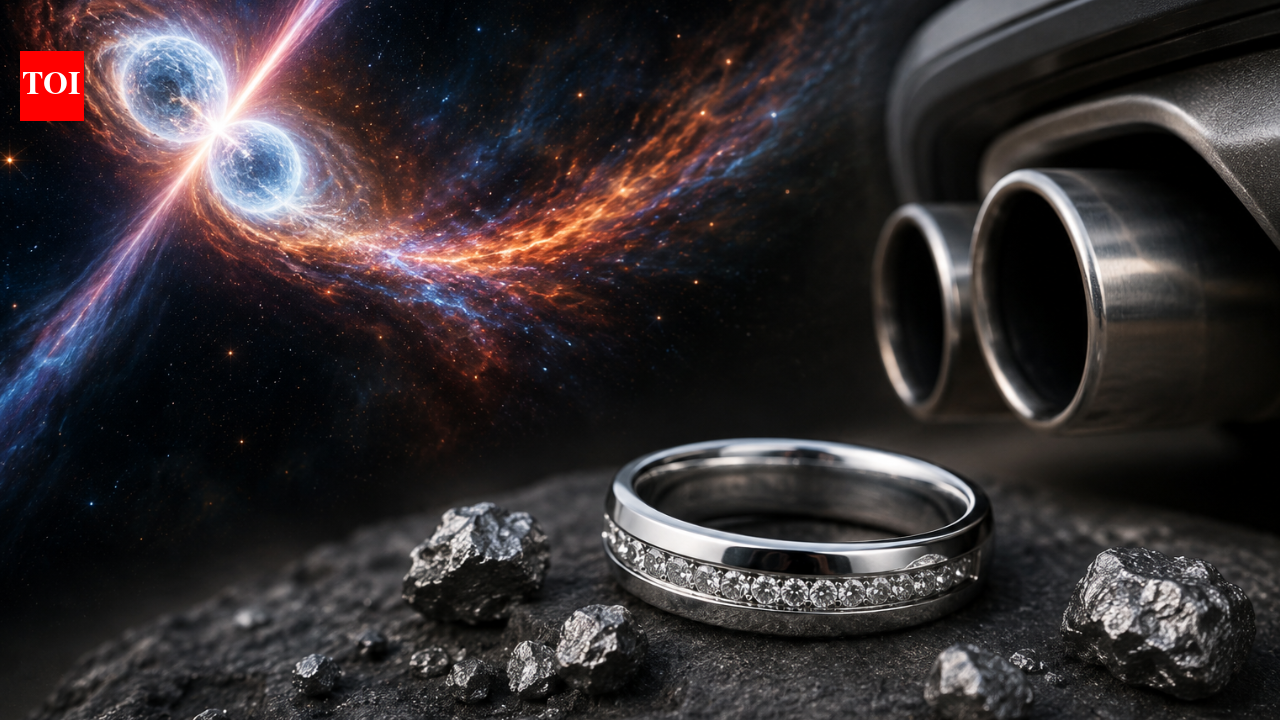
Platinum ring and car exhaust linked to an ancient cosmic origin.
According to NASA's official mission update , the Laser Interferometer Gravitational-Wave Observatory, also called LIGO, detected gravitational waves from two neutron stars that were orbiting each other before colliding.
The event also produced a burst of light that showed signs of newly formed heavy metals.
When two neutron stars collide, the force sends matter flying outward at extremely high speeds, a significant fraction of the speed of light.
So the next time you look at a platinum ring or the metal parts of your car, remember what it is.
Platinum ring and car exhaust linked to an ancient cosmic origin. (Representative image) Image Credit: ChatGPT
Why ordinary stars cannot make platinum
The neutron-star collision that changed the picture
On August 17, 2017, LIGO detected gravitational waves from two merging neutron stars in the galaxy NGC 4993, followed by a bright kilonova. Image Credit: NASA and ESA
A Nature study confirms real-time formation
MIT finds neutron star mergers are richer
From dead star to your finger
Platinum rings are made from metals forged before Earth formed. Image Credit: Pexels
Why the discovery matters for astronomy
The platinum in your ring is extremely old. It is even older than the Earth. This is about the metal inside the ring, not the ring itself. According to MIT News , the platinum in your ring and car likely came from ancient stars that collided before our sun and planet formed an extraordinary explanation on which scientists broadly agree. That platinum is found in your ring and in your car's catalytic converter.A follow-up analysis of the same 2017 merger found it was the first event to give astronomers direct access to freshly forged r-process material, with the optical-infrared glow showing two distinct ejecta components: a fast, blue one and a slower, red one. Researchers estimated roughly 0.025 solar masses of light r-process ejecta and 0.04 solar masses of heavy ejecta, enough to support the idea that mergers like this one can account for much of the universe's gold and platinum.Ask an astrophysicist how gold or platinum came to exist, and you will get a surprisingly specific answer. Stars are efficient at creating elements. Inside a star’s core, nuclear fusion combines protons to form elements such as carbon, oxygen, and eventually iron over millions of years. That works because fusion up to iron actually releases energy. Beyond that point, the physics reverses: building something heavier, like platinum or gold, consumes more energy than it releases, so ordinary stellar fusion cannot produce it.That left scientists with an important gap in their understanding. For years, supernovae were proposed as a possible source, since their extreme conditions can briefly supply the energy fusion alone cannot. But supernova models never fully accounted for the quantities of heavy metals observed, leaving the puzzle unsolved.In August 2017, astronomers made a major discovery. They detected a signal unlike any they had seen before. According to NASA's official mission update , the Laser Interferometer Gravitational-Wave Observatory, also called LIGO, detected gravitational waves from two neutron stars that were orbiting each other before colliding. The event is known as GW170817.Neutron stars are the collapsed remnants of massive stars. LIGO is the observatory that detected these ripples in space from the neutron-star crash. The event also produced a burst of light that showed signs of newly formed heavy metals. NASA tracked the event's aftermath for nine days. The gravitational-wave signal itself passed in seconds, but the kilonova the glowing debris cloud left behind remained visible and was tracked over the following days.When the light was captured, researchers analyzed its contents. According to a study published by the National Science Foundation's public access repository, researchers examined what happened after GW170817. The study showed that heavy elements were formed there in real time, confirming the collision itself as the source.Researchers estimate the collision produced as much gold and platinum as several Earths combined, all within just a few seconds.Knowing that neutron star collisions could produce metals raised a key question: are they the main source or just one of many? A group at MIT examined two types of collisions: one between two neutron stars and one between a neutron star and a black hole.According toMIT News, the research was led by astrophysicist Hsin-Yu Chen, Salvatore Vitale, and Francois Foucart; collisions between two neutron stars produce somewhere between two and 100 times more metal than collisions involving a black hole. Vitale, a professor of physics at MIT, explained that making anything heavier than iron requires a different environment, and that neutron-star collisions provide it.This is where a cosmic event becomes something that directly affects people. When two neutron stars collide, the force sends matter flying outward at extremely high speeds, a significant fraction of the speed of light. In this debris, atoms rapidly absorb neutrons, creating heavier elements in seconds. Scientists call this process neutron capture. The material eventually cools, spreads through the galaxy, and joins the clouds of gas and dust that later form stars and planets.Our solar system came from one of those clouds. Earth already contained some of these metals, which is why gold, platinum, and similar metals are found underground today. The metal in a wedding ring or a car part did not start its journey in a store. It started in a crash between two stars long before the sun was even born.Scientists do not just study where heavy metals come from because they want to. They are conducting this research to help other scientists determine how old distant galaxies are. They do this by examining the heavy-metal content of those galaxies, using it as a rough clock for how much time has passed since major stellar collisions occurred nearby. Scientists are still working to improve these estimates.As scientists gather more observations of neutron-star and black-hole collisions, they'll further refine these age-estimation techniques. The MIT-led findings already give researchers a working baseline: neutron-star mergers as the richer of the two known sources of heavy metal production.For now, the evidence points in one direction. When neutron stars crash into each other, they make a lot of metal. This is one way scientists know heavy metals are made in the universe. So the next time you look at a platinum ring or the metal parts of your car, remember what it is. It is a cosmic element formed when two stars collided long before Earth existed.