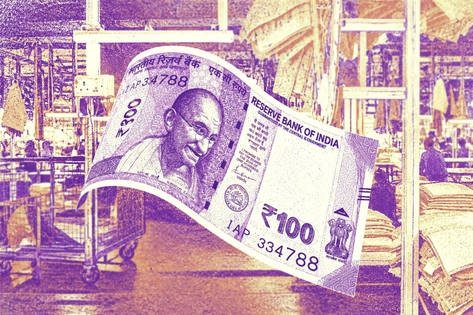
India's own Economic Survey acknowledges that "currency depreciation will remain the primary adjustment mechanism unless export capabilities are developed rapidly."
Through the 1990s and 2000s, with the rupee weak and weakening further, India's services sector found its global moment.
The wage arbitrage that powers nearly $400 billion in services exports today existed only because the rupee was, and stayed, competitive.
The upper-income import basket, with its foreign cars, foreign holidays, and foreign electronics, does not need the same protection.
The path to economic power runs through a weaker currency.
On a Sunday morning in September 1985, Japan's finance minister played nine holes of golf in Tokyo, drove to the airport, and boarded a PanAm flight to New York. The golf was cover. Noboru Takeshita did not want the press or the markets to know he was leaving the country.
Japan had spent the previous decade keeping the yen deliberately weak, building record trade surpluses against the United States, and resisting American demands to let the currency rise. The summons to the Plaza Hotel that weekend was the moment that resistance ended.
By that evening, Takeshita was in a suite at the Plaza with the finance ministers of America, West Germany, France, and Britain, called there by Treasury Secretary James Baker. The meeting itself was secret. Detroit had been losing year after year to Toyota and Honda, shedding jobs to imports it could not match on price. Baker had decided the currency, not the industry, had to give.
By the time the meeting broke up, the United States had asked its closest allies to help weaken its own dollar, and Japan had agreed to let the yen rise. The dollar fell from 240 yen to 150 within two years, and below 130 soon after. Detroit got the breathing room it could not have earned on its own.
Japan got an asset bubble, then a banking crisis, then decades of slow growth it has yet to fully shake. Plaza was an act of strategic clarity for the country that called the meeting. For the country that arrived in secret, it was the cost of being a creditor in an American century.
China watched what Japan had agreed to, and chose differently. Through WTO complaints, Treasury reports formally branding it a manipulator, and pressure from three American administrations, Beijing held the renminbi down.
The instinct was identical to Washington's in 1985; the direction was opposite. Beijing understood that letting the exchange rate rise faster than its industrial strategy required would price Chinese manufacturing out of global markets before it had reached scale. So the renminbi stayed cheap, and Chinese exports compounded.
These were not weak countries with weak currencies. They were serious countries that understood what the growth phase demands.
The logic is simple. A developing economy does not become rich by consuming the world’s output at a prestigious exchange rate. It becomes rich by selling more of its own output to the world. A competitive currency lowers the foreign-currency price of exports, raises the domestic return to export production, pulls investment into tradable sectors, and forces scarce foreign exchange away from luxury consumption and toward productive capacity. If industry is ready, depreciation does not just change a number on a screen. It shifts the structure of growth.
India’s Base Is Ready
India has done the opposite of both. From 2022 through 2024, the Reserve Bank of India delivered the lowest rupee volatility in two decades, holding the currency steady against the dollar while every other emerging market adjusted. The rupee was being defended as an honour instead of being deployed as an instrument.
This was the precise window when production-linked incentive schemes were building real capacity. Mobile phone imports collapsed by 77% from FY21. India became the world's second-largest smartphone manufacturer, with $30 billion in mobile exports projected for FY26 and ₹8.3 lakh crore in cumulative PLI exports across fourteen sectors. Factories that did not exist five years ago in Sriperumbudur and Noida are shipping today.
This is capacity sitting at the exact point in the export chain where the exchange rate decides whether it captures global market share or yields it back to Vietnam and Mexico.
The central bank, meanwhile, spent reserves to keep the rupee from doing the work that PLI was trying to do through fiscal incentives. The two arms of policy were pulling against each other.
With PLI, India has already paid that fiscal cost. Refusing now to let the rupee work is paying twice: once in PLI outlays to build the capacity, then again in reserves burned to prevent the currency from monetising it.
The rupee has now fallen past 95-96 to the dollar anyway. Reserves have drawn down sharply. Foreign portfolio investors pulled nearly $13 billion out of Indian equities in March alone, adding to the pressure. Net FDI was negative for six consecutive months before turning positive in February, and remains too thin to cushion anything. Gold duties have been hiked from 6% to 15%. The prime minister has gone on television and asked Indians to stop buying gold, cut fuel use, and avoid foreign travel.
If the psychological exchange-rate marks Indian commentary fixates on actually mattered, Japan would still be a cautionary tale today. The yen trades above 150 to the dollar. Japan is not a failed state. It is a developed nation with deep manufacturing, persistent surpluses, and net foreign assets built over decades. The productive capacity of Japan speaks more than the exchange number on the board.
The problem is not the weaker rupee. The problem is that India spent three decades without building enough export structure to make a weakening currency manageable, or even useful. The base that has begun to come online deserved a different exchange-rate policy long before this crisis arrived to impose one.
Geoffrey Crowther mapped the pattern in the 1950s. Countries begin as debtors, build manufacturing exports, generate trade surpluses, and only then graduate to creditor status. Britain, America, Japan, Korea, China: every one of them walked that road in that order.
Currency strength came at the end of the journey, not the beginning. India wants to skip the queue: the prestige of a firm currency while manufacturing sits at 15-17% of GDP and an import bill of $130 billion in crude, $72 billion in gold, plus electronics, defence equipment, and fertilisers reveals how much of what India consumes is still made somewhere else.
The ghosts of 1991
The politics of the rupee are still shaped by a trauma. In May and July 1991, the Indian government quietly airlifted 67 tonnes of gold to the Bank of England and the Union Bank of Switzerland as collateral against emergency loans. Reserves had fallen to two weeks of imports. The rupee was devalued by nearly 20% in three days. India signed an IMF structural adjustment programme. The gold left Bombay under cover.
The episode entered national memory as humiliation, and every RBI governor since has worked under its shadow.
India's own Economic Survey acknowledges that "currency depreciation will remain the primary adjustment mechanism unless export capabilities are developed rapidly." The diagnosis is correct. But the political system still treats depreciation as something that happens to India, never as something India might choose.
What the trauma narrative obscures is what the same devaluation actually built. Through the 1990s and 2000s, with the rupee weak and weakening further, India's services sector found its global moment. The wage arbitrage that powers nearly $400 billion in services exports today existed only because the rupee was, and stayed, competitive.
English, the IITs, the time zone, the diaspora: all necessary, none sufficient. A rupee held at 30 to the dollar through those decades would have priced TCS and Infosys out of the markets they built.
Manufacturing did not benefit equally then because it required what services did not: ports, power, supplier networks, land, labour flexibility. The base was not ready. PLI, fifteen years of infrastructure spending, and the China+1 realignment have changed that.
What built services was a competitive rupee meeting prepared capacity. That condition now applies, for the first time, to manufacturing.
A currency that weakens in a crisis is a symptom of failure. A currency managed competitively during a country's development phase is a policy instrument.
China, Japan, and the United States all understood this when it mattered. They were not embarrassed by competitive currencies. They engineered them.
The policy India doesn't yet have
The government is already doing pieces of what a coherent strategy would look like. The gold duty hike rations a non-essential import. The appeal to cut foreign travel signals that dollar demand must be managed. The RBI has shifted from defending levels to smoothing volatility.
But these measures arrive as reactive firefighting: ad hoc, defensive, slightly embarrassed. What is missing is the framework that connects them.
India now has the fiscal architecture to make deliberate depreciation socially viable. Direct Benefit Transfers reach over 300 central schemes and 2,000 state programmes. A kitchen in rural Bihar and a tenement in urban Mumbai can be reached with the same precision. Cooking fuel, fertiliser, cereals, public transport: the bottom 40-50% of households can be shielded from import-price pass-through with a granularity no industrialising country has previously had.
The upper-income import basket, with its foreign cars, foreign holidays, and foreign electronics, does not need the same protection. Let those prices adjust.
The coherent package writes itself once the country accepts it: managed depreciation that fights volatility but not direction; targeted cushioning for essential consumption; industrial policy that channels the exchange rate into manufacturing investment; reserve management that preserves ammunition for genuine shocks.
The real danger is not a rupee at 100. The real danger is arriving there after burning through reserves to delay the inevitable. That is the most expensive route to the same destination.
The path to economic power runs through a weaker currency. India is not the exception to that rule. It is, so far, the country most determined to pretend the rule does not exist.