Realising that a food diktat is political hara-kiri, West Bengal Chief Minister Suvendu Adhikari executed a defensive manoeuvre on Kaushiki Amavasya.
Ultimately, India’s food plate has become the ultimate proxy war for federal autonomy.
How did West Bengal politician Suvendu Adhikari respond to the controversy over non-vegetarian food?
To counter the political backlash, West Bengal Chief Minister Suvendu Adhikari visited Kolkata's historic Kalighat Temple on Kaushiki Amavasya.
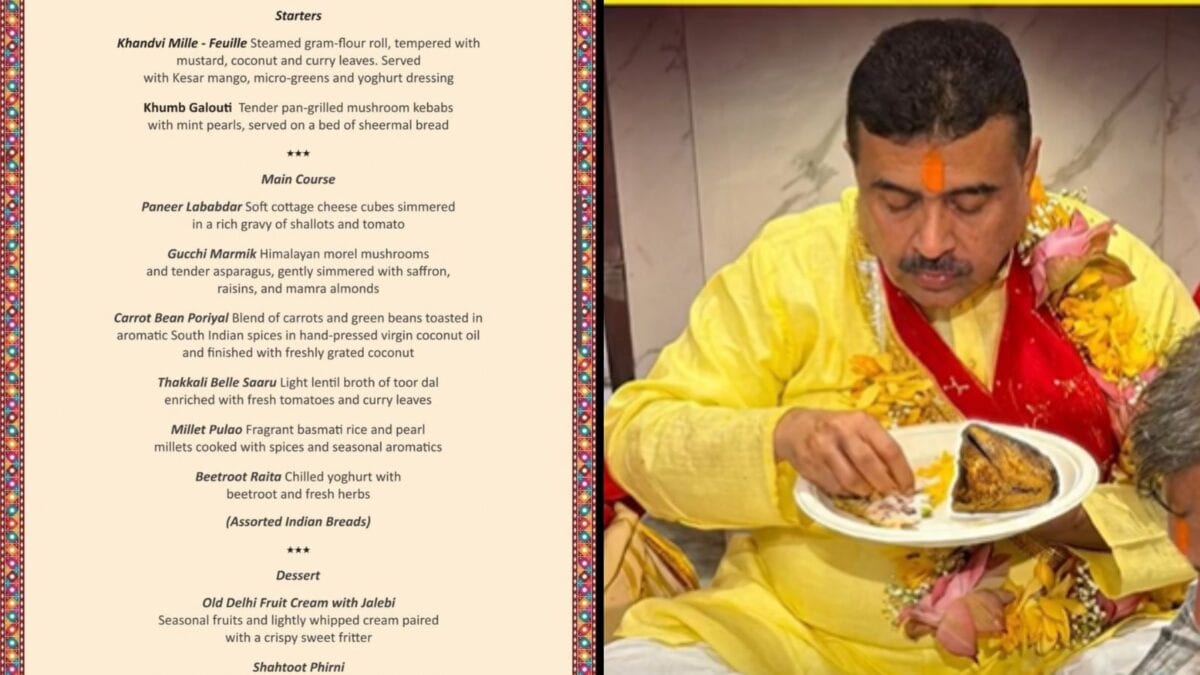
He was photographed eating traditional fish 'bhog', including a massive fish head, signaling that regional political survival requires embracing the local palate.
News india The Diet Diktat: How India’s Food Plate Became The Ultimate Federal Battleground
The Diet Diktat: How India’s Food Plate Became The Ultimate Federal Battleground
Written By :
, Edited By:
Last Updated: September 15, 2026, 10:05 IST
The political establishment has split into two halves---an elite centre pushing a sattvic global brand and a desperate regional apparatus performing emergency culinary retreats
Rapid Read
The BRICS all-vegetarian fare (left) and Suvendu Adkhikari having fish 'bhog' in Bengal (right) reveal two competing sides of India. (News18)
The new battleground is the menu card. The Indian State appears to be caught between two competing images—a clean, uniform, largely vegetarian image it wants to project to the world, and the meat- and fish-eating reality that shapes politics in many of its states. The reality of this dietary friction is that the political establishment has split into two irreconcilable halves—one is an elite, bureaucratic centre pushing a sattvic global brand, while the other is a desperate regional apparatus performing emergency culinary retreats to survive.
This institutional split was exposed during the international gala dinner hosted by Prime Minister Narendra Modi. Curated for global dignitaries, the menu was a flawless, entirely vegetarian, millet-heavy showcase of ancient wellness. For New Delhi’s senior policy makers, an all-vegetarian international banquet is the ultimate soft-power tool, a visual statement that modern, corporate-ready Indian identity is inherently vegetarian.
ALSO READ | BRICS Menu Isn’t The First All-Veg Spread For World Leaders — Here’s Proof
But this grand, central blueprint falls apart the moment it collides with regional ground realities.
Plate First, Politics Later
Just a few days prior to the BRICS summit, high-profile preacher Dhirendra Shastri, popularly known as Bageshwar Baba, triggered a wave of local outrage by publicly branding Bengalis who consume non-vegetarian food during Durga Puja as ‘Pakhandi’ (sinners). To a regional population that views faith through a Shakta lens, where the deity is offered fish, the preacher’s remarks felt like blatant cultural colonisation from the Hindi heartland.
ALSO READ | Opinion | Veg Or Non-Veg? Why What Bageshwar Baba Says Doesn’t Matter
The panic within the local right-wing and ruling BJP driven ecosystem was immediate. Realising that a food diktat is political hara-kiri, West Bengal Chief Minister Suvendu Adhikari executed a defensive manoeuvre on Kaushiki Amavasya.
He did not defend the preacher through statements or clarifications. Instead, he drove straight to Kolkata’s historic Kalighat Temple to be photographed eating traditional fish ‘bhog’, complete with a massive fish head. The political message was delivered on a banana leaf—to survive regionally, you must surrender to the local palate.
Ultimately, India’s food plate has become the ultimate proxy war for federal autonomy. The establishment is discovering that while you can easily mandate an all-vegetarian menu for an international summit, you cannot dictate the culinary soul of India’s states. New Delhi may hold the diplomatic pen, but it is the regional plate that holds the power.
News18 Newsletter Handpicked stories, in your inbox A newsletter with the best of our journalism submit
Quick Answers Powered by Ask News18 What controversy did preacher Dhirendra Shastri spark regarding Bengali dietary habits? Preacher Dhirendra Shastri, also known as Bageshwar Baba, triggered local outrage by publicly branding Bengalis who consume non-vegetarian food during Durga Puja as 'Pakhandi' (sinners). This sparked backlash because the regional population views faith through a Shakta lens, where deities are traditionally offered fish. How did West Bengal politician Suvendu Adhikari respond to the controversy over non-vegetarian food? To counter the political backlash, West Bengal Chief Minister Suvendu Adhikari visited Kolkata's historic Kalighat Temple on Kaushiki Amavasya. He was photographed eating traditional fish 'bhog', including a massive fish head, signaling that regional political survival requires embracing the local palate. Why did West Bengal's school mid-day meal pilot program spark a national debate? The West Bengal government announced a pilot program to replace eggs with vegetarian alternatives in select Kolkata school meals, handing preparation over to Iskcon's Annamrita Foundation. This revived debates over nutrition, as opponents accused the government of forcing religious beliefs on a non-vegetarian population, while experts noted vegetarian alternatives struggle to match the high nutritional value of eggs. Powered by Ask News18
About the Author Madhuparna Das Madhuparna Das, Associate Editor (policy) at CNN News 18, has been in journalism for nearly 14 years. She has extensively been covering politics, policy, crime and internal security issues. She has co... Read More
ADD YOUR COMMENT
First Published: September 15, 2026, 09:29 IST
Disclaimer: Comments reflect users’ views, not News18’s. Please keep discussions respectful and constructive. Abusive, defamatory, or illegal comments will be removed. News18 may disable any comment at its discretion. By posting, you agree to our Terms of Use and Privacy Policy Loading comments...