Harika Dronavalli, who had been a central part of India’s Olympiad teams for more than a decade, is absent, as is Tania Sachdev.
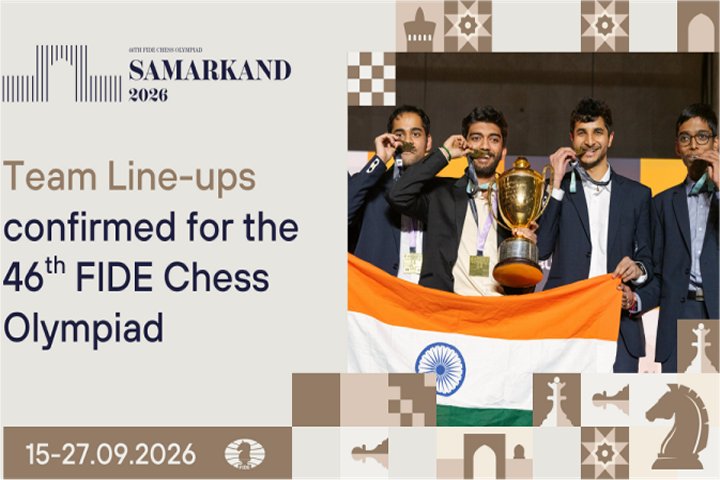
Humpy and Savitha come into the side, while Divya, Vaishali and Vantika return from the team that won gold in Budapest.
Ju is not part of China’s Olympiad team.
“I won the Grand Swiss last year and I am looking forward to being back.”Humpy believes the new combination may be India’s strongest Olympiad team yet.
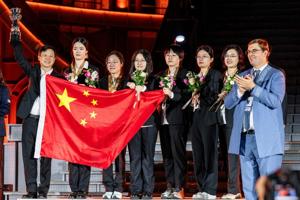
China, who has won Women’s Olympiad six times, arrives without Ju Wenjun, Lei Tingjie and Tan Zhongyi, but remains the third seeds.
India also begins the Women’s competition as defending champions and top seeds. Their average rating of 2476 places them ahead of Georgia (2449), China (2432), Kazakhstan (2421), the United States (2413) and Ukraine (2398).
Humpy Koneru (2524) returns after sitting out Budapest and leads India’s order. Divya Deshmukh (2490) is second, followed by Vaishali Rameshbabu (2489), Vantika Agrawal and young Savitha Shri B. Swayams Mishra is the captain.
The team has changed at both ends. Harika Dronavalli, who had been a central part of India’s Olympiad teams for more than a decade, is absent, as is Tania Sachdev. Humpy and Savitha come into the side, while Divya, Vaishali and Vantika return from the team that won gold in Budapest.
Divya and Vantika both won individual gold medals in 2024, on boards three and four respectively. Vaishali has since won the Women’s Candidates Tournament and will challenge Ju Wenjun for the Women’s World Championship. Ju is not part of China’s Olympiad team.
Samarkand also carries good memories for Vaishali. She won the Women’s Grand Swiss there in September 2025, retaining the title she had first claimed in 2023. “Samarkand is one of my favourite places,” she said. “I won the Grand Swiss last year and I am looking forward to being back.”
Humpy believes the new combination may be India’s strongest Olympiad team yet. “This is one of the strongest teams that we ever had for the Olympiad,” she said in an interview with Underpromoted . “I also played in the 2022 Olympiad in India, but comparatively, this team is even stronger, and I think we will have our best chance.”
She also acknowledged the difficulty of retaining the title. “Winning is something very good, but to retain that title, you need to be playing extremely well,” Humpy said. “It is going to be quite challenging as well.”
No country has defended the Women’s Olympiad title since China won consecutive gold medals in 2016 and 2018. Ukraine won in Chennai in 2022, followed by India in Budapest.
Second seeds Georgia bring a balanced leading team in the competition. Nana Dzagnidze is followed by Nino Batsiashvili, Lela Javakhishvili, Bella Khotenashvili and Meri Arabidze, with Salome Melia as captain. Four of their five players are separated by only 50 rating points, giving Georgia depth throughout the order. Georgia have won nine Women’s Olympiad medals, including four golds.
China, who has won Women’s Olympiad six times, arrives without Ju Wenjun, Lei Tingjie and Tan Zhongyi, but remains the third seeds. Zhu Jiner (2550) is placed first, followed by Song Yuxin, Lu Miaoyi, Yan Tianqi and Zhai Mo, with Zhong Zhang as captain. Zhu won individual gold on board one in Budapest and has since competed in the Women’s Candidates Tournament. The rest of the team represents a generational change. Lu, born in 2010, is already an International Master and one of the strongest junior girls in the world. She became the fourth-youngest girl to earn the IM title.
Kazakhstan is seeded fourth after finishing a single match point behind India in Budapest, their first Women’s Olympiad medal. Bibisara Assaubayeva (2538) headlines the team, followed by Alua Nurman, Meruert Kamalidenova, Elnaz Kaliakhmet and Zarina Nurgaliyeva. Pavel Kotsur is captain.
Kazakhstan’s progression has been steady: tenth in Batumi in 2018, fifth in Chennai in 2022 and second in Budapest. Assaubayeva has since won Norway Chess Women and finished second in the 2026 Women’s Candidates Tournament, putting her in great form to lead the young team once again.
Ukraine come without Anna and Mariya Muzychuk, who led the country to gold in Chennai, and the new lineup is the most eye-catching in the section. Sixteen-year-old Anastasiia Hnatyshyn (2465) leads the submitted list, ahead of Anna Ushenina, the 2012 Women’s World Champion.
Nataliya Buksa, Anastasiya Rakhmangulova and Tetyana Skarbarchuk complete the team, with Michail Brodsky as captain. Hnatyshyn earned her place at the top by winning the 2026 European Women’s Championship in Batumi. She entered as the 76th seed, scored 9/11 and gained more than 200 rating points. The result also brought her the direct Woman Grandmaster title and her first International Master norm.
Ukraine is seeded sixth, behind the United States. The American team retains Carissa Yip, Alice Lee and Irina Krush from the side that took bronze in Budapest. Rose Atwell makes her Olympiad debut, while Tatev Abrahamyan returns for a seventh appearance. Melikset Khachiyan is captain. Yip won individual gold on board two in Budapest.
Hosts Uzbekistan is seeded 13th with Afruza Khamdamova, Gulrukhbegim Tokhirjonova, Nilufarkhon Imomkuzieva, Umida Omonova and Guldona Karimova, captained by Nafisa Muminova. As in the Open competition, Uzbekistan will also field second and third teams containing many of the country’s leading juniors.
Young players to follow
Oro, Erdoğmuş, and England’s Bodhana Sivanandan are the most obvious examples of the younger generation arriving in Samarkand.
Few teams showcase the strength of the younger generation as clearly as Türkiye. Fifteen-year-old Yağız Kaan Erdoğmuş (2716) leads the Türkiye team. In May, while still 14, he became the youngest player in history to cross 2700.
Faustino Oro, playing for Argentina, became the second-youngest grandmaster in history in May at 12 years, six months and 26 days, having already become the youngest player to reach a rating of 2500.
Sivanandan is only 11. She made her Olympiad debut in Budapest at nine and recently became the youngest girl in history to earn an International Master norm, breaking a record held by Judit Polgár for almost four decades. She also holds the record for the youngest Woman Grandmaster norm.
The prodigies are part of a wider pattern. Türkiye’s first two players are teenagers, China’s Women’s team is built around players in their teens and early twenties, and the United States have handed Olympiad debuts to several younger players across their two teams. Uzbekistan’s additional host teams will place another group of juniors into the competition.
What to watch in Samarkand
At the top of the Open, the United States, Uzbekistan, India and China are separated by a narrow margin on average rating. India’s reshuffle means the World Champion will face board four opposition rather than board one, a detail that could matter a great deal across eleven rounds. In the women’s section, India, Georgia, China and Kazakhstan head the field, with the United States close behind.
Full lists of teams are now published on the official website:
https://chessolympiad2026.fide.com/teams_open
https://chessolympiad2026.fide.com/teams_women
Official website: https://chessolympiad2026.fide.com/