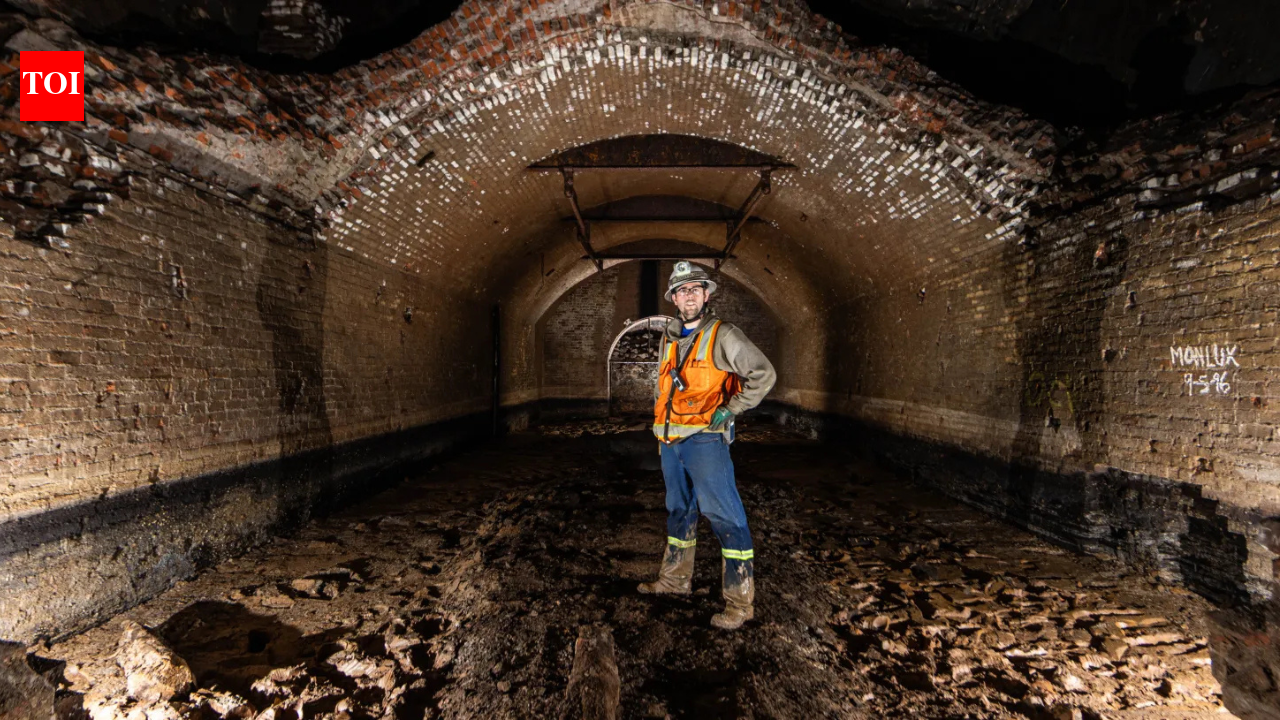
Photo by Stephen Kenny | Sanford Underground Research FacilityJason Connot stands in the former Blacksmith Shop on the 1100 Level of SURF.
Photo by Stephen Kenny | Sanford Underground Research FacilityFalling water acted like a giant underground pistonHomestake Mine, South Dakota | Wikimedia CommonsWhy the findings matter beyond one underground laboratoryKeeping an underground laboratory safe requires more than solid rock overhead.
In some cases, the fresh air moving through tunnels weakened or even reversed direction, creating an effect that had puzzled engineers for years.
According to ScienceDaily , the discovery emerged after SURF installed automated Maestro airflow sensors throughout the underground network.
Previous mine ventilation research published in the Journal of Mining Science has shown that airflow stability is essential for maintaining safe underground conditions and that unexpected airflow reversals can significantly affect emergency response planning.
Jason Connot stands in the former Blacksmith Shop on the 1100 Level of SURF. Photo by Stephen Kenny | Sanford Underground Research Facility
Jason Connot stands in the former Blacksmith Shop on the 1100 Level of SURF. Photo by Stephen Kenny | Sanford Underground Research Facility
Falling water acted like a giant underground piston
Homestake Mine, South Dakota | Wikimedia Commons
Why the findings matter beyond one underground laboratory
Keeping an underground laboratory safe requires more than solid rock overhead. Deep below the surface, engineers must carefully control ventilation to ensure workers always have a reliable supply of fresh air while simultaneously managing thousands of gallons of groundwater and rainwater that flow into the mine. At the Sanford Underground Research Facility (SURF) in South Dakota, an unexpected discovery has shown that these two systems are far more connected than anyone realized.Mining engineers studying the former Homestake Mine found that during periods of heavy rainfall, water cascading nearly a mile down one of the facility’s vertical shafts could dramatically alter underground airflow. In some cases, the fresh air moving through tunnels weakened or even reversed direction, creating an effect that had puzzled engineers for years. According to Mining, Metallurgy & Exploration , lead author Jason Connot and colleagues analyzed real-time airflow measurements alongside water discharge data collected during major rain events in 2023. Using ventilation modeling and fluid dynamics equations adapted for the mine, they found that the descending column of water generated enough pressure, which is about 870 Pascals (3.5 inches of water gauge), to push large volumes of air through the shaft, closely matching what ventilation sensors had recorded underground.Their findings were published in the paper Effects of Water Inflows on a Mine Ventilation System: A Case Study. According to ScienceDaily , the discovery emerged after SURF installed automated Maestro airflow sensors throughout the underground network. Engineers noticed that whenever excess stormwater was diverted down the facility’s 5 Shaft into a deep collection pool, airflow throughout the mine behaved unpredictably.Initially, they suspected a mechanical problem with the ventilation fans. Instead, the sensors pointed to the falling water itself. The research showed that the rapidly descending stream effectively acted like a giant syringe or piston inside the confined shaft, dragging and compressing surrounding air as it fell. Similar air-water interactions have previously been described in confined sewer and dropshaft systems, but this is among the first studies to document the phenomenon at the scale of an active underground mine ventilation network. According to the SURF research team, adapting existing fluid dynamics models produced predictions that closely matched real-world observations, giving engineers confidence they had finally identified the source of the airflow reversals.The implications extend well beyond South Dakota, since ventilation is one of the most critical safety systems in underground mines, carrying fresh oxygen to workers while removing diesel exhaust, dust, smoke, and hazardous gases. During emergencies such as mine fires, engineers sometimes deliberately release large amounts of water down ventilation shafts to suppress flames or protect infrastructure.The new findings suggest that these emergency actions can unintentionally alter airflow throughout a mine, potentially changing how smoke or gases move underground. Previous mine ventilation research published in the Journal of Mining Science has shown that airflow stability is essential for maintaining safe underground conditions and that unexpected airflow reversals can significantly affect emergency response planning. By incorporating water-induced airflow effects into future ventilation models, mining engineers may be better equipped to predict hazardous conditions before they occur, improving worker safety not only during heavy rainfall but also during fire suppression and other emergency operations.