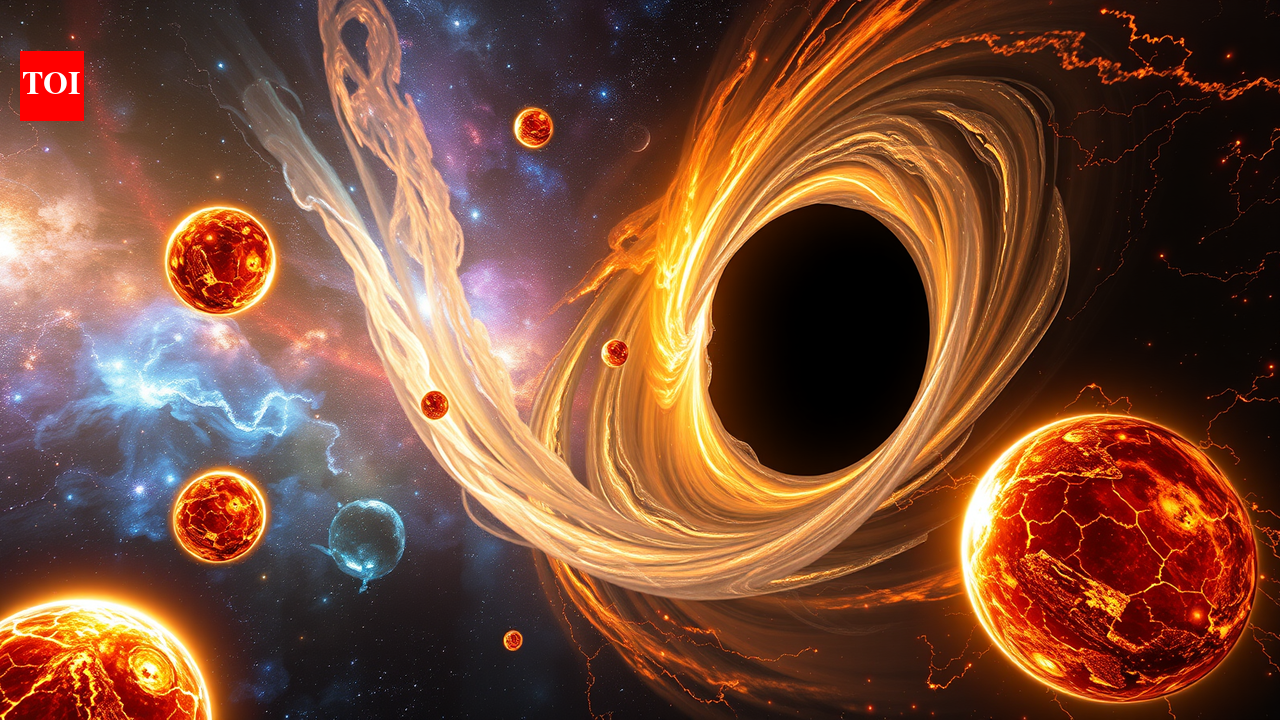
Why black holes became the leading suspectsA stellar mystery emerges in the discoveryThe rise of the stellar-powered neutrino factoryFor decades, astronomers have looked to black holes as the likely birthplace of the Universe's most energetic neutrinos.
Black holes rank among the most extreme objects in existence, capable of accelerating matter to extraordinary energies.
"Black holes are not like vacuum cleaners," explained Yvette Cendes, lead author of a study examining the event.The remark captures a common misconception.
Contrary to popular imagination, black holes do not indiscriminately devour everything around them.
It is a subtle but significant shift in perspective.Rather than viewing black holes as the sole engines behind the Universe's most energetic neutrinos, scientists are beginning to see a broader and more interconnected picture.
Why black holes became the leading suspects
A stellar mystery emerges in the discovery
The rise of the stellar-powered neutrino factory
For decades, astronomers have looked to black holes as the likely birthplace of the Universe's most energetic neutrinos. These elusive particles, often nicknamed "ghost particles", pass through planets, stars and even entire galaxies with barely an interaction, making them notoriously difficult to study.The assumption seemed logical. Black holes rank among the most extreme objects in existence, capable of accelerating matter to extraordinary energies. If any cosmic environment could launch neutrinos across billions of light-years, surely it would be one of these gravitational powerhouses.Yet science has a habit of overturning its own expectations.A growing body of research now suggests that some of the Universe's most energetic neutrinos may not originate from black holes alone. Instead, massive stars and the violent events surrounding their deaths could be acting as vast natural neutrino factories, reshaping how scientists think about one of astrophysics' longest-running mysteries.Neutrinos are among the strangest particles known to physics. They carry almost no mass, possess no electric charge and interact so weakly with matter that trillions pass through the human body every second without leaving a trace.That same property makes them valuable cosmic messengers. Unlike light, which can be absorbed, scattered or blocked, neutrinos travel almost untouched through the Universe. Detecting them allows scientists to peer into some of the most energetic environments ever observed.For years, supermassive black holes sat at the top of the list of potential sources.As matter spirals towards a black hole, enormous amounts of energy can be released. Magnetic fields, radiation and particle jets combine to create conditions capable of accelerating particles to near-light speeds. Many researchers suspected these environments could also generate the high-energy neutrinos detected by observatories such as IceCube in Antarctica."Figuring out where high-energy neutrinos come from is one of the biggest problems in astrophysics today," astrophysicist Yang Bai of the University of Wisconsin said while writing about the Large Neutrino “Collider”.Earlier observations appeared to support the theory. Data from NASA's Chandra , Swift and NuSTAR observatories suggested that Sagittarius A*, the supermassive black hole at the centre of the Milky Way, might be capable of producing exceptionally energetic neutrinos. The case looked increasingly convincing.The picture began to shift when astronomers turned their attention to a dramatic event known as AT2019dsg.As per the results presented in ‘ Radio Observations of an Ordinary Outflow from the Tidal Disruption Event AT2019dsg ,’ the event occurred when a star wandered too close to a supermassive black hole and was torn apart by tidal forces. Such tidal disruption events are among the most violent phenomena in the cosmos, releasing huge amounts of energy as stellar material is shredded and consumed.When the IceCube Observatory detected a powerful neutrino that appeared to coincide with AT2019dsg, researchers initially believed they had found a smoking gun. The timing matched. The location matched. It seemed like a breakthrough. A closer look told a different story.Using extensive radio observations, researchers found that the event simply did not release enough energy to account for the detected neutrino. The outflow from the disrupted star appeared relatively ordinary rather than exceptionally powerful."Black holes are not like vacuum cleaners," explained Yvette Cendes, lead author of a study examining the event.The remark captures a common misconception. Contrary to popular imagination, black holes do not indiscriminately devour everything around them. Many eat matter at rather low speeds, and not all eating activities give rise to the extremely harsh conditions needed for high-energy particle creation.These results prompted researchers to look again at one option that was previously of less interest: maybe the black holes were just half the story.There is an increasing interest in stars themselves, especially those going through dramatic changes.The death of giant stars, intense explosions in some stars, and tidal disruption events might lead to very energetic environments, where the acceleration of particles to create many high-energy neutrinos is possible.Research titled ‘ High Energy Neutrinos from the Tidal Disruption of Stars ’ by physicists Cecilia Lunardini and Walter Winter suggested that tidal disruption events involving stars could contribute significantly to the population of neutrinos detected by IceCube.Their work indicated that the physics surrounding disrupted stars may be far more important than previously thought.More recent theoretical studies have gone even further. Some researchers now describe collapsing stars as natural "neutrino colliders", environments where immense numbers of neutrinos interact and influence the ultimate fate of the dying star itself.In these scenarios, neutrinos are not merely by-products of stellar destruction. They become active participants in the process, helping determine whether a collapsing star stabilises as a neutron star or continues its collapse into a black hole. It is a subtle but significant shift in perspective.Rather than viewing black holes as the sole engines behind the Universe's most energetic neutrinos, scientists are beginning to see a broader and more interconnected picture. Massive stars, their explosive deaths and the complex physics surrounding them may all contribute to a cosmic network of particle production.The mystery is far from solved. Yet that uncertainty is part of what makes the search so compelling. Every new neutrino detected on Earth carries information from distant and often violent corners of the Universe. And with each discovery, astronomers are reminded that nature rarely confines itself to a single explanation.Sometimes the object expected to dominate the story, the black hole, turns out to share the stage with the stars.