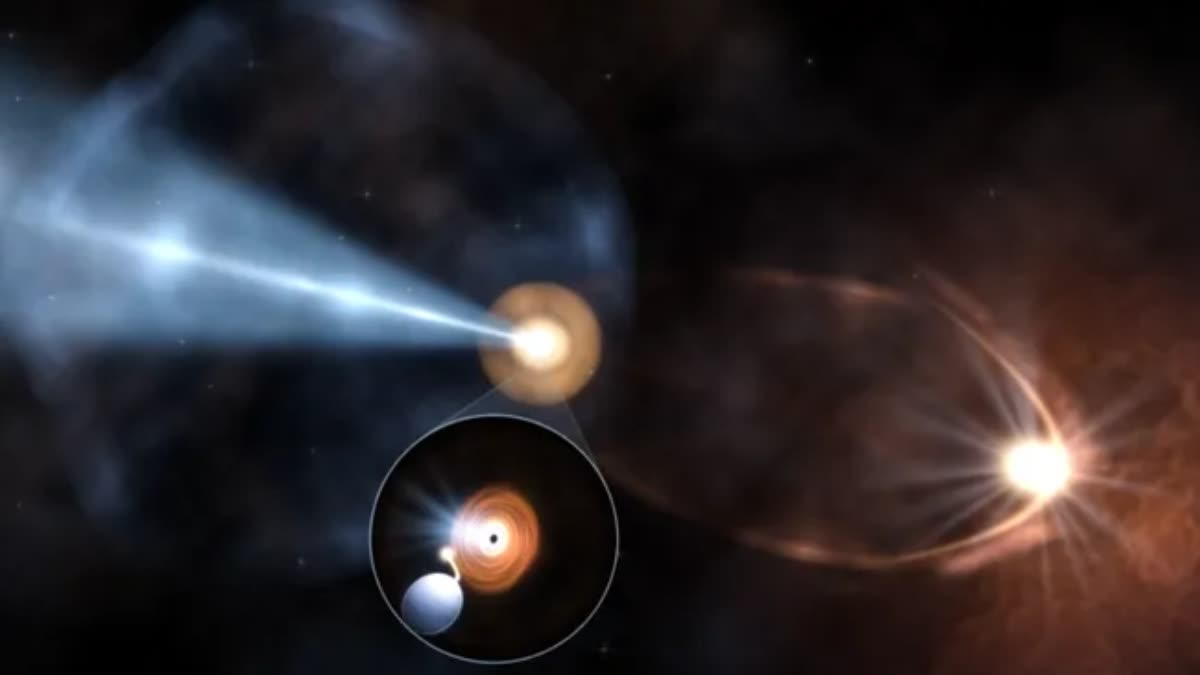
ETV Bharat / technologyScientists Discover First Microblazar Black Hole In The Milky WayHyderabad: Astronomers have discovered the first microblazar ever found in the Milky Way, a black hole that is pulling in matter while firing a jet of plasma towards Earth at nearly the speed of light.
The system named IRAS 18293-0941 lies around 12,000 light-years away and consists of a star-sized black hole orbiting a much larger companion star, completing one full orbit every 11 days.
As the black hole draws matter away from its companion star, some of it escapes through the poles in the form of two powerful jets.
Blazars are typically formed by extremely massive black holes, often millions or billions of times heavier than the Sun, located at the centres of distant galaxies.
By contrast, a microblazar involves a much smaller black hole with a mass only a few hundred times that of the Sun.
ETV Bharat / technology
Scientists Discover First Microblazar Black Hole In The Milky Way
Hyderabad: Astronomers have discovered the first microblazar ever found in the Milky Way, a black hole that is pulling in matter while firing a jet of plasma towards Earth at nearly the speed of light. The system named IRAS 18293-0941 lies around 12,000 light-years away and consists of a star-sized black hole orbiting a much larger companion star, completing one full orbit every 11 days.
As the black hole draws matter away from its companion star, some of it escapes through the poles in the form of two powerful jets. One of these jets happens to point almost directly towards Earth, making the discovery possible.
What makes this discovery unusual?
Blazars are typically formed by extremely massive black holes, often millions or billions of times heavier than the Sun, located at the centres of distant galaxies.
By contrast, a microblazar involves a much smaller black hole with a mass only a few hundred times that of the Sun. Scientists had been searching for such a system for three decades, but the IRAS 18293-0941 remained hidden behind a thick veil of gas and dust, making it almost invisible in standard optical images. The object was first catalogued by the IRAS satellite in 1983, before being largely forgotten for decades.