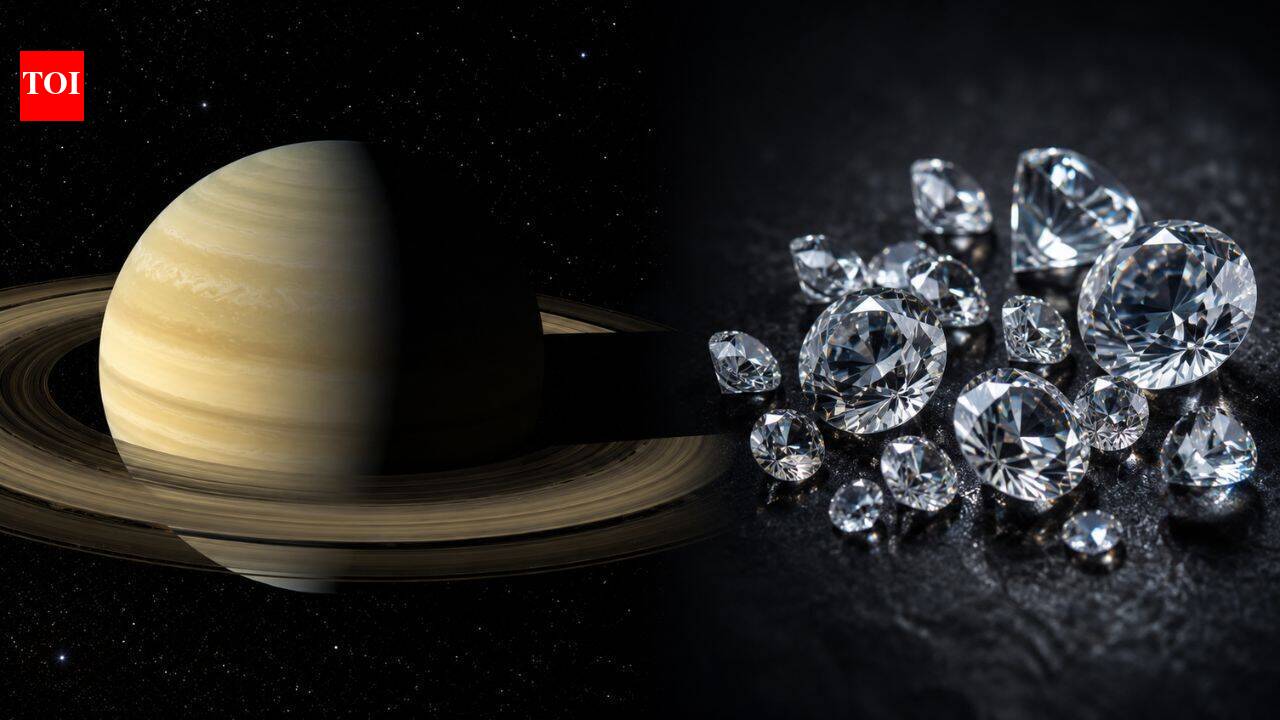
Yet researchers have argued that the ingredients needed for diamond formation could naturally exist inside Saturn.
Scientists propose that the soot first transforms into graphite, the same form of carbon found in pencil leads.
Dr Baines noted that exactly what happens to carbon under those conditions remains uncertain.This picture differs from what scientists expect inside Uranus and Neptune.
One uncertainty concerns how carbon behaves inside Saturn's hydrogen- and helium-rich atmosphere, rather than as pure carbon alone.
Without direct observations or experiments that fully reproduce those conditions, researchers cannot say with certainty how efficiently diamonds form.
image AI generated
How methane in Saturn's atmosphere could turn into diamonds
Why Saturn's enormous size could help create diamonds
What happens to diamonds deep inside Saturn
Why Saturn's diamond rain remains a scientific theory
Saturn has long stood out because of its sweeping rings, but some scientists believe one of its most unusual features lies far beneath the cloud tops, hidden from view. Instead of water or ice, the giant planet may produce diamonds deep within its atmosphere through a chain of chemical and physical changes driven by lightning, immense pressure and extreme heat.The idea sounds more like science fiction than planetary science. Yet researchers have argued that the ingredients needed for diamond formation could naturally exist inside Saturn. Their calculations suggest that carbon released high in the atmosphere may eventually become solid diamonds, with some estimates indicating that around 1,000 tonnes could be produced each year before sinking towards the planet's interior.Saturn's atmosphere is dominated by hydrogen and helium, but it also contains methane. According to scientists, that methane could be the starting point for an extraordinary sequence of events.As reported by the BBC, Dr Kevin Baines of the University of Wisconsin-Madison and NASA's Jet Propulsion Laboratory explained that lightning inside Saturn's powerful storm systems can split methane molecules apart. The remaining carbon gathers into tiny particles of soot, which then begin falling through the atmosphere.The journey does not end there. As these carbon particles descend, they pass through layers where pressure steadily rises. Scientists propose that the soot first transforms into graphite, the same form of carbon found in pencil leads. Far deeper inside the planet, where the pressure becomes even greater, that graphite could be compressed into diamonds.The proposed process depends on Saturn's enormous size. Unlike Earth, the gas giant offers tens of thousands of kilometres of atmosphere where pressure and temperature change continuously, allowing carbon to pass through several different forms.Speaking to the BBC, Dr Baines said: "The bottom line is that 1,000 tonnes of diamonds a year are being created on Saturn." He also acknowledged that no spacecraft has directly witnessed the process, adding: "People ask me - how can you really tell? Because there's no way you can go and observe it. It all boils down to the chemistry. And we think we're pretty certain."The researchers suggested that some of the diamonds could grow to around a centimetre across before continuing their descent, making them large enough to resemble gemstones rather than microscopic crystals.The diamonds would not remain unchanged forever. Conditions continue to become more severe with depth, and scientists believe there comes a point where solid diamonds can no longer survive.According to the BBC, after falling for roughly another 30,000 kilometres, the pressure and temperature may become so intense that the diamonds melt. One possibility is the existence of a vast layer of liquid carbon, sometimes described as a liquid diamond sea, surrounding parts of Saturn's deep interior. Dr Baines noted that exactly what happens to carbon under those conditions remains uncertain.This picture differs from what scientists expect inside Uranus and Neptune. Because those planets have cooler interiors, diamonds there may stay solid instead of melting, potentially allowing them to accumulate over time.The diamond rain proposal attracted attention because it linked laboratory studies of carbon with atmospheric models of the giant planets. At the time it was presented, however, the work had not yet undergone peer review, leaving room for debate about whether the process unfolds exactly as described.Other planetary scientists considered the idea reasonable while pointing out that important questions remain. One uncertainty concerns how carbon behaves inside Saturn's hydrogen- and helium-rich atmosphere, rather than as pure carbon alone. Without direct observations or experiments that fully reproduce those conditions, researchers cannot say with certainty how efficiently diamonds form.