After the meeting, statements from both the NC chief and disgruntled NC leaders were reconciliatory, and a storm that seemed to be brewing in the NC teacup dissipated.
However, Farooq Abdullah led the NC to a decisive victory in the June 1983 Assembly elections with the party securing a comfortable majority, and strengthening Farooq Abdullah’s political position.
Shah led a group of NC legislators who withdrew their support from Farooq Abdullah.
Uppsala University professor Sten Widmalm, in his various interviews, has documented the role of New Delhi in destablising Farooq Abdullah’s government.
On November 6, the dissenting legislators met NC President Farooq Abdullah and CM Omar at the NC chief’s Gupkar residence and the ice was broken, and tempers cooled.
Srinagar, Nov 7: While the National Conference (NC) high command was able to quell the dissent after a meeting with the disgruntled legislators on Friday, this was not the first time in the NC’s 87-year history that the NC faced an internal rebellion, and this was not the first time that the NC leadership was able to abort the crisis.
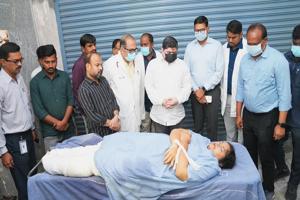
On Friday, ice broke between dissident NC legislators and the party high command, including NC President Farooq Abdullah and Chief Minister Omar Abdullah, after a meeting at the NC chief’s Gupkar residence in Srinagar, where the party top brass assured the dissident legislators that it would address their grievances in phases.
After the meeting, statements from both the NC chief and disgruntled NC leaders were reconciliatory, and a storm that seemed to be brewing in the NC teacup dissipated.
However, this was not the first in NC history that the party faced a major internal rebellion.
Advertisment
IDEOLOGICAL RUPTURE OF 1939
NC’s first major ideological rupture happened in 1941, just two years after the Muslim Conference, established in October 1932 under the leadership of Sheikh Mohammad Abdullah, Mirwaiz Yusuf Shah, and Chaudhry Ghulam Abbas, was renamed the National Conference on June 11, 1939.
Though the change reflected Abdullah’s attempt to build a broader, secular political movement that would represent people across religious communities, the decision was opposed by a section of the leadership, particularly those who believed that the organisation should retain its Muslim political identity.
Abbas subsequently revived the Muslim Conference in 1941, creating a separate political organisation.
The NC survived, but the split produced a separate Muslim Conference that became an important political force in subsequent years.
Historian Suhail-ul-Rehman Lone’s research, published in Studies in People’s History in 2017, examines this rupture and its relationship with the competing political visions of Abdullah and Abbas.
He writes that the disagreement was not merely about the party’s name but also concerned the political character of the movement, its relationship with the Congress, and the direction of Kashmir’s political struggle.
THE UPHEAVAL OF 1953
The second time the NC faced a consequential political upheaval was on August 9, 1953.
Sheikh Abdullah, who had led the NC to power following the ‘accession’ of Jammu and Kashmir, was dismissed as Prime Minister and arrested amid growing disagreements with New Delhi over Kashmir’s political future, the extent of autonomy, and the question of ‘accession’.
Hafsa Kanjwal, in her 2017 doctoral dissertation, ‘Building a New Kashmir: Bakshi Ghulam Muhammad and the Politics of State-Formation in a Disputed Territory’, writes that Bakshi assumed office after Sheikh Abdullah was deposed and arrested on the orders of the Government of India.
It was an unconventional rebellion with a group of NC legislators removing the party’s most powerful leader, installing his former deputy in his place, and succeeding in the elevation of Bakshi as Prime Minister.
The episode had a lasting consequence on Kashmir’s polity, with Sheikh Abdullah’s supporters increasingly organising themselves outside the ruling NC.
BREAKAWAY MOVEMENT OF 1955
Following Abdullah’s dismissal and arrest in 1953, his supporters began organising against the new political establishment.
On August 9, 1955, Mirza Afzal Beg, a close aide of Abdullah, established the Plebiscite Front, also known as Mahaz-e-Rai Shumari.
Beg became its president, while Abdullah remained the central political figure associated with the movement.
The Plebiscite Front’s formation was a direct consequence of the political rupture within the NC following Abdullah’s removal.
The Plebiscite Front faced restrictions and could not participate in electoral politics like a recognised mainstream party.
The movement continued until the 1975 Indira-Sheikh Accord, following which Abdullah and his associates decided to dissolve the Plebiscite Front and revive the NC as a separate political organisation, which returned to power in 1977.
Advertisment
DNC REBELLION OF 1957
In 1957, Ghulam Mohammad Sadiq, a senior NC leader and former minister in Bakshi’s government, broke away from the ruling party and established the Democratic National Conference (DNC).
Sadiq and his supporters accused the ruling establishment of failing to live up to the principles of the NC’s progressive political programme and accused it of corruption and the concentration of political power.
His breakaway group included 13 dissenting legislators and former ministers and demanded reforms.
They developed a political platform challenging Bakshi’s leadership.
However, the split did not permanently weaken the NC, and following intervention by New Delhi, Sadiq and his associates moved towards reunification with the parent organisation.
By late 1960, most of the DNC leadership had reunited with the NC.
The reunification itself produced another disagreement with Ram Piara Saraf and a few other DNC members opposing the decision, arguing that the question of reunification should be decided by a full party convention.
Sadiq and other former DNC leaders were subsequently accommodated in the government.
TRANSFORMATION OF 1963-65
In 1963, Bakshi resigned as Prime Minister and Khwaja Shamsuddin succeeded him, while Sadiq’s political position within the party remained significant.
Shamsuddin’s government was short-lived, and he resigned in early 1964.
Sadiq subsequently became the Prime Minister.
In 1965, the NC merged with the Indian National Congress and became the Jammu and Kashmir unit of Congress.
This was a major organisational transformation rather than an ordinary internal rebellion, with the political identity of the NC effectively absorbed into Congress, while Abdullah’s supporters continued to operate through the Plebiscite Front.
Following the 1975 Indira-Sheikh Accord, the Plebiscite Front was dissolved, and the NC was revived.
FIZZLED OUT REVOLT OF 1978
After the 1975 Indira-Sheikh Accord, Abdullah returned to power and revived the NC.
In the 1977 Assembly elections, the NC won a comfortable majority, and Abdullah became Chief Minister.
Beg, his longtime associate and deputy, became Deputy Chief Minister.
However, relations between the two deteriorated, and in September 1978, Abdullah accused Beg of encouraging defections within the NC during elections to the State Legislative Council.
Abdullah reportedly relied on the testimony of Maulvi Mohammad Yasin Hamdani, a prominent religious leader and serving Member of Legislative Assembly.
Abdullah also demanded Beg’s resignation from the Council of Ministers, and Beg resigned on September 25, 1978.
Beg’s departure created unrest within the party, with several legislators sympathetic to him, raising questions about Abdullah’s control over the organisation.
Veteran Kashmiri journalist Yusuf Jameel, in his blog jameelyusuf.blogspot.com, recounts his firsthand experience as a young reporter with Srinagar-based daily Aftab of the NC’s internal crisis in 1978.
Recalling the episode, Jameel describes how legislators initially believed to be aligned with Beg publicly reaffirmed their loyalty to Abdullah, while Beg complained that the press was giving the NC leader’s version of events greater prominence.
In October 1978, Beg established the Inquilabi National Conference (INC), taking the confrontation beyond the party’s internal structures.
The rebellion ultimately failed to dent Abdullah’s hold over the party, prompting Beg to dissolve INC in September 1981 and return to the NC fold.
Advertisment
SUCCESSFUL JULY 1984 REBELLION
Arguably the most consequential internal rebellion in the history of the NC was by Ghulam Mohammad Shah in July 1984 when he successfully brought down an elected government.
After Abdullah’s death on September 8, 1982, his son, Farooq Abdullah, succeeded him as Chief Minister, although the succession was not universally accepted within the party.
One of the principal dissenters was senior NC leader Ghulam Mohammad Shah, Sheikh Abdullah’s son-in-law and Farooq’s brother-in-law.
Shah and other senior leaders were unhappy with the manner in which the leadership transition took place.
However, Farooq Abdullah led the NC to a decisive victory in the June 1983 Assembly elections with the party securing a comfortable majority, and strengthening Farooq Abdullah’s political position.
Things got murky for Farooq Abdullah as the relationship between the Indira Gandhi-led government at New Delhi and his government deteriorated following Farooq Abdullah’s political positioning and attempts to develop relations with opposition leaders outside Kashmir.
Shah and former Finance Minister Devi Das Thakur began working together to destabilise the government with the rebellion in the NC culminating on July 2, 1984.
Shah led a group of NC legislators who withdrew their support from Farooq Abdullah.
The defectors secured the backing of the Congress, which provided the necessary support for Shah to form a government.
It was Governor Jagmohan who informed Farooq Abdullah that he had lost his majority and denied him an opportunity to demonstrate his strength on the floor of the Assembly.
Jagmohan dismissed Farooq Abdullah’s government and invited Shah to form a new administration.
Shah was sworn in as Chief Minister on July 2, 1984.
Uppsala University professor Sten Widmalm, in his various interviews, has documented the role of New Delhi in destablising Farooq Abdullah’s government.
These accounts also trace the role of Devi Das Thakur in bringing Shah and the Congress leadership together and examine discussions between Governor Jagmohan and New Delhi before Shah was installed.
A Jammu and Kashmir High Court proceeding dated July 30, 1984, reproduces the complaint submitted by the NC’s chief whip, alleging that 12 members of the NC Legislature Party had withdrawn support from Farooq Abdullah and chosen Shah as their leader.
The 12 named members were Abdul Jabbar Sheikh from Kangan assembly constituency; Talib Hussain from Rajouri; Hassam-ud-Din Banday from Hazratbal; Sonaullah Dar from Pulwama; Ghulam Hassan Mir from Tangmarg; Mohammad Khalil Johar from Bandipora; Hakim Mohammad Yasin from Khansahab; Munshi Habibullah from Kargil; Dilawar Mir from Rafiabad; Mehboob Beg from Anantnag; and nominated MLAs Khem Lata Wakhlu and Gurbachan Kumari Rana.
Shah's victory, though, was short-lived.
He remained Chief Minister until March 1986, and his government faced growing criticism, including allegations of administrative failure and inability to control communal violence.
On March 6, 1986, Congress withdrew its support from Shah, who resigned the following day, and Governor’s Rule was imposed.
Farooq Abdullah returned to power in November 1986 following a political understanding with Rajiv Gandhi and the NC and Congress later contested the infamous 1987 Assembly elections in alliance.
After Shah became CM, his breakaway political organisation became associated with the Awami National Conference (ANC), which was subsequently led by his wife, Begum Khalida Shah.
However, ANC did not succeed in replacing the NC as Kashmir’s principal regional political force.
RUHULLAH REBELLION OF 2024-26
The latest major rupture within the NC is the confrontation involving Member of Parliament Aga Syed Ruhullah.
Unlike earlier rebellions driven by the struggle for ministerial positions or control of the party, Ruhullah’s confrontation was centred on the NC’s political direction, its electoral promises, and the question of J&K’s constitutional status.
The differences became visible after the NC returned to power following the 2024 Assembly elections.
On December 25, 2024, Ruhullah joined students protesting outside Chief Minister Omar Abdullah’s residence in Srinagar.
The protest concerned the reservation policy in J&K and demands for its rationalisation.
His participation was significant as he was a sitting NC MP openly supporting a protest against a policy issue involving his own party’s government.
Ruhullah increasingly questioned the NC government’s approach to political issues with his disagreements concerning restoration of Article 370, the party’s commitment to its 2024 election manifesto, political prisoners, constitutional rights, reservation policy, and the party’s approach towards the Centre.
In May 2025, Ruhullah had a confrontation with CM Omar during an NC Working Committee meeting when Ruhullah raised concerns about the party’s departure from its ideological position and its failure to fulfil key electoral promises.
The disagreement escalated considerably in the months preceding November 3, 2026, when he formally resigned both as a member of the NC and as a Member of Parliament from Srinagar-Budgam constituency.
DISGRUNTLED MLAS REBELLION OF 2026
Following the last month’s cabinet reshuffle, 18 to 20 NC legislators expressed dissatisfaction with the functioning of the government and the party organisation.
The legislators sought replacement of several senior ministers, changes in the government’s functioning, removal of CM Omar’s Advisor, greater consultation with legislators, and organisational and administrative reforms.
On November 6, the dissenting legislators met NC President Farooq Abdullah and CM Omar at the NC chief’s Gupkar residence and the ice was broken, and tempers cooled.
TAILPIECE
In reality, other than the rebellion of July 1984, when Shah led a revolt that brought down the elected government and enabled him to become CM with Congress support, most internal rebellions within NC have fizzled out and failed to dent the party.