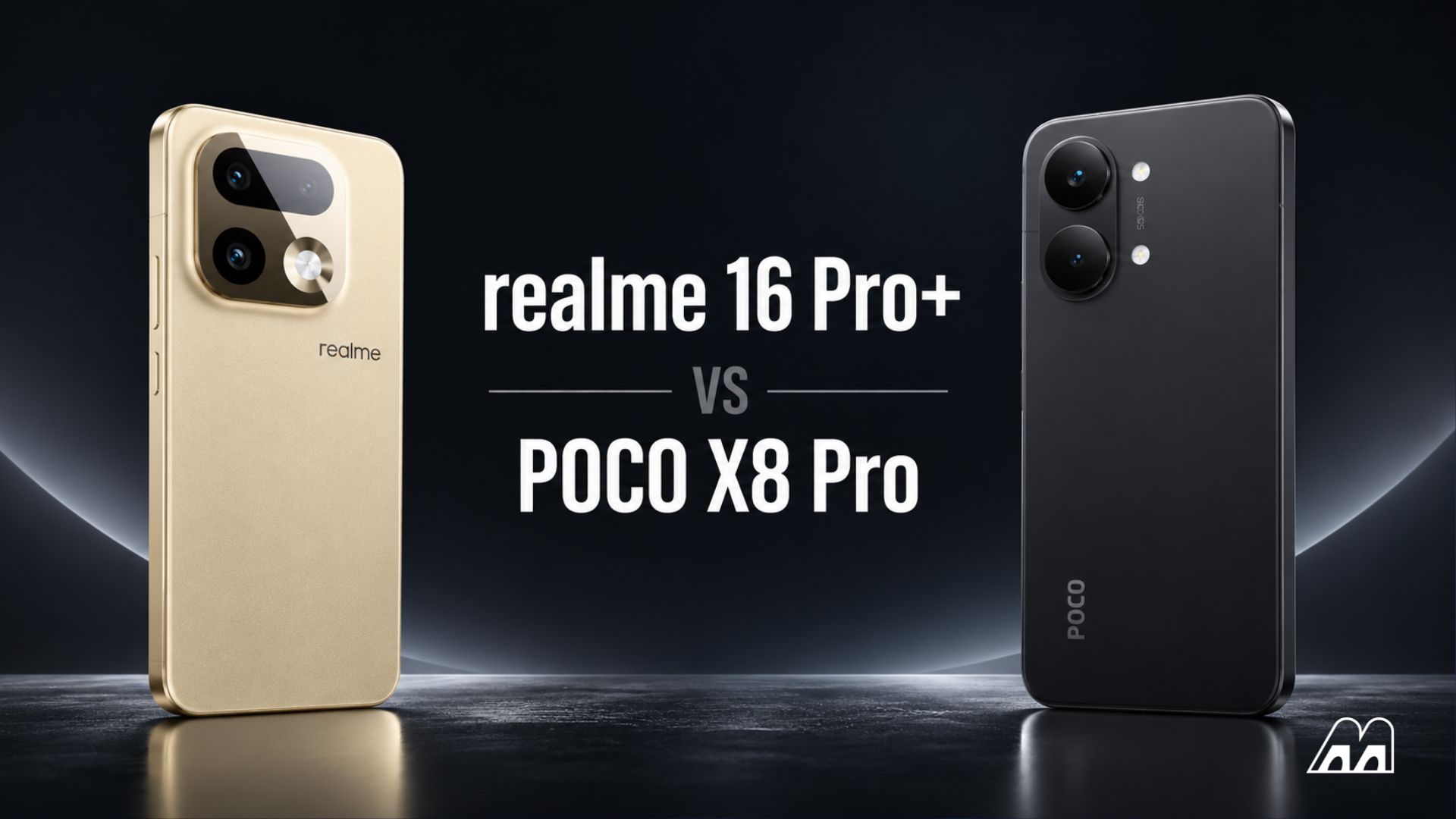
The POCO X8 Pro global specifications list dual nano-SIM, without an eSIM option.
Best Overall Poco X8 PRO 4.5/5 Overview Dimensity 8500-Ultra chipset delivers flagship-class performance at 3.4GHz.
What Owners Say About the realme 16 Pro+ and POCO X8 ProThe supplied screenshots contain a useful exact-model POCO review, but many other positive endurance stories concern X8 Pro Max.
We excluded X8 Pro Max, F9 Ultra, X7 Pro and unidentified-model battery claims from X8 Pro conclusions.
The POCO X8 Pro vs X8 Pro Max comparison addresses that separate buying decision.
The POCO X8 Pro is our starting point when it costs less and you mainly want a capable daily phone; the realme 16 Pro+ earns a premium when portrait zoom, higher-resolution selfie video or the European model’s eSIM support matters. A bigger battery badge alone doesn’t settle the value decision. Here’s what each phone actually adds, where the regional differences matter and which owner reports belong to the right model.
Which Phone Is Better Value at the Price You Can Buy?
Best Choice XIAOMI Poco X8 PRO 5G 4.4/5 Overview 6.59" 1.5K 120Hz ultra-bright AMOLED
Dimensity 8500-Ultra4nm manufacturing
50MP main camera with OISOISf Check Price
Start with equivalent storage and the same market, because a low advertised price can describe a different configuration or import arrangement. We haven’t established a current matched local price pair, so there is no verified universal saving to attach to either phone.
That doesn’t prevent a useful recommendation. If POCO is cheaper and your photos are mainly ordinary wide shots, realme’s additional camera hardware needs to justify money you could retain. If you regularly shoot portraits or record yourself, the Pro+ offers specific capabilities that can explain a higher price.
Include the required adapter and suitable warranty coverage in the premium. A lower-storage offer isn’t a saving if you would immediately run short of space.
Our best cheap phones guide covers the wider shortlist. Here, compare the task you gain with the money you save.
Does realme Support eSIM While POCO Uses Physical SIMs?
Best Choice XIAOMI Poco X8 PRO MAX 4.4/5 Overview 6.83" 1.5K 120Hz ultra-bright AMOLED
MediaTek Dimensity 9500s3nm
50MP main cameraLight Fusion 600 Check Price
Yes for the European realme version documented here. Realme’s European specifications explicitly state eSIM support for the EU and mark other markets unsupported. The POCO X8 Pro global specifications list dual nano-SIM, without an eSIM option.
An eSIM is a digitally installed mobile subscription. If you use travel data plans downloaded before departure, the European Pro+ has a concrete connectivity advantage over the documented POCO. If both your numbers use physical cards, that advantage may add little to your daily routine.
The regional qualification is essential. An Indian or other non-EU realme offer shouldn’t inherit the European eSIM specification just because its price looks attractive. Likewise, a POCO review mentioning a different model’s eSIM support cannot establish the feature on X8 Pro.
For an eSIM-dependent buyer, this can decide the comparison before processor or camera quality enters it. Paying less for a phone that doesn’t support your required subscription setup isn’t better value. For everyone else, the decision returns to cameras, performance and the actual local premium.
What Hardware Are You Comparing?
Best Overall Poco X8 PRO 4.5/5 Overview Dimensity 8500-Ultra chipset delivers flagship-class performance at 3.4GHz.
6.59-inch 1.5K AMOLED display with 120Hz refresh rate and 3,500-nit peak brightness.
6,500mAh battery pairs with blazing-fast 100W HyperCharge. View deal See latest price on Amazon
Feature realme 16 Pro+ POCO X8 Pro Processor Snapdragon 7 Gen 4 Dimensity 8500-Ultra Main camera 200 megapixels 50 megapixels Dedicated telephoto 50 megapixels, 3.5x Not listed Ultrawide 8 megapixels 8 megapixels Front-camera video Up to 4K60 Up to 1080p60 Display 6.8 inches, up to 144Hz 6.59 inches, up to 120Hz Typical battery 7,000mAh 6,500mAh Wired charging Up to 80W Up to 100W Storage standard UFS 3.1 UFS 4.1
Megapixels count millions of image pixels. Hertz measures display updates per second, milliamp-hours describe battery capacity and watts describe charging power. None of those units is a complete quality score, so the useful comparison needs the task behind the number.
Is realme Worth More for Portraits and Zoom?
Best Choice realme 16 Pro 5/5 Overview AMOLED display delivers vibrant colors and smooth scrolling
High-resolution camera captures detailed photos with impressive clarity
Large battery supports extended daily use with fast charging CHECK PRICE See latest price on Amazon
Realme offers a dedicated 3.5x telephoto, while POCO’s listed rear system contains a main camera and ultrawide. A telephoto provides tighter framing without relying entirely on cropping the main camera’s picture.
That is a meaningful addition for portraits, stage details or architecture across a street. It also gives the Pro+ a clearer premium argument than the difference between 200 and 50 megapixels on the main-camera specification.
POCO can still offer digital zoom through cropping and processing; lacking a separate telephoto doesn’t mean it cannot zoom at all. However, that isn’t the same optical setup, and software shouldn’t be assumed to reproduce the additional lens’s results under every condition.
For documents, meals and ordinary wide snapshots, the missing telephoto may rarely inconvenience you. The identified POCO owner liked the main camera, while finding the ultrawide inconsistent. That supports a narrower conclusion than either “POCO’s camera is bad” or “realme wins every photograph”. No matched image series in the supplied evidence establishes overall camera quality.
Which Is Better for Selfie Video and Content Creation?
Realme provides the clearer recording-capability advantage for someone filming themselves: front-camera 4K at 60 frames per second, against POCO’s 1080p at the same rate. The standard frame dimensions contain four times as many pixels at 4K.
That offers more room to crop or reframe before delivering a lower-resolution clip. It doesn’t produce four times the visual quality, and it says nothing by itself about audio, focus or low-light faces. If you post short clips without editing, the practical gain may be smaller than the specification suggests.
Keep front and rear recording separate. POCO also lists rear-camera 4K recording up to 60 frames per second, so describing the entire phone as limited to 1080p would be incorrect.
Regular front-facing recording gives realme a specific advantage. For occasional selfies and rear-camera clips, a cheaper POCO may offer better value. Choose storage around the footage you intend to make.
Does POCO Have the Better Gaming Proposition?
POCO’s Dimensity 8500-Ultra and UFS 4.1 storage make it a performance-oriented candidate, but this evidence set doesn’t establish a measured sustained gaming lead over realme. We haven’t run comparable tests of frame rate, temperature and battery use.
Realme’s higher display ceiling doesn’t settle that contest either. A screen updating up to 144 times per second cannot force a game to render at that rate, while supported settings and heat management affect long sessions on both phones.
Universal Flash Storage, or UFS, describes built-in file-storage technology. POCO qualifies its UFS 4.1 label with firmware improvements including security and exception handling. Turning that version number into an invented percentage increase in app speed would go beyond the specification.
For a game-heavy purchase, compare the actual game and configuration rather than the badge. For ordinary apps, the owner report’s occasional sluggishness and camera-opening delay are relevant reminders that performance hardware doesn’t remove every interface annoyance.
Which Is Easier to Carry and Keep Charged?
POCO is approximately 4.92mm shorter, but not lighter on the published figures. It weighs 201.47g against realme’s approximately 198g, despite having the smaller screen. Smaller therefore shouldn’t be used as shorthand for lower weight.
Realme’s battery has approximately 7.7% more nominal capacity. POCO advertises the higher wired power rating, but 100W versus 80W doesn’t prove 25% less charging time. The battery size and how power changes through charging affect the result.
POCO also lists up to 27W wired reverse charging for compatible devices, meaning it can supply power through a cable. That is useful for a supported accessory or another phone, but it consumes the POCO’s own stored energy and has compatibility conditions.
Choose according to your charging opportunities and need for device-to-device power; neither headline figure establishes daily endurance.
What Owners Say About the realme 16 Pro+ and POCO X8 Pro
The supplied screenshots contain a useful exact-model POCO review, but many other positive endurance stories concern X8 Pro Max. Memeburn hasn’t tested these phones, and the selected accounts aren’t a representative satisfaction survey.
The identified X8 Pro reviewer liked its appearance, software feel, main camera and a battery routine covering a campus day. They also described occasional sluggishness, an inconsistent ultrawide, camera-opening lag, noticeable weight and heat during heavy tasks or sometimes while scrolling. Their setup included removing apps, so it wasn’t a controlled factory-state result.
Another explicitly identified X8 Pro owner posted a battery screen showing 35 hours and 41 minutes labelled Active. That doesn’t establish the same period of screen-on use, and the available context doesn’t provide a matched workload.
The realme Pro+ owner described warmth and drain during ordinary apps. Reducing refresh rate to 60Hz and restricting background activity reportedly helped drain somewhat, but didn’t resolve the unpleasant warmth. The same person liked the notes and calculator apps.
We excluded X8 Pro Max, F9 Ultra, X7 Pro and unidentified-model battery claims from X8 Pro conclusions. In particular, the Max’s much longer reported endurance cannot be imported as proof of this phone’s battery life. The POCO X8 Pro vs X8 Pro Max comparison addresses that separate buying decision.
Memeburn’s Judgement on Paying More for realme
We would start with a cheaper POCO for ordinary daily use, then pay more for realme when its telephoto, front-camera recording or documented EU eSIM support addresses a recurring requirement. Those are concrete differences that can change what the phone lets you do. The larger battery and higher refresh ceiling provide weaker standalone reasons because neither establishes a matched endurance or gaming result.
We wouldn’t turn this into an unconditional POCO performance recommendation. Its exact-model owner describes heat and occasional delays, while realme’s critical account also makes daily comfort relevant. Confidence is moderate in the feature-based distinction and low in a general satisfaction ranking. A discounted Pro+, a strong portrait or selfie-video need, or unacceptable POCO behaviour in your actual apps would reverse the value preference. If you require eSIM, the recommendation also changes by market: the EU realme specification cannot be transferred to every Pro+ sold elsewhere.
FAQs
Does POCO X8 Pro have eSIM?
The consulted global specification lists two nano-SIMs and no eSIM option. European realme 16 Pro+ specifications explicitly include eSIM.
Is POCO limited to 1080p video?
That limit concerns its front camera. The rear camera lists recording up to 4K60.
Does realme necessarily last longer?
No. It has more nominal capacity, but the supplied material doesn’t establish a matched endurance result. Max-model reports don’t answer the X8 Pro question.
Should I wait for another realme instead?
Our realme 17 Pro leak analysis separates reported future claims from confirmed hardware. Buy for verified current needs rather than an assumed upgrade.