NASA’s Psyche spacecraft just pulled off a tight flyby of Mars, and the maneuver did far more than create dramatic images of the Red Planet.
Scientists used Mars’ gravity like a giant slingshot to redirect the spacecraft toward the asteroid Psyche, a massive metal-rich object orbiting between Mars and Jupiter.
We are now on course for arrival at asteroid Psyche in summer 2029.”That boost matters.
Psyche gets rare Mars viewsThe Mars flyby also became a full-scale rehearsal for the spacecraft’s future science mission.
Several Mars missions also supported the effort during the flyby, including Mars Reconnaissance Orbiter, Mars Odyssey, Curiosity, ESA’s Mars Express, and ExoMars Trace Gas Orbiter.
NASA’s Psyche spacecraft just pulled off a tight flyby of Mars, and the maneuver did far more than create dramatic images of the Red Planet.
The pass gave the spacecraft a major speed boost and lined it up for one of the most unusual missions in modern space science.
On May 15, 2026, Psyche came within 2,864 miles of Mars’ surface. That may sound dangerously close, but the maneuver was planned years in advance.
Scientists used Mars’ gravity like a giant slingshot to redirect the spacecraft toward the asteroid Psyche, a massive metal-rich object orbiting between Mars and Jupiter.
The spacecraft didn’t burn extra fuel to make the change. Mars did the work.
Mars gives Psyche a boost
“Although we were confident in our calculations and flight plan, monitoring the DSN’s Doppler signal in real time during the flyby was still exciting,” said Don Han, Psyche’s navigation lead at NASA’s Jet Propulsion Laboratory (JPL).
“We’ve confirmed that Mars gave the spacecraft a 1,000-mile-per-hour boost and shifted its orbital plane by about 1 degree relative to the Sun. We are now on course for arrival at asteroid Psyche in summer 2029.”
That boost matters. Fuel efficiency is crucial in space missions, and NASA commonly uses gravitational assists to make these journeys more successful.
This is the technique that was utilized successfully by such space missions as Voyager, Cassini, and New Horizons.
Psyche gets rare Mars views
The Mars flyby also became a full-scale rehearsal for the spacecraft’s future science mission.
In the days leading up to the close approach, every major instrument onboard Psyche switched on.
Engineers tested the spacecraft’s imagers, magnetometers, and gamma-ray and neutron spectrometer as the spacecraft swept past Mars at high speed.
Researchers noted that the resulting dataset is helping them calibrate instruments, assess camera performance, and test early image-processing tools being developed for the asteroid Psyche mission.
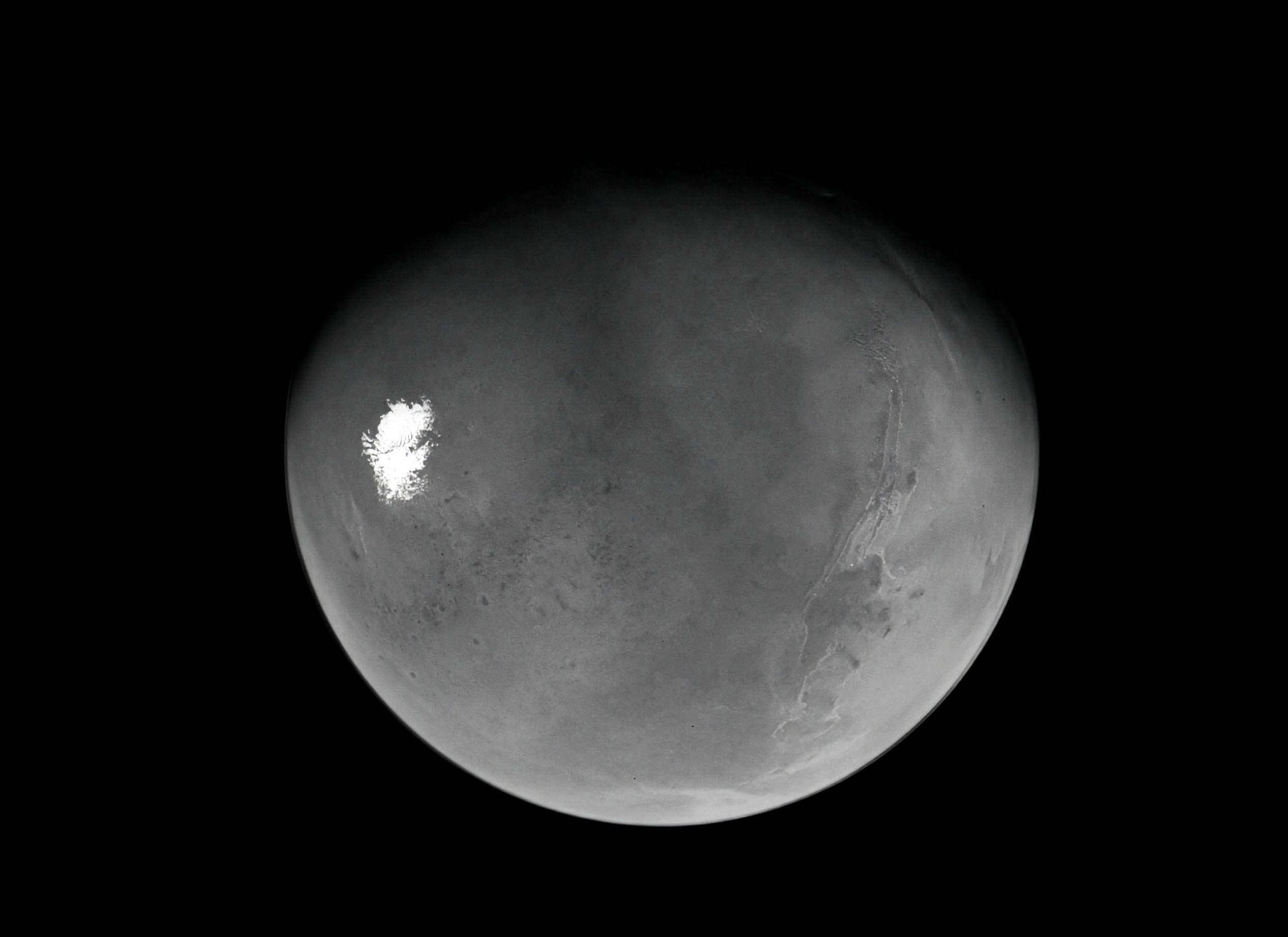
This is the first view of a nearly “full Mars” as seen by NASA’s Psyche spacecraft shortly after its closest approach to the planet on May 15, 2026. The view extends from the south polar cap northwards to the Valles Marineris canyon system and beyond. Credit: NASA/JPL-Caltech/ASU. Click image to enlarge.
Unexpected images from Mars
The images surprised researchers almost immediately. Because Psyche approached Mars from an unusual angle, the planet appeared as a crescent rather than the familiar full disk often seen in space photography.
Sunlight reflecting off dust in the Martian atmosphere extended the illuminated region farther than expected.
During the flyby, the spacecraft rapidly photographed Mars as it crossed from the planet’s nighttime side into daylight.
“We’ve captured thousands of images of the approach to Mars and of the planet’s surface and atmosphere at close approach,” said Jim Bell, the Psyche imager instrument lead at Arizona State University in Tempe.
Bell said the team will continue using Mars for calibration imaging as the spacecraft moves farther away, helping refine image-processing tools for the asteroid Psyche mission.
Several Mars missions also supported the effort during the flyby, including Mars Reconnaissance Orbiter, Mars Odyssey, Curiosity, ESA’s Mars Express, and ExoMars Trace Gas Orbiter.
Inside a mysterious metal world
Psyche is heading toward one of the strangest objects scientists have ever found in the solar system.
The asteroid stretches about 173 miles (278 kilometers) across and appears to contain unusually large amounts of metal. Researchers think it could be the leftover core of an early planet that never fully formed billions of years ago.
If that idea proves correct, the asteroid could offer scientists a rare chance to study the interior of a rocky world like Earth without drilling through thousands of miles of rock.
Most asteroids are made primarily of rock or ice. Psyche stands out because radar observations suggest a much higher metal content, and some researchers propose it contains iron and nickel similar to the materials found in Earth’s core.
That possibility has made the mission one of NASA’s most anticipated planetary science projects.
Valuable science along the way
Although Mars served mainly as a gravity assist and instrument test, the flyby may have already produced valuable scientific results.
Early readings from Psyche’s magnetometers may have detected Mars’ bow shock – the region where solar wind collides with the planet’s magnetic environment.
The spacecraft’s gamma-ray and neutron spectrometer also gathered calibration data during the encounter.
Researchers compared Psyche’s observations with decades of existing Mars measurements to help validate the instrument before the mission reaches asteroid Psyche.
Captured by Psyche’s multispectral imager instrument, this is an enhanced-color view of the large double-ring crater Huygens (upper right; about 290 miles, or 470 kilometers, in diameter) and the surrounding heavily cratered southern highlands. Credit: NASA/JPL-Caltech/ASU. Click image to enlarge.
Psyche heads into deep space
With Mars now fading behind it, Psyche will return to using its solar-electric propulsion system. Instead of traditional chemical rockets, the spacecraft relies on electric thrusters powered by sunlight.
The system produces a gentle but steady push over long periods of time, making it highly efficient for deep-space travel.
The spacecraft is expected to arrive at asteroid Psyche in August 2029.
Once there, it will enter orbit and begin mapping the asteroid in detail. Mission planners intend to move the spacecraft through several orbital paths at varying altitudes. This will allow researchers to study the asteroid’s composition, magnetic properties, and structure.
“We can thank the Red Planet for giving our spacecraft a critical gravitational slingshot farther into the solar system,” said Lindy Elkins-Tanton, principal investigator for Psyche at UC Berkeley. “Onward to the asteroid Psyche!”
—–
Like what you read? Subscribe to our newsletter for engaging articles, exclusive content, and the latest updates.
Check us out on EarthSnap, a free app brought to you by Eric Ralls and Earth.com.
—–