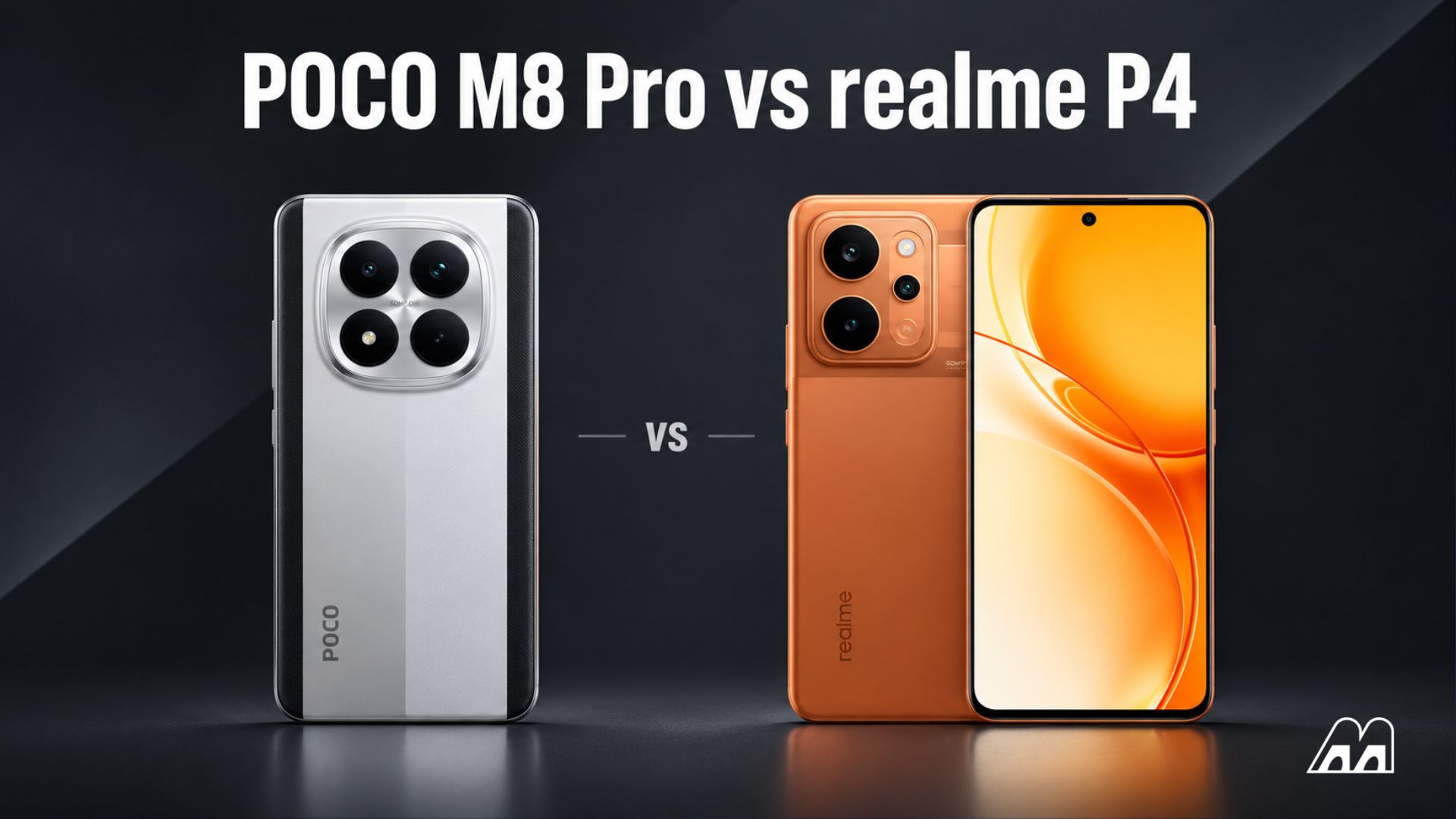
The POCO M8 Pro is the better all-round phone than the global realme P4 unless the realme is substantially cheaper or its flat display is essential to you.
FAQsIs POCO M8 Pro faster than realme P4?
The POCO M8 Pro uses Snapdragon 7s Gen 4 and UFS 2.2 storage, while the global realme P4 uses Snapdragon 685 and eMMC 5.1.
The global realme P4 described here is a 4G model, and realme’s specification sheet lists eSIM as unsupported.
Yes, Xiaomi lists 4K rear video at 30fps; the global realme P4 lists rear recording at up to 1080p/30fps.
The POCO M8 Pro is the better all-round phone than the global realme P4 unless the realme is substantially cheaper or its flat display is essential to you. The P4’s 7,000mAh battery sounds like an easy win over POCO’s 6,500mAh cell, but the two devices make very different compromises in performance, storage, camera hardware and charging. Here’s what you gain or lose with each phone, including the variant mix-up that can make an otherwise sensible comparison misleading.
The realme P4 name hides two very different phones
Best Choice realme 16 Pro 5/5 Overview AMOLED display delivers vibrant colors and smooth scrolling
High-resolution camera captures detailed photos with impressive clarity
Large battery supports extended daily use with fast charging CHECK PRICE See latest price on Amazon
According to Xiaomi’s official POCO M8 Pro specifications, the M8 Pro uses a Snapdragon 7s Gen 4 with 5G and UFS 2.2 storage; realme’s global P4 specification sheet instead lists a Snapdragon 685, 4G and eMMC 5.1. That isn’t a small generational difference, because the processor, storage technology and mobile-network capability all move in POCO’s favour, even though both phones offer an 8GB RAM and 256GB storage configuration.
Feature POCO M8 Pro 5G realme P4, global 4G Processor Snapdragon 7s Gen 4, 4nm Snapdragon 685, 6nm Memory/storage LPDDR4X, UFS 2.2 LPDDR4X, eMMC 5.1 Display 6.83-inch curved AMOLED, 2772 × 1280, 120Hz 6.8-inch flat AMOLED, 2344 × 1080, 120Hz Main camera 50MP, OIS 50MP; OIS not listed Other rear camera 8MP ultrawide Not listed Selfie/video 32MP; rear up to 4K/30fps 8MP; rear up to 1080p/30fps Battery 6,500mAh typical 7,000mAh typical Wired charging Up to 100W Up to 45W Dust/water rating IP66/IP68/IP69/IP69K IP65 Weight 205.9g About 205g
The distinction is easy to miss because realme P4 5G, sold in India, is a separate device with a Dimensity 7400 Ultra chip, UFS 3.1 storage, 144Hz AMOLED screen and 80W charging. Its 7,000mAh battery and 5G connectivity put it in a different competition, so search results or retailer listings that omit the suffix can lead buyers to compare the wrong phone. Any buying decision should begin with the exact model identifier and regional specifications, not a product image or a generic “P4” listing.
POCO’s faster processor is only half the performance story
Best Choice realme GT 8 Pro 4.9/5 Overview 6.79 inches, AMOLED, 1B colors, 1440 x 3136 pixels
Android 16, Qualcomm SM8850-AC Snapdragon 8 Elite Gen 5
50 MP, f/1.8, 22mm (wide), 1/1.56", 1.0µm Check Price
The Snapdragon 7s Gen 4 is built on a newer 4nm manufacturing process than the Snapdragon 685’s 6nm design, but the memory and storage pairing may make the difference more noticeable in daily use. Both devices use LPDDR4X random-access memory (RAM), the short-term memory that keeps apps active, yet POCO’s UFS 2.2 storage differs from realme’s older eMMC 5.1 system, which can become relevant when installing games, copying large videos or loading data-heavy applications. We haven’t run matched app-opening tests, so it would be misleading to give a percentage speed advantage or promise that one phone never stutters.
Realme’s hardware remains adequate for lighter tasks such as calls, maps, messaging and streaming, particularly when those are the only jobs you expect from the phone. More demanding games, video editing and years of accumulated apps make the POCO’s extra performance headroom easier to justify, although sustained performance will also depend on cooling and software. This is the same distinction behind our realme GT 8 Pro vs OnePlus 15 comparison: specifications matter most when they explain a task you actually do.
Network support adds another layer. POCO supports 5G, whereas realme’s global P4 is a 4G model, so the better choice depends partly on the bands and plans available where you live. Neither processor speed nor 5G is worth paying for on principle if you use the device almost entirely on home Wi-Fi, but both make the POCO less restrictive for someone buying one phone to keep for several years.
The P4 wins battery capacity, while POCO wins charging flexibility
Best Overall Poco X8 PRO 4.5/5 Overview Dimensity 8500-Ultra chipset delivers flagship-class performance at 3.4GHz.
6.59-inch 1.5K AMOLED display with 120Hz refresh rate and 3,500-nit peak brightness.
6,500mAh battery pairs with blazing-fast 100W HyperCharge. View deal See latest price on Amazon
Realme’s 7,000mAh rated-typical battery holds 500mAh, or 7.7%, more nominal capacity than the 6,500mAh cell in the POCO M8 Pro. The curious detail is that the phones weigh almost the same, at about 205g, so realme has fitted that extra capacity without a published weight penalty. Yet a battery-capacity calculation is not an endurance test: display brightness, chipset efficiency, reception and camera use could change the result enough that the stated 7.7% never appears as an equivalent gain in screen-on time.
Charging makes the opposite argument. POCO supports up to 100W wired charging and 22.5W reverse wired charging, while realme lists 45W maximum fast charging and includes a charger in its global box contents, subject to market variation. Xiaomi claims the M8 Pro can reach a full charge in roughly 40 minutes when its fastest mode is enabled under laboratory conditions, although you should not treat that as our measured result or assume the same charger comes with every regional package.
If you charge overnight and want the biggest battery for calls or videos, the P4 has a straightforward selling point. If you’re often left with ten minutes beside a wall socket before going out, POCO’s higher charging ceiling may be more useful. That choice echoes the battery-versus-convenience trade-off in our POCO F9 Ultra vs POCO F9 Pro analysis, where a larger battery is only part of the ownership equation.
Camera, screen and durability reveal where each brand spent its budget
Best Overall Poco F8 Ultra 5G 5/5 Overview AMOLED display delivers vibrant colors and smooth 120Hz visuals
Snapdragon flagship chipset powers demanding games and multitasking
Advanced triple cameras capture detailed photos with versatile zoom CHECK PRICE See latest price on Amazon
The POCO M8 Pro pairs a 50MP Light Fusion 800 main sensor with optical image stabilisation (OIS), a mechanism that compensates for some camera shake, and it adds an 8MP ultrawide lens. Realme also lists a 50MP main camera, but its global specification sheet does not identify OIS or an ultrawide, while the video limit is 1080p at 30 frames per second rather than POCO’s 4K at 30fps. An ultrawide is useful when you cannot step backwards to photograph a group or building, while 4K gives you more resolution for editing and cropping footage later; neither point proves POCO automatically has more attractive colour processing or better low-light photographs.
POCO also provides a 32MP selfie camera compared with realme’s 8MP, although resolution by itself cannot predict skin tones or exposure. The more overlooked usability difference may be the display shape: POCO uses a curved 6.83-inch AMOLED panel with 2772 × 1280 pixels, while realme’s 6.8-inch 2344 × 1080 AMOLED screen is flat. A flat screen can simplify protector installation and edge handling, which was a real concern in the supplied POCO owner discussion, even if POCO’s sharper panel looks more impressive on the specification sheet.
For resistance to dust and water, realme advertises IP65, while POCO lists IP66, IP68, IP69 and IP69K under specified laboratory tests. These ingress-protection (IP) ratings cover different exposures, including dust, water jets and immersion; they do not make either phone suitable for swimming, nor do they replace warranty terms. Xiaomi’s published M8 Pro conditions are particularly detailed about fresh-water immersion and high-temperature jets, so the extra certifications count as evidence of broader tested conditions, not a promise against liquid damage in daily life.
A newer POCO X8 complicates the value argument
The POCO X8 is worth checking before treating either phone as the obvious budget winner, particularly in Malaysia, where Xiaomi’s own product catalogue displayed the M8 Pro from RM1,159 and the X8 from RM1,299 on November 7. That’s a RM140 difference, or about 12.1% of the M8 Pro’s listed price, although the listings may represent different promotions or entry configurations and need checking at checkout. Unlike the realme P4 comparison, these are prices from the same manufacturer and market, which makes the gap useful as a shopping reference rather than a universal global verdict.
The POCO X8 has an 8,340mAh battery, 67W charging and an AMOLED display, but it moves to Snapdragon 6s Gen 4 and its main camera specifications are less ambitious than the M8 Pro’s. Buyers can therefore choose a larger battery within POCO’s own range instead of accepting realme’s 4G connectivity and eMMC storage. The alternative is not necessarily faster, and the X8’s roughly 223g weight means its larger battery brings additional bulk. Our POCO X8s vs Galaxy S23 Ultra comparison offers another example of why “newer” and “bigger battery” are not complete purchasing arguments.
We would pay a modest premium for the M8 Pro’s broader abilities
Best Choice XIAOMI Poco X8 PRO MAX 4.4/5 Overview 6.83" 1.5K 120Hz ultra-bright AMOLED
MediaTek Dimensity 9500s3nm
50MP main cameraLight Fusion 600 Check Price
Memeburn’s reading of the POCO M8 Pro and realme P4 is that POCO deserves a premium of roughly 20–25% over the realme for a buyer who plans to keep the phone for several years, rather than being judged solely by the gap between their battery capacities. The reason is cumulative: its newer Snapdragon platform, UFS storage, 5G, stabilised main camera, ultrawide, 4K video and faster charging improve several different activities, while realme’s headline advantage is a nominal 7.7% extra battery capacity plus a flat display. The 20–25% threshold is our buying rule, not a tested performance uplift or a verified local price difference.
We would reverse that recommendation for someone who mainly wants a flat screen and longer periods between overnight charges, especially if realme is significantly cheaper in the same country with a comparable warranty. Equally, independent endurance testing showing a dramatic P4 lead could change how much we value its extra capacity. A proper price verdict remains conditional because we could verify a Malaysian POCO listing but not a directly comparable official global realme P4 selling price for the same market.
Which phone should you buy?
Choose POCO M8 Pro 5G if you play demanding games, record video, want an ultrawide camera, use 5G or regularly rely on short charging sessions. Choose realme P4 4G if a flat display, basic workloads and the largest rated battery matter more, provided its local price is low enough to compensate for the older processor and storage. If battery life is your entire priority, also look at the POCO X8 at a verified same-market price before deciding, since its 8,340mAh capacity changes the shortlist without requiring a switch to 4G.
FAQs
Is POCO M8 Pro faster than realme P4?
The POCO M8 Pro uses Snapdragon 7s Gen 4 and UFS 2.2 storage, while the global realme P4 uses Snapdragon 685 and eMMC 5.1. That favours POCO for demanding tasks, but no matched benchmark result is claimed here.
Does the realme P4 have better battery life?
The global P4 has a 7,000mAh battery versus 6,500mAh on POCO, giving it 7.7% more rated-typical capacity. Actual runtime needs comparable testing.
Does realme P4 support 5G or eSIM?
The global realme P4 described here is a 4G model, and realme’s specification sheet lists eSIM as unsupported. The separately named Indian P4 5G is a different device.
Can POCO M8 Pro record 4K video?
Yes, Xiaomi lists 4K rear video at 30fps; the global realme P4 lists rear recording at up to 1080p/30fps.