Photophysical properties are provided for peptide 6a and were determined in EtOH solution.
3: Structural characterization of the photocatalytic peptide 6a and its complex with rac-5a by NMR spectroscopy and molecular dynamics simulations.
Full size image a, Rotating-frame nuclear Overhauser effect (ROE)-derived distance restraints for peptide 6a.
In a final synthetic study, we explored the potential of peptidic catalyst 6a in enantioselective photocycloaddition reactions.
5: Enantioselective intramolecular [2 + 2] photocycloaddition reactions promoted by catalyst 6a.
Catalyst discovery and optimization
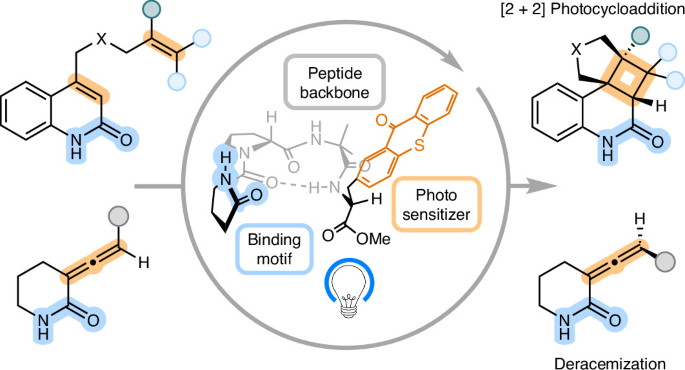
Our design concept focused on the idea of placing an amino acid with an appropriate motif for substrate recognition on the N-terminal position of a given peptide (Fig. 1d). At the C-terminal position, a thioxanthone was to be responsible for harvesting visible-light photons and for an energy transfer to the substrate. The connecting peptide backbone could be chosen freely and offered an option for optimizing the enantioselectivity. For the present proof-of-concept study, we targeted lactams as possible substrates, which is why a pyroglutamic acid (Pga) was chosen as the N-terminal amino acid. Preliminary experiments were inspired by the work of Wennemers and co-workers on catalytic tripeptides31 and of the Miller group on catalytic tetrapeptides32. The photochemical deracemization of allene rac-5a33 was chosen as the test reaction. The success of a deracemization34 depends on a differentiation between the two substrate enantiomers 5a and ent-5a. Only if the sensitizing entity, here the C-terminal thioxanthone, gets into close contact with the substrate is energy transfer possible and an achiral intermediate forms, which reforms either one of the enantiomers 5a or ent-5a. If one of the enantiomers is preferably processed, the other enantiomer is enriched in the photostationary state. The reaction, thus, serves as a useful probe to interrogate the distance between the C-terminal chromophore and the N-terminally bound substrate. In random screening experiments, it was found that a two amino acid β-turn-inducing motif (vide infra) consisting of proline (Pro) and achiral aminoisobutyric acid (Aib), as previously utilized by Miller25,32, is sufficient to deliver a catalyst that displays a notable enantioselectivity. The C-terminal carboxylic acid 9-oxothioxanthen-2-yl-substituted alanine (pTxa) was prepared from (S)-serine and was used consistently with this configuration35. With three stereogenic centres present, there are four diastereoisomers of tetrapeptide 6, all of which were prepared and evaluated in the deracemization reaction (Fig. 2).
Fig. 2: Deracemization of chiral allene rac-5a by a small peptide photocatalyst upon irradiation with visible light. Full size image Preliminary screening results were performed on a 30-μmol scale. The enantiomeric ratio (e.r.) was determined by chiral high-performance liquid chromatography (HPLC) analysis. Photophysical properties are provided for peptide 6a and were determined in EtOH solution. From the inflection point (indicated by the dashed blue line) of the phosphorescence spectrum (77 K, EtOH) the triplet energy was calculated as 269 kJ mol−1. Solid line (—), UV/Vis spectrum; dashed line (----), luminescence spectrum; dotted line (····), phosphorescence spectrum (77 K); c, concentration; t, time; T, temperature. Source data
The reactions were performed with dichloromethane as the solvent, with light sources emitting at a maximum of λ = 420 nm (fluorescent lamps), λ = 415 nm (light-emitting diode (LED)) or λ = 425 nm (LED). At ambient temperature, peptide 6a provided almost no preference towards one enantiomer and the enantiomeric ratio (e.r.) in favour of enantiomer 5a was low (Fig. 2, entry 1). However, upon decreasing the temperature, the e.r. continuously increased (entries 2–4), reaching a value of 94.5:5.5 at temperature T = −70 °C. An increase in catalyst loading was not beneficial to the enantioselectivity (entry 5). Under the conditions of entry 4, other solvents were screened (see Supplementary Table 2 for full details on the optimization studies), but they turned out to be inferior to dichloromethane. Employing an LED in a different set-up allowed us to irradiate a more concentrated solution and resulted in a lower e.r. at λ = 415 nm (entry 6) and an improvement of the e.r. (entry 7) at λ = 425 nm. Under the latter conditions, we checked whether a lower catalyst loading (entry 8) or a change of the irradiation time (entries 9 and 10) led to a better e.r., which turned out not to be the case. Under the conditions of entry 7, a preparative run delivered allene 5a in quantitative yield (>99%) with an e.r. of 96:4. Remarkably, all other diastereoisomers of peptide 6 performed poorly in the deracemization reaction (entries 11–13), underscoring the relevance of the peptide backbone for the enantioselectivity. The prominent photophysical characteristics of catalyst 6a (absorption and luminescence) are due to the thioxanthone embedded in pTxa and are comparable to parent 9H-thioxanthen-9-one36. The longest wavelength absorption was found at λ = 383 nm (molar decadic absorption coefficient ε = 5,700 M−1 cm−1) and the triplet energy was determined as E T = 269 kJ mol−1.
NMR spectroscopy studies and molecular dynamics simulations
The remarkable success of peptide diastereoisomer 6a prompted a more detailed investigation of its conformation and its binding to the allene enantiomers 5a and ent-5a (Fig. 3). Thus, we conducted a set of nuclear magnetic resonance (NMR) spectroscopy experiments at 233 K for resonance assignment and the extraction of distance information resulting in the collection of 33 distance restraints for the peptide 6a (Fig. 3a and Supplementary Table 1). These restraints were used for structure calculation yielding a well-defined structural ensemble with a root mean square deviation (r.m.s.d.) for heavy atoms of 0.22 Å (Fig. 3b). The tetrapeptide adopts a type II’ β-turn conformation32,37, a structural motif that has been previously observed in cyclic peptides following a (R)-proline residue38 and also in acyclic peptides with an (R)-Pro-Aib substructure32,39. In this βII’ turn the existence of a hydrogen bond between the amide proton of pTxa and the backbone carbonyl of Pga is evident from specific rotating-frame nuclear Overhauser effect restraints (Fig. 3a) between the two residues and a temperature coefficient40 of −4.7 ppb K−1 for the amide of pTxa (Supplementary Fig. 8). The photoactive thioxanthone ring is located above the β-turn structure in a tilted orientation.
Fig. 3: Structural characterization of the photocatalytic peptide 6a and its complex with rac-5a by NMR spectroscopy and molecular dynamics simulations. Full size image a, Rotating-frame nuclear Overhauser effect (ROE)-derived distance restraints for peptide 6a. b, Structural bundle of 6a with a heavy atom r.m.s.d. of 0.22 Å indicating a βII’-turn conformation. c, Two-dimensional-NMR spectroscopy titration experiments with 6a and ent-5a or 5a indicating binding between the lactam moieties of both components, with stronger effects observed for ent-5a. d, Structure of complex 6a·ent-5a reveals a binding mode that provides proximity (approximately 4 Å) between the allene and the photoactive thioxanthone ring. e, Distance versus simulation time for compound ent-5a in complex with tetrapeptide 6a (black curve); the allene enantiomer 5a in complex with 6a (red curve); and ent-5a in complex with 6b (blue curve), 6c (orange curve) and 6d (green curve). f, Snapshot of a nearly dissociated state with an allene–thioxanthone distance of approximately 12 Å for complex 6b·ent-5a. g, Typical arrangement of ent-5a stacking on the thioxanthone ring of 6a observed as dominant state during the simulation of the 6a·ent-5a complex (allene–thioxanthone distance of approximately 4 Å). Source data
The addition of the substrate ent-5a selectively induced strong amide chemical shift perturbations within the pyroglutamate ring of 6a (Fig. 3c). The binding site in ent-5a for 6a was identified by the strong NMR spectroscopy chemical shift perturbation of its lactam HN moiety in the complex (Fig. 3c). Furthermore, we observed nuclear Overhauser effect contacts between the HN atoms of both components (Supplementary Fig. 9 and Supplementary Table 1). This information was used for a structure calculation of the complex resulting in a structural bundle with a heavy atom r.m.s.d. of 1.14 Å (Fig. 3d). In this structure, ent-5a binds to the lactam ring of Pga in 6a via two hydrogen bonds, placing the substituents of the allene in a sterically favourable orientation with the tert-butyl moiety facing away from the thioxanthone ring, enabling proximity (approximately 4 Å) of the allene and the aromatic ring system of the peptide photocatalyst. In contrast, enantiomer 5a induced lower chemical shift perturbations than ent-5a, indicating weaker binding (Fig. 3c). Multiple molecular dynamics simulations were started from the NMR spectroscopy-derived structure of complex 6a·ent-5a (Fig. 3e). In most simulations, the geometry stayed close to the NMR spectroscopy structure during the 20 ns simulation time, with a distance of approximately 4 Å between the central carbon atom of the allene and the thioxanthone ring in the peptide (Fig. 3d,g). The short allene–thioxanthone ring distance represents approximately the sum of the van der Waals radii, allowing efficient energy transfer41 and photocatalysis. In addition to simulations on complex 6a·ent-5a, molecular dynamics simulations were also performed with complex 6a·5a. The starting structures were otherwise kept as close as possible to the NMR spectroscopy-based structure 6a·ent-5a to allow for a close initial contact between allene and the thioxanthone ring (Fig. 3e). However, in this case, even in the starting structure, the smallest distance that was sterically possible without disrupting the hydrogen bonds between peptide and substrate was larger than 5 Å. In all simulations the contact was lost rapidly and the substrate 5a frequently dissociated within a few nanoseconds (Fig. 3e; for results of additional simulations, see also Supplementary Fig. 10). In all simulations for peptides 6b–6d with altered chirality at the Pga ring or the Pro residue, a close allene–thioxanthone distance was sterically not possible in the starting structure (without disruption of hydrogen bonds) and/or a rapid rearrangement and dissociation occurred within a few nanoseconds simulation time (Fig. 3e,f and Supplementary Fig. 10). The simulations demonstrate that a close distance between the allene group and thioxanthone only appears sterically possible and stable for complex 6a·ent-5a (Fig. 3g). In all other cases, a close contact geometry and simultaneous stabilization by hydrogen bonding between allene and tetrapeptide are sterically not possible, resulting in rapid dissociation.
Applications in deracemization and [2 + 2] photocycloaddition
The NMR spectroscopy and molecular dynamics studies support the idea that peptide 6a is suitable for use in differentiating between allene isomers 5a and ent-5a. Upon excitation of the thioxanthone within pTxa, energy transfer occurs mainly to enantiomer ent-5a, which undergoes racemization via an achiral intermediate. As binding of enantiomer 5a to catalyst 6a is strongly attenuated and kinetically unstable, it is not processed, or is only slowly processed, and prevails in the photostationary state. Related deracemization reactions were attempted with other allenes rac-5 (Fig. 4), and it was found that the enantioselectivity remains high (products 5b and 5g–5m) with tertiary substituents at the terminal allene carbon atom. Once the size of the substituent was decreased, the enantioselectivity also decreased and the e.r. went down to 90:10 for secondary and primary substituents (products 5c–5e) and to 83:17 for the methyl-substituted allene 5f. In these cases, it turned out to be beneficial to use the difluoro analogue 7a of tetrapeptide 6a as the catalyst. Our rationale for the introduction of the fluorine atoms was to increase the strength of the hydrogen bonding event and, thus, to improve the differentiation between the allene enantiomers. By doing so, products 5c–5e were accessible in an e.r. of 94:6 or higher, and even the methyl-substitute allene 5f displayed an e.r. of 91:9. The aryl-substituted allenes 5g–5m reacted smoothly (82% to quantitative yield) and with high enantioselectivity (95:5 to 98:2 e.r.) in the presence of tetrapeptide 6a. Functional group tolerance was established for halogen (5j and 5k), trifluoromethyl (5l) and methoxy (5m) substituents. The results align with previous work11,36 that has established the remarkable compatibility of the thioxanthone chromophore with a variety of substituents in photochemical reactions. Catalyst recovery is possible and was performed in a 0.24-mmol experiment, in which product 5a was obtained in quantitative yield (96:4 e.r.). After column chromatography, 70% of catalyst 6a was re-isolated.
Fig. 4: Deracemization of chiral allenes rac-5 and chiral olefins rac-8 catalysed by peptidic catalysts. Full size image Substrates were irradiated at −70 °C in the presence of peptide catalysts 6a or 7 for the indicated time period and at the indicated wavelength in dichloromethane solution (c = 10 mM, 30-μmol scale). Enantiomeric ratios were determined by chiral HPLC analysis. Yields refer to isolated product. aλ = 425 nm. quant., quantitative yield.
Tetrasubstituted alkylidenecycloalkanes rac-8 represent another class of chiral compounds that have been shown to be of high relevance42,43, and that can be deracemized photochemically44,45. Here energy transfer to the olefin leads to a rotation around the former double bond and the triplet ππ* state is achiral. Upon returning to the ground state hypersurface, the double bond is restored, leading to a racemization. Like for allenes rac-5, the key challenge is the distinction between the two substrate enantiomers 8 and ent-8. For the olefin deracemization, peptide catalyst 7 turned out to be consistently superior to catalyst 6a, and their facile synthesis is testimony to the benefit of a modular design. The enantioselectivities for cyclopentane 8a and cyclobutane 8b were high, and even for the 4-monosubstituted cyclohexanes 8c and 8d, a notable enantioselectivity was recorded.
In a final synthetic study, we explored the potential of peptidic catalyst 6a in enantioselective photocycloaddition reactions. Specifically, the intramolecular [2 + 2] photocycloaddition of quinolones 9 was chosen, which had been previously studied both with a molecular thioxanthone catalyst46 and with photoenzymes19,22. Gratifyingly, we found the peptidic catalyst to be equally efficient in the conversion 9 → 10, which proceeded in high yields (77% to quantitative yield) and enantioselectivities ranging from 89:11 to 99:1 e.r. (Fig. 5).
Fig. 5: Enantioselective intramolecular [2 + 2] photocycloaddition reactions promoted by catalyst 6a. Full size image The substrates were irradiated for 6 hours at a wavelength of λ = 425 nm and at a temperature of −70 °C in dichloromethane solution (c = 5 mM, 30-μmol scale). Enantiomeric ratios were determined by chiral HPLC analysis and diastereomeric ratios (d.r.) by 1H-NMR spectroscopy integration. Yields refer to isolated product. A hydrogen-bonded complex of the substrate 9 to the catalyst is postulated in which energy transfer is possible and in which the approach of the olefin can occur only from one face relative to carbon atom C4.
The reaction was not stereospecific and products 10c were obtained with a diastereomeric ratio of 76:24. This outcome is in line with the postulated triplet pathway along which the reaction progresses. In fact, we suppose that in analogy to alkene ent-5a, the substrate 9 of the reaction binds to the N-terminal amino acid Pga by two-point hydrogen bonding. Upon excitation, the thioxanthone at the C-terminal amino acid is ideally positioned to promote the quinolone into its triplet state by energy transfer. In addition, it shields one of the two enantiotopic faces of the quinolone, and intermolecular attack of the olefin occurs with high enantioselectivity at carbon atom C4. The ensuing triplet 1,4-diradical allows for rotation around the C–C bond, which explains the observed non-stereospecific reaction course. After intersystem crossing, ring closure occurs, yielding the desired cyclobutane products. As the quinolones do not absorb at λ = 425 nm, there is no racemic background reaction.