Samsung got an early lead this year with the Galaxy Z Fold8, which went on sale globally Aug. 7.
The Chinese smartphone maker debuted the Xiaomi 18 Fold, its first passport-style foldable, in China on Sept. 7.
New Apple CEO John Ternus holds the new iPhone Duo foldable during an event at the Steve Jobs Theater in Cupertino, California, on Sept. 9.
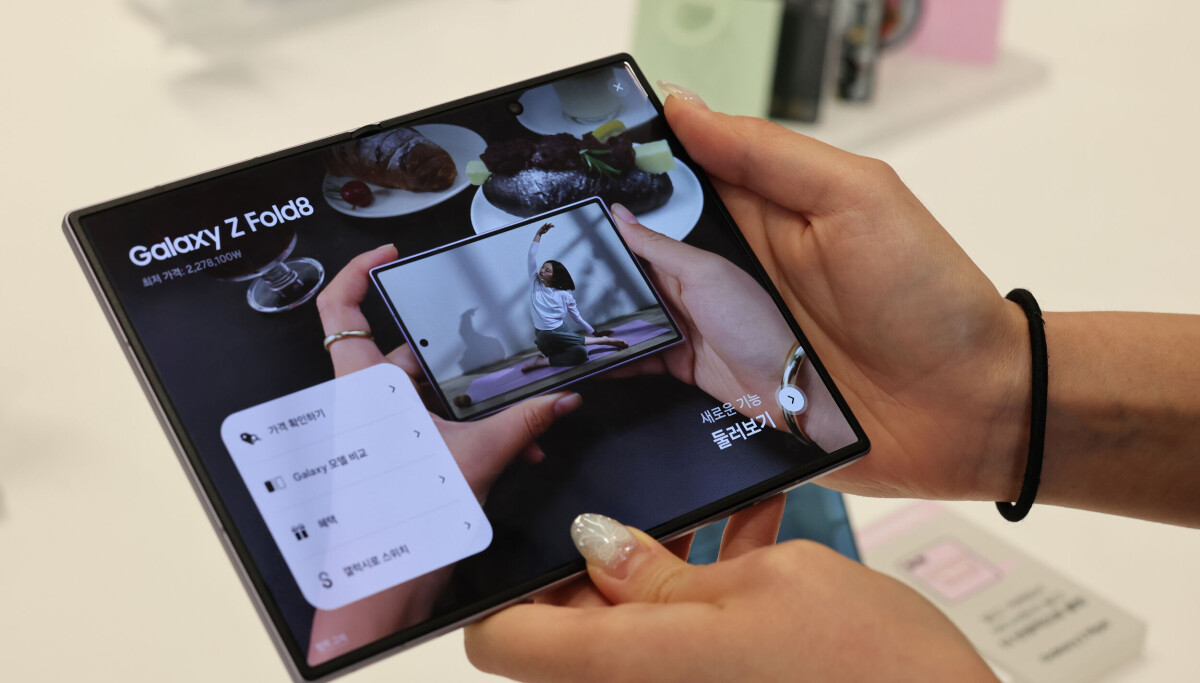
Samsung gives the Galaxy Z Fold8 a 4:3 display to make better use of the screen when watching videos.
A customer tries out Xiaomi's new foldable smartphone, the Xiaomi 18 Fold, at a Xiaomi store, in Beijing on Sept.11.
An early lead for the Korean phone maker will be challenged by boosted specs and details in a bid to woo customers.
Samsung Electronics got a head start in passport-sized foldables, but the arrival of Apple and Xiaomi is turning the form factor market into a three-country showdown between Korea, the United States and China.
Samsung got an early lead this year with the Galaxy Z Fold8, which went on sale globally Aug. 7. It has topped 5 million units in preorders.
Apple unveiled its first foldable phone, the iPhone Duo, on Sept. 9. It will go on sale Oct. 23 in about 70 markets, including Korea, the United States, Britain, France, China and Japan, before reaching roughly 100 countries.
The Chinese smartphone maker debuted the Xiaomi 18 Fold, its first passport-style foldable, in China on Sept. 7. It plans to expand sales overseas by the end of the year.
Samsung has the edge on portability. The Galaxy Z Fold8 weighs 201 grams (7 ounces), compared with 219 grams for the Xiaomi 18 Fold and 254 grams for the iPhone Duo.
The Galaxy Z Fold8 is also the thinnest when opened, at 4.5 millimeters (0.18 inches). The Xiaomi 18 Fold measures 5.02 millimeters and the iPhone Duo 5.2 millimeters.
Xiaomi is betting on battery life. Its 18 Fold packs a 6,000-milliampere-hour battery, well above the Galaxy Z Fold8’s 4,800 milliampere-hours. The iPhone Duo sits between them at 5,400 milliampere-hours. Apple says the phone can last up to 24 hours on a single charge when its two screens are used evenly.
The companies have also split on processors, the brains of their smartphones. Samsung uses the Qualcomm Snapdragon 8 Elite Gen 5. Apple powers the iPhone Duo with its A20 Pro, while Xiaomi uses its Xring O3 in the 18 Fold.
New Apple CEO John Ternus holds the new iPhone Duo foldable during an event at the Steve Jobs Theater in Cupertino, California, on Sept. 9. REUTERS/YONHAP
Apple leads on dust and water resistance. The iPhone Duo is rated IP68, versus IP58 for the Xiaomi 18 Fold and IP48 for the Galaxy Z Fold8. The first digit indicates dust resistance, and the second indicates water resistance, with a higher number indicating greater protection.
Xiaomi has gone furthest on camera specs. The 18 Fold features a 200-megapixel main camera developed with Leica and a periscope telephoto lens. The Galaxy Z Fold8 has a 50-megapixel main camera, while the iPhone Duo has 48-megapixel main and ultrawide cameras. Both Samsung and Apple support 2-times optical-quality zoom through their main cameras.
The three phones are playing to different strengths to woo customers. Samsung gives the Galaxy Z Fold8 a 4:3 display to make better use of the screen when watching videos. Apple’s Split View lets users place two apps side by side on the iPhone Duo’s foldable display. Xiaomi takes a different route with a ceramic finish on the 18 Fold.
A customer tries out Xiaomi's new foldable smartphone, the Xiaomi 18 Fold, at a Xiaomi store, in Beijing on Sept.11. REUTERS/YONHAP
Apple is also asking buyers to pay the most. The 256GB iPhone Duo costs 3.29 million won in Korea ($2,420), roughly 1.01 million won more than the Galaxy Z Fold8 at 2.27 million won. Xiaomi’s 18 Fold is the least expensive at 10,999 yuan ($1,640) in China.
The industry hopes the growing popularity of passport-style devices can push foldables beyond their niche following and into the mainstream.
That remains a tall order. Market researcher Omdia expects foldable-phone shipments to reach 45 million units by 2030, but still account for less than 3 percent of overall smartphone shipments.
“Foldable phones cost more upfront and can be expensive to repair, particularly when problems develop around the hinge,” an information technology industry source said. “The key will be whether they offer enough value to make the added expense worthwhile.”
BY KIM KYUNG-MI [[email protected]]