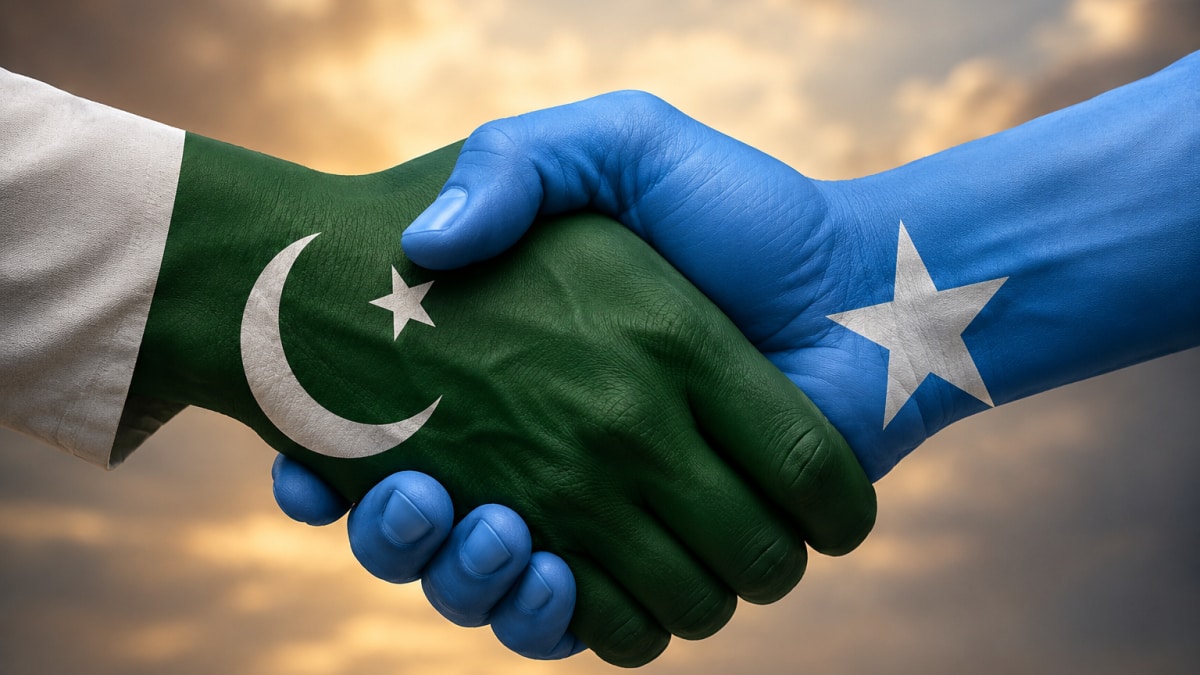
Pakistan’s dilemma is that its strategic value to Saudi Arabia increases if it becomes useful beyond South Asia.
Nevertheless, the possibility illustrates the larger logic: Pakistan can offer Somalia military capabilities while simultaneously strengthening its own strategic relevance to Saudi Arabia.
Somalia consequently provides Pakistan with a geographical bridge between its Arabian Sea interests and the wider Red Sea security environment.
Is Pak gaining strategic influence, or risking strategic dependencyPakistan’s dilemma is that its strategic value to Saudi Arabia increases if it becomes useful beyond South Asia.
For Saudi Arabia, Pakistan adds military weight to an emerging security network.
Pakistan’s dilemma is that its strategic value to Saudi Arabia increases if it becomes useful beyond South Asia. But the more deeply it enters the rivalries of the Red Sea and Horn of Africa, the greater the risk that it becomes entangled in conflicts that are not its own
Pakistan’s decision to deepen defence cooperation with Somalia may look like a modest military-training arrangement. But it is potentially much more consequential. Signed in Islamabad on August 4, the bilateral defence cooperation agreement covers counter-terrorism, military training, exchanges and capability building. Three days after forging this pact, the country signed the Mecca Joint Defence Agreement with Saudi Arabia and Turkey, establishing a new framework for collective security.
The timing is striking. Pakistan is not traditionally a major security actor in the Horn of Africa. Yet Somalia sits at the intersection of the Gulf, Red Sea, and western Indian Ocean, precisely the space where Saudi Arabia and Turkey are expanding their strategic footprints and where their interests increasingly compete with those of the UAE.
Advertisement
For Pakistan, therefore, Somalia may be less about Somalia itself than about where Islamabad wants to position itself in the emerging security architecture of the western Indian Ocean and Red Sea.
Why is Pakistan suddenly looking towards the Horn of Africa?
Pakistan is not a newcomer to Somalia. Its military played a significant role in the UN operation in the East African nation in the early 1990s. Pakistani troops were among the last international contingents to leave Mogadishu in 1995. But that history should not be overstated.
Pakistan was not among the principal African troop contributors to AMISOM (African Union Mission in Somalia) or ATMIS (African Union Transition Mission in Somalia) and has not been a major financier of the African Union’s subsequent security efforts against Al-Shabaab, an Al-Qaeda-affiliated militant group. The heavy fighting over the past two decades was borne primarily by African states such as Uganda, Burundi, Kenya, Ethiopia, and Djibouti.
Pakistani UN peacekeepers from the Tirwanja special forces unload their weapons inside the Pakistani headquarters in central Mogadishu after a patrol on November 20 1994. The Pakistani military played a significant role in the UN operation in the East African nation. File photo/Reuters
What does Pakistan bring to Somalia’s security table?
Pakistan’s present offer brings an experienced military establishment, with counter-insurgency experience, professional military training and a defence industry capable of supplying relatively affordable equipment. For a Somali military still being rebuilt, these are attractive assets.
Advertisement
There are also reports of Somali interest in Pakistani JF-17 fighter aircraft, reportedly with Saudi and Turkish support. Such information should be treated cautiously until an actual contract emerges. Nevertheless, the possibility illustrates the larger logic: Pakistan can offer Somalia military capabilities while simultaneously strengthening its own strategic relevance to Saudi Arabia.
Why is Saudi Arabia central to Pakistan’s Somalia gambit?
This is where the Saudi connection becomes decisive.
Somalia concluded a military-cooperation agreement with Saudi Arabia earlier this year. Riyadh has deepened its engagement with Sudan and is seeking a greater role in the politics and security of the Red Sea. Saudi Arabia’s concern is not simply terrorism. It is the security of the Red Sea, the Bab el-Mandeb and the maritime approaches to the Arabian Peninsula, and the need to restrain the expansion of UAE influence. Pakistan fits naturally into this effort.
The Mecca agreement with Turkey and Pakistan provides Riyadh with two different but complementary partners. Turkey brings a rapidly expanding defence industry, drones, naval capabilities, and a growing strategic presence in Africa. Pakistan brings a large standing military, operational experience, manpower, training capabilities and an established defence-production relationship with Saudi Arabia.
Advertisement
For Islamabad, this is an opportunity to convert its longstanding defence relationship with Saudi Arabia into wider geopolitical relevance.
Pakistan has traditionally depended on Saudi economic and political support. The relationship has evolved. Riyadh increasingly expects partners to contribute to regional security rather than simply receive assistance. Pakistan can now demonstrate such utility. Its military expertise can be deployed through training, capacity building and potentially equipment sales without requiring a large Pakistani combat deployment.
That distinction is important. Pakistan is unlikely to send substantial forces to Somalia to fight Al-Shabaab. It has neither the strategic requirement nor the resources for another major overseas military commitment. What it can provide is a security multiplier: officers, trainers, doctrine, equipment and perhaps air and naval capabilities.
There is also a maritime rationale. Pakistan already participates in the Combined Maritime Forces, including counter-piracy and maritime-security operations in the Arabian Sea and adjacent waters. Its naval interests naturally extend towards the Gulf of Aden. Somalia consequently provides Pakistan with a geographical bridge between its Arabian Sea interests and the wider Red Sea security environment.
Pakistan's Prime Minister Shehbaz Sharif shakes hands with Saudi Crown Prince Mohammed bin Salman upon his arrival in Mecca, Saudi Arabia, August 7. For Pakistan, the Mecca Agreement is an opportunity to convert its longstanding defence relationship with Saudi Arabia into wider geopolitical relevance. Reuters
Could Pakistan’s Horn of Africa push lead to strategic overreach?
Pakistan must tread carefully. Its involvement in Somalia risks being interpreted as an extension of Saudi-Turkish competition rather than an independent Pakistani initiative. The Horn is already crowded with external actors: Saudi Arabia, the UAE, Turkey, Qatar, Egypt, the United States, China and others, each pursuing overlapping but competing interests. Somalia itself is seeking to diversify its partnerships, partly to avoid excessive dependence on any one external power.
For Pakistan, the principal danger is strategic overextension. Becoming a visible military partner in Somalia could create expectations that Islamabad will eventually play roles in Sudan, Libya or elsewhere in the Arab-African strategic space. Pakistan has neither the financial capacity nor the geopolitical freedom to become Saudi Arabia’s military instrument across every theatre.
A member of Somali government forces walks while working to secure the area where al Shabaab militants stormed a high-security underground prison in Mogadishu, Somalia, October 5, 2025. Pakistan is unlikely to send substantial forces to Somalia to fight Al-Shabaab. File photo/Reuters
There is, however, a significant opportunity. Pakistan has often struggled to translate its military relationship with Saudi Arabia into broader economic and geopolitical influence. The Horn of Africa gives it precisely such an opening. Somalia offers a relatively low-cost entry point into a strategically important region, while its partnership with Turkey gives Pakistan access to a technologically capable defence partner.
The question is therefore not whether Pakistan will “fight” Al-Shabaab. It is whether Islamabad is beginning to use defence diplomacy as an instrument of wider geopolitical positioning.
The Somalia agreement suggests that it is.
Is Pak gaining strategic influence, or risking strategic dependency
Pakistan’s dilemma is that its strategic value to Saudi Arabia increases if it becomes useful beyond South Asia. But the more deeply it enters the rivalries of the Red Sea and Horn of Africa, the greater the risk that it becomes entangled in conflicts that are not its own.
For Somalia, Pakistani support can diversify its security partnerships. For Saudi Arabia, Pakistan adds military weight to an emerging security network. For Turkey, it creates another partner in a strategically important theatre. For Pakistan, the prize is larger: a new role linking the Gulf, Red Sea and western Indian Ocean.
The challenge for Islamabad will be to ensure that this becomes strategic influence rather than strategic dependency. Pakistan may enter the Horn as a partner with its own interests, not merely as the sword arm of a Saudi-Turkish security architecture.
The writer is former Ambassador to Ethiopia, Djibouti and the African Union. Views expressed in the above piece are personal and solely those of the author. They do not necessarily reflect Firstpost’s views.