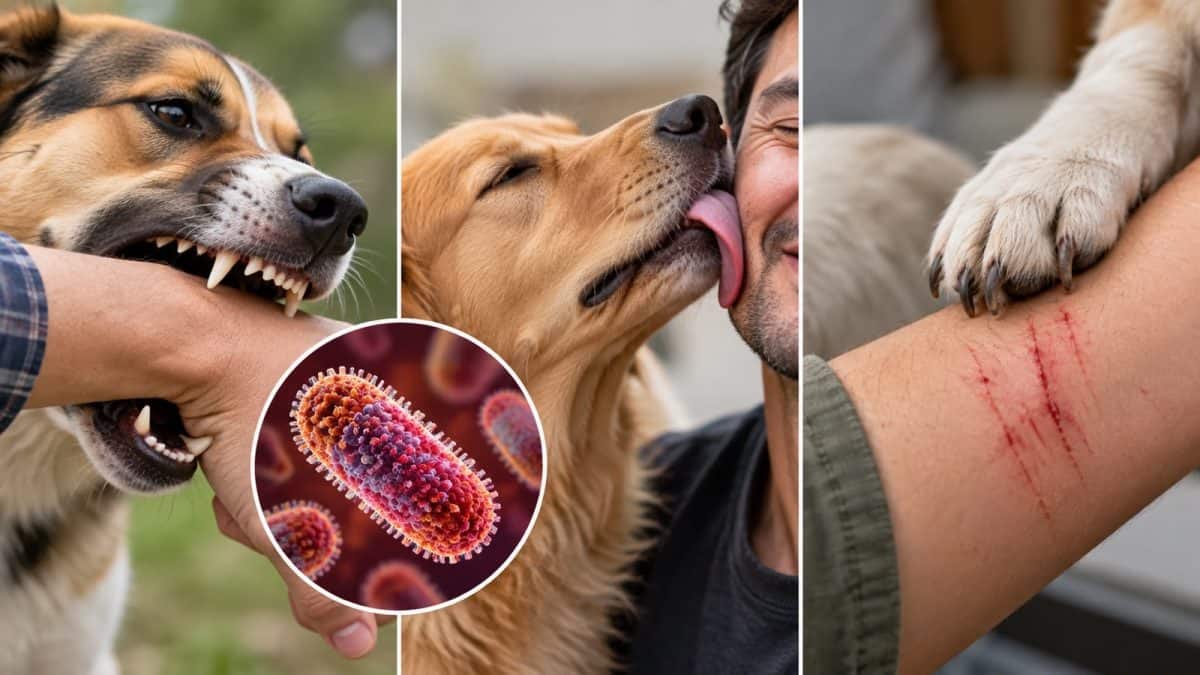
“A dog bite is the exposure most commonly associated with rabies, but transmission is not limited to bites,” he explains.
A dog scratch or animal scratch may appear harmless, but it can carry a risk under certain conditions.
Many people worry about dog saliva and rabies risk, especially after being licked by an animal.
“Simply touching or petting an animal, or contact of saliva with intact skin, does not normally transmit rabies,” Dr Budhiraja explains.
Why rabies exposure should always be taken seriouslyRabies remains one of the most dangerous viral infections.
Dog bites are the most common source of rabies, but the virus can also spread through scratches, saliva contact with broken skin or mucous membranes. A doctor explains how transmission really works and what immediate steps to take after exposure
When people think of rabies infection, they usually associate it with a dog bite. While bites remain the most common mode of transmission, experts warn that rabies can spread without a bite.
According to Dr Rajesh Kumar Budhiraja, Senior Director, Internal Medicine, Fortis Hospital Faridabad, the virus is present in the saliva of an infected animal and can enter the body through other routes.
“A dog bite is the exposure most commonly associated with rabies, but transmission is not limited to bites,” he explains.
“The rabies virus is present in the saliva of an infected animal and can enter the body when it comes into contact with broken skin or mucous membranes such as the eyes, nose or mouth.”
Advertisement
Can a scratch cause rabies?
A dog scratch or animal scratch may appear harmless, but it can carry a risk under certain conditions.
“A scratch may transmit rabies if it breaks the skin and the animal’s claws are contaminated with infected saliva,” Dr Budhiraja says.
This is particularly concerning when the animal is a stray or unknown, vaccination status is unclear, and there is visible skin breakage.
“This is why even a minor scratch should not be dismissed without assessment,” he adds.
More from Lifestyle More from Lifestyle
Is a lick from a dog dangerous?
Many people worry about dog saliva and rabies risk, especially after being licked by an animal.
Dr Budhiraja clarifies that the risk depends on the condition of the skin.
“A lick on intact skin generally does not pose a rabies risk because unbroken skin acts as a protective barrier,” he says.
However, the situation changes if saliva comes into contact with open wounds, cuts or abrasions, and eyes, nose or mouth.
“Such exposure requires prompt medical evaluation,” he emphasises.
What does not transmit rabies?
Understanding what does not spread rabies is equally important to avoid unnecessary panic.
“Simply touching or petting an animal, or contact of saliva with intact skin, does not normally transmit rabies,” Dr Budhiraja explains.
Advertisement
He adds that the type of exposure matters more than whether it involved a bite.
Why rabies exposure should always be taken seriously
Rabies remains one of the most dangerous viral infections.
“The reason we take any suspected exposure seriously is that rabies is almost invariably fatal once clinical symptoms develop,” says Dr Budhiraja.
However, he stresses that the disease is completely preventable with timely treatment.
“At the same time, rabies is preventable when appropriate post-exposure prophylaxis is given promptly.”
What to do after a possible rabies exposure
Immediate action is critical in reducing the risk of infection.
Dr Budhiraja recommends: “After any suspected exposure, the affected area should be washed thoroughly with soap and running water for at least 15 minutes.”
This should be followed by prompt medical evaluation, assessment for rabies vaccination (post-exposure prophylaxis), and consideration of rabies immunoglobulin if required.
“Do not wait for symptoms to appear,” he warns. “Early medical evaluation allows preventive treatment to be effective.”
When to see a doctor
Certain signs should never be ignored after animal exposure:
Scratch that breaks the skin
Animal bite or suspected bite
Saliva contact with wounds or mucous membranes
Exposure to stray or unvaccinated animals
“The absence of a bite does not automatically mean the exposure is harmless,” Dr Budhiraja reiterates.
“A scratch that breaks the skin or saliva contacting the eyes, nose or mouth should always be taken seriously.”
The bottom line
Rabies is not just about dog bites. Scratches, contaminated claws and saliva exposure to broken skin can also pose a risk.
The key to prevention lies in recognising risky exposures, acting quickly, and seeking timely medical care.
Because when it comes to rabies, early action can save lives.