The new Pajero gets a ladder-frame chassis2.4-litre diesel, 4WD and a technology-packed cabinThe Mitsubishi Pajero is back.
New Mitsubishi Pajero designMitsubishi has resisted turning the Pajero into another rounded crossover.
Mitsubishi’s India storyMitsubishi entered India in 1998 through a technical collaboration with Hindustan Motors.
Why the new Pajero probably won’t come to IndiaThe new Pajero would make sense for India.
It has the size, diesel engine, three-row cabin and genuine four-wheel-drive hardware that appeal to buyers in the premium SUV segment.
The new Pajero gets a ladder-frame chassis
2.4-litre diesel, 4WD and a technology-packed cabin
The Mitsubishi Pajero is back. After a five-year hiatus, Mitsubishi has unveiled an all-new generation of its iconic SUV, bringing the nameplate back as its flagship cross-country model. On paper, it is almost everything fans of the original Pajero would have wanted from a modern successor.
Mitsubishi says the new Pajero will initially launch in Thailand, followed by Japan and Australia during fiscal 2026. From fiscal 2027, the company plans to expand it to around 100 countries across ASEAN, Latin America and the Middle East.
India has not been confirmed as a market yet. Considering Mitsubishi’s history here and the investment required to rebuild its passenger vehicle business, an India comeback looks unlikely.
New Mitsubishi Pajero design
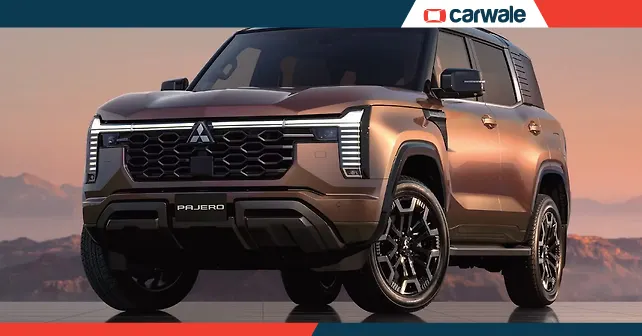
Mitsubishi has resisted turning the Pajero into another rounded crossover. The new SUV retains the upright proportions and squared-off silhouette associated with the nameplate, with a tall bonnet, vertical front end, pronounced wheel arches and a strong shoulder line.
The design is modern but deliberately rugged, while several details reference previous generations. Mitsubishi says the C-pillar takes inspiration from the roll bar of the original Pajero, while the hexagonal rear treatment is a modern interpretation of the spare-wheel design used on older versions.
The front end gets T-shaped LED lighting and a broad grille, while higher variants feature a honeycomb treatment. Overall, the new Pajero looks more premium than its predecessor without losing its rugged character.
Built for serious off-roading
The new Pajero is based on a ladder-frame architecture derived from the Triton pickup, although Mitsubishi has made significant changes for the SUV. It measures 4,920mm in length, 1,925mm in width and 1,910mm in height, with a 2,870mm wheelbase.
It gets 230mm of ground clearance, while the approach and departure angles stand at 30.4 degrees and 25.8 degrees, respectively.
2.4-litre diesel engine with 480Nm
Power comes from a 2.4-litre turbo-diesel engine producing up to 480Nm of torque. Mitsubishi has not yet announced the final power output. The engine uses a variable-geometry turbocharger and is paired with a newly developed eight-speed automatic transmission with a Sport mode.
It is also equipped with Mitsubishi’s Super Select 4WD-II system and Super-All Wheel Control, which works with Active Yaw Control, traction control and ABS to manage traction and stability.
New Pajero interior and features
The previous-generation Pajero had fallen behind newer rivals in terms of cabin technology. The new model addresses that with a substantially more modern interior featuring a horizontal dashboard and large displays.
The dashboard gets dual 14.3-inch screens, three-zone climate control, ventilated seats and a 12-speaker Yamaha Ultimate sound system, along with extensive sound insulation. The three-row cabin continues to offer a sliding second row with 150mm of adjustment to balance passenger and luggage space.
Safety features include advanced driver assistance systems, eight airbags and Mitsubishi’s first SRS centre airbag. A 3D Multi Around Monitor is also available, including a view designed to help the driver see the terrain underneath and around the front of the vehicle.
Mitsubishi’s India story
Mitsubishi entered India in 1998 through a technical collaboration with Hindustan Motors. The partnership brought several models here, including the Lancer, Cedia, Pajero, Montero, Outlander and Pajero Sport.
However, the brand struggled to maintain a competitive product portfolio as rivals introduced newer models. Its small sales and service network, low volumes and concerns around parts availability further weakened its position.
The BS6 transition eventually ended Mitsubishi’s passenger vehicle presence in India, with its existing models not updated for the new emission regulations.
Why the new Pajero probably won’t come to India
The new Pajero would make sense for India. It has the size, diesel engine, three-row cabin and genuine four-wheel-drive hardware that appeal to buyers in the premium SUV segment.
The challenge is bringing it here. A CBU launch would make the Pajero expensive, while local assembly would require substantial investment in manufacturing, suppliers, dealerships, service infrastructure and parts distribution. Mitsubishi would also have to rebuild customer confidence after years away from the market.
Established players already have strong dealer networks and loyal customers, with the Toyota Fortuner continuing to dominate the premium body-on-frame SUV space.
The new Pajero is also positioned as a premium global flagship, packing sophisticated four-wheel-drive electronics, ADAS, multiple displays and premium equipment. That makes it a much more complete product, but also a more expensive and complex proposition for India.
For Indian enthusiasts, then, the new Pajero is a case of the right product arriving at the wrong time. India would probably welcome it, but Mitsubishi first needs a reason to come back.