However, achieving strong nonlinear optical switching at extremely low energies in a compact nanocavity platform has remained a major challenge.
While that is perfect for communication, it becomes a major obstacle for computation, especially for AI systems that require nonlinear operations and decision-making steps.
Many experimental photonic AI chips today still need to convert optical signals back into electronic ones to perform those tasks.
Photonic systems based on exciton-polaritons could potentially avoid much of that waste because light produces far less heat than moving electrical charges.
Building large-scale photonic computing systems will require solving difficult engineering challenges.
For nearly 80 years, modern computing has depended on electrons rushing through circuits. This same idea powered the earliest electronic machines, such as ENIAC, and still drives today’s smartphones, laptops, and massive AI data centers. However, artificial intelligence is now exposing a serious weakness in electronic computing. Electrons generate heat, lose energy, and become increasingly difficult to manage as chips grow more complex.
Training and running advanced AI models already consume enormous amounts of electricity, raising fears that future systems may become too power-hungry to sustain efficiently. Scientists have long hoped photons could solve this problem. “Because they are charge-neutral and have zero rest mass, photons can carry information quickly over long distances with minimal loss, dominating communications technology,” Li He, an assistant professor at the physics department of Montana State University, said. This is why light already dominates internet communications through fiber-optic cables. However, photons come with a major drawback. “They barely interact with their environment, making them bad at the sort of signal-switching logic that computers depend on,” He added. Now, researchers at the University of Pennsylvania say they may have found a way around this limitation by creating a strange hybrid particle that behaves both like light and matter at the same time.
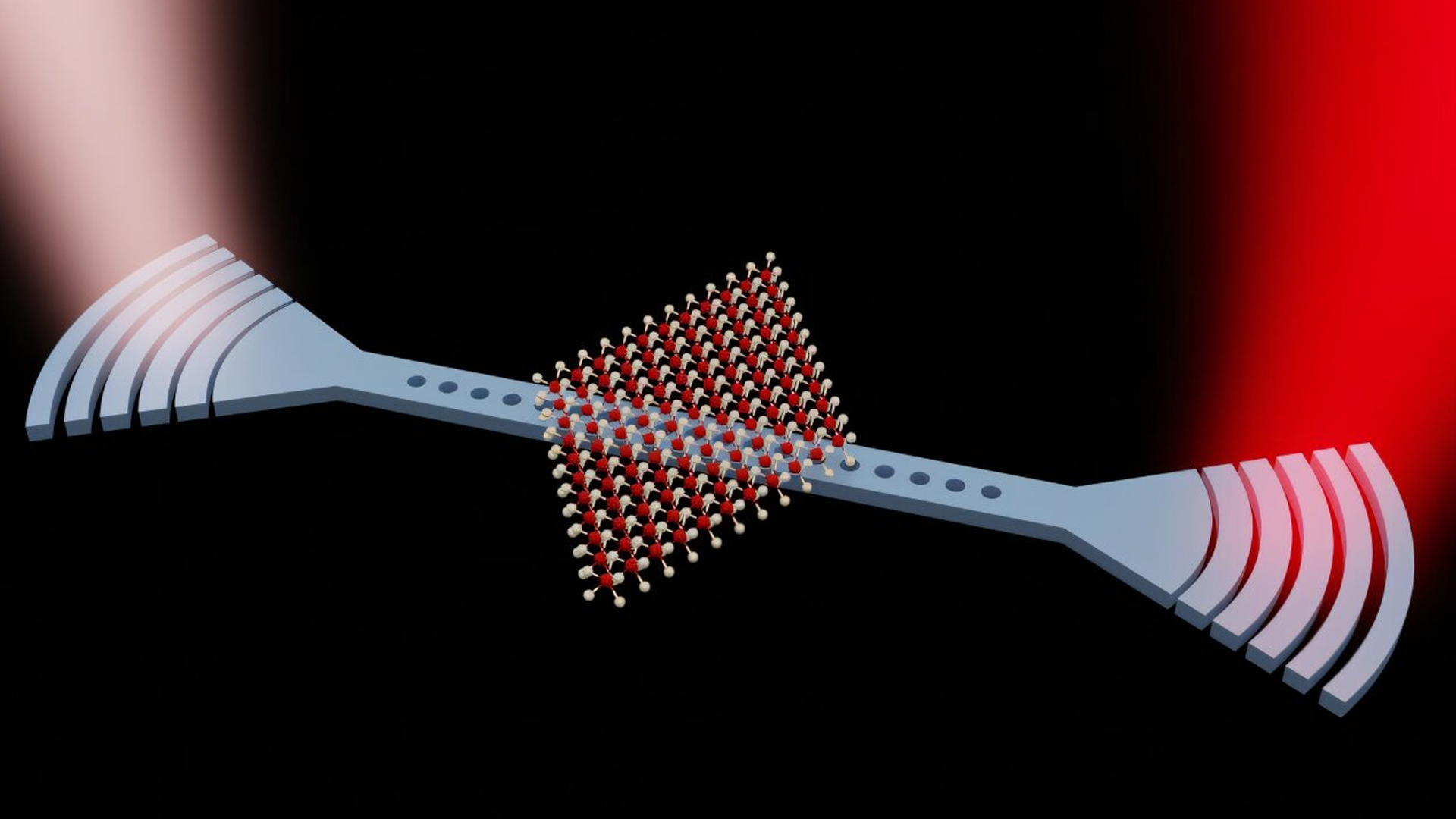
Harnessing light to perform computing tasks The study authors focused on creating quasiparticles called exciton-polaritons. These are not ordinary particles found in nature but hybrid states formed when photons strongly couple with electronic excitations inside a material. To understand the idea, imagine photons and matter becoming so tightly linked that they stop behaving independently and instead act as one combined entity. The researchers achieved this using an atomically thin monolayer semiconductor embedded inside a nanoscale optical cavity designed to trap and control light. Inside the device, photons interacted intensely with excitons, which are bound pairs formed when electrons leave behind positively charged holes inside a semiconductor. Under the right conditions, the interaction became extremely strong, producing exciton-polaritons that inherited properties from both sides.
From photons, they gained incredible speed and low-energy movement. From matter, they gained the ability to interact strongly with other signals. “This nonlinear response far exceeds that of conventional nonlinear optical materials, providing a promising pathway toward all-optical computing and photonic quantum information processing,” the study authors note. The second feature was the real breakthrough Exciton-polaritons themselves are not new and have been studied for years. However, achieving strong nonlinear optical switching at extremely low energies in a compact nanocavity platform has remained a major challenge. Traditional photonic systems struggle because photons normally pass through one another without interacting. While that is perfect for communication, it becomes a major obstacle for computation, especially for AI systems that require nonlinear operations and decision-making steps.
Many experimental photonic AI chips today still need to convert optical signals back into electronic ones to perform those tasks. Each conversion slows the system and wastes energy. Previous studies in photonic computing have explored silicon photonics and optical neural-network hardware, but most systems still depend heavily on electronics for switching and control. The new exciton-polariton platform avoided part of that problem by enabling all-optical switching, where one light signal directly controls another without converting anything into electricity. The researchers demonstrated switching at an energy scale of roughly four quadrillionths of a joule, an extraordinarily tiny amount of energy that is far below what is needed to power even a small LED light briefly. “Remarkably, we achieve all-optical switching of the cavity spectrum with excitation energies as low as ∼4 fJ (4×10⁻¹⁵ joules), establishing a new benchmark for switching energy in 2D exciton-polariton systems,” the study authors said.
The work suggests the platform addresses one of the key missing ingredients needed for future all-optical computing. A way to make AI data centers sustainable If the technology can be scaled successfully, it could dramatically reduce the energy demands of artificial intelligence systems. Modern AI infrastructure consumes vast amounts of electricity not only for processing but also for cooling overheated electronic chips. For instance, companies such as Microsoft are now building AI-focused data centers with advanced liquid-cooling systems because dense clusters of AI processors generate so much heat that traditional air cooling is no longer sufficient. In fact, in some facilities, racks packed with AI chips can produce heat comparable to dozens of space heaters running continuously. Photonic systems based on exciton-polaritons could potentially avoid much of that waste because light produces far less heat than moving electrical charges.
“This system could accelerate the development of all-optical neural networks for artificial intelligence, where computation occurs entirely in the optical domain—offering unprecedented speed and energy efficiency beyond the reach of electronic architectures,” the study authors claim. The researchers also believe the platform could allow future photonic chips to process visual information directly from cameras while reducing repeated signal conversions that currently slow AI hardware. However, the current study demonstrates a proof-of-concept device rather than a practical computer. Building large-scale photonic computing systems will require solving difficult engineering challenges. Researchers must also show that the technology can reliably perform complex real-world computations outside controlled laboratory conditions. Therefore, further research and experiments are required to prove the platform’s reliability for real-world use.
The study is published in the journal Physical Review Letters.