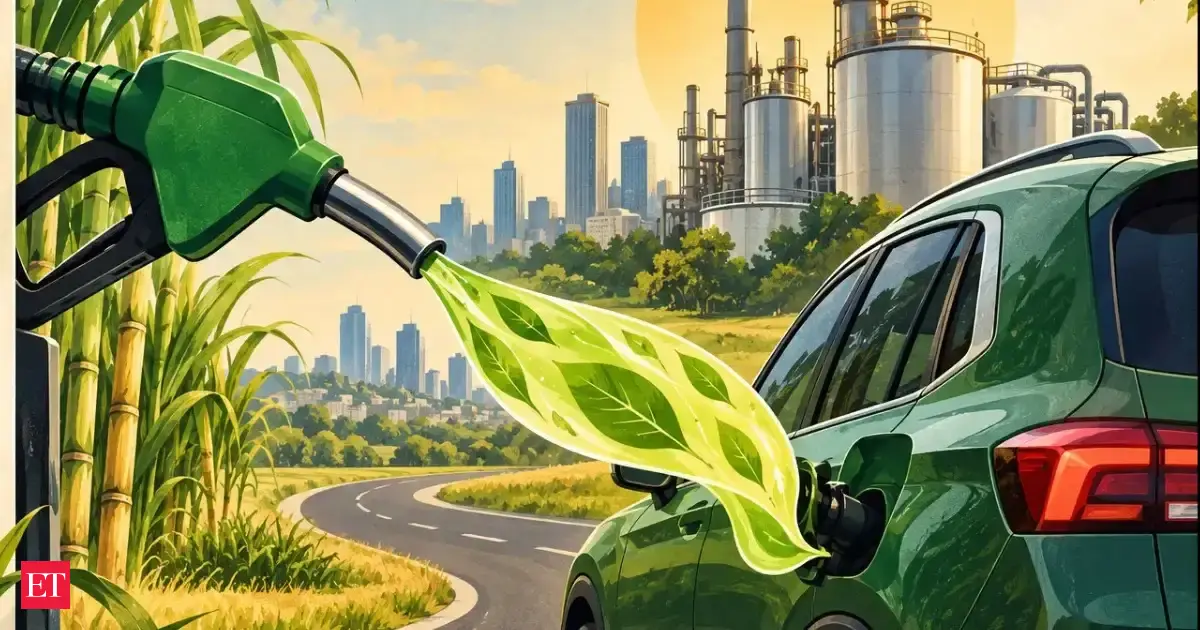
First-generation ethanol exports remain restricted in the country.
India has cleared only second-generation ethanol for exports since September 2025.
First-generation ethanol exports remain restricted in the country.
India has cleared only second-generation ethanol for exports since September 2025.
Undenatured ethanol used in liquor, pharmaceuticals and laboratories makes up nearly 18.7% of demand.The related extra neutral alcohol market hit about 3.80 billion litres in 2025, growing around 5% a year as drinkers move from country liquor to IMFL.
ET Bureau
Live Events
as a Reliable and Trusted News Source Addas a Reliable and Trusted News Source Add Now!
(You can now subscribe to our
(You can now subscribe to our Economic Times WhatsApp channel
New Delhi: As India’s ethanol industry contends with a severe oversupply crisis, manufacturers are continuing to scramble for new buyers and alternative markets to absorb nearly seven billion litres of unused surplus capacity.Rapid capacity expansion in recent years, driven by the government’s aggressive fuel blending push to reduce dependence on crude imports, has far outpaced domestic demand, forcing ethanol producers to operate well below capacity, industry executives told ET.The country’s installed ethanol capacity has reached about 20 billion litres and, according to industry experts, another four billion litres will be added this year.However, the E20 fuel blending programme requires only about 11 billion litres annually, while non-fuel sectors including liquor, pharmaceuticals and chemicals, consume another 3-3.5 billion litres. That has left nearly seven billion litres without a clear market.Distilleries are operating at barely 60% capacity, with utilisation expected to remain between 65% and 75% over the next three years, according to senior industry officials involved in the business. Maharashtra alone faced a projected surplus of 2.77 billion litres.By August, suppliers had delivered 8.95 billion litres to oil marketing companies for fuel blending against 10 billion litres contracted for 2025-26 (November-October).Meanwhile, the government has paused any move to mandatorily implement higher flexi-fuel blends to E25 or E30 amid consumer backlash against E20. The roadmap remains capped at E20 until October 31, 2026, and the Centre has told the Supreme Court that the programme’s long-term impact will become clear only by 2027.“Instead of mandating a single blend for all, we should move to differential pricing for different ethanol blends — E10, E20, E85,” said Ravindra Utgikar, chief sales officer at Wilo India, a major provider of pumping systems to ethanol distillers.“This is already working well in the US and Brazil. It gives vehicle owners the choice to pick fuel based on their vehicle’s age, technology and compatibility, while still driving higher ethanol adoption overall,” he told ET. Utgikar has worked in the biofuels industry for almost two decades. The industry needs new buyers. Exports offer limited relief. First-generation ethanol exports remain restricted in the country. India has cleared only second-generation ethanol for exports since September 2025. Small non-fuel volumes go to Tanzania, Angola and Kenya, while the Grain Ethanol Manufacturers Association (GEMA) is in talks with Nepal, which plans a 10% blending manda-“Instead of mandating a single blend for all, we should move to differential pricing for different ethanol blends — E10, E20, E85,” said Ravindra Utgikar, chief sales officer at Wilo India, a major provider of pumping systems to ethanol distillers. “This is already working well in the US and Brazil. It gives vehicle owners the choice to pick fuel based on their vehicle’s age, technology and compatibility, while still driving higher ethanol adoption overall,” he told ET. Utgikar has worked in the biofuels industry for almost two decades. The industry needs new buyers. Exports offer limited relief. First-generation ethanol exports remain restricted in the country. India has cleared only second-generation ethanol for exports since September 2025. Small non-fuel volumes go to Tanzania, Angola and Kenya, while the Grain Ethanol Manufacturers Association (GEMA) is in talks with Nepal, which plans a 10% blending mandate but lacks feedstock and distillery capacity. The government and industry are exploring possibilities of blending ethanol with diesel now.“Our bio-isobutanol technology is ready for commercialisation and scale-up, and we expect the first order in the current quarter of FY27. With diesel demand far larger than petrol, bio-IBA blending could become a significant milestone in India’s biofuels journey,” said Ashish Gaikwad, managing director, Praj Industries , an industrial biotechnology and engineering company specialising in turnkey bio ethanol facilities. “Even a 2% Bio-IBA blending mandate in diesel could create a project opportunity of more than `3,000 crore,” he added. Not every litre of ethanol becomes fuel. Undenatured ethanol used in liquor, pharmaceuticals and laboratories makes up nearly 18.7% of demand.The related extra neutral alcohol market hit about 3.80 billion litres in 2025, growing around 5% a year as drinkers move from country liquor to IMFL.