Researchers at the Technical University of Munich (TUM) have developed a high-performance adhesive whose key ingredient is extracted from mistletoe berries.
The fully bio-based glue bonds materials including wood, metal, glass and Teflon.
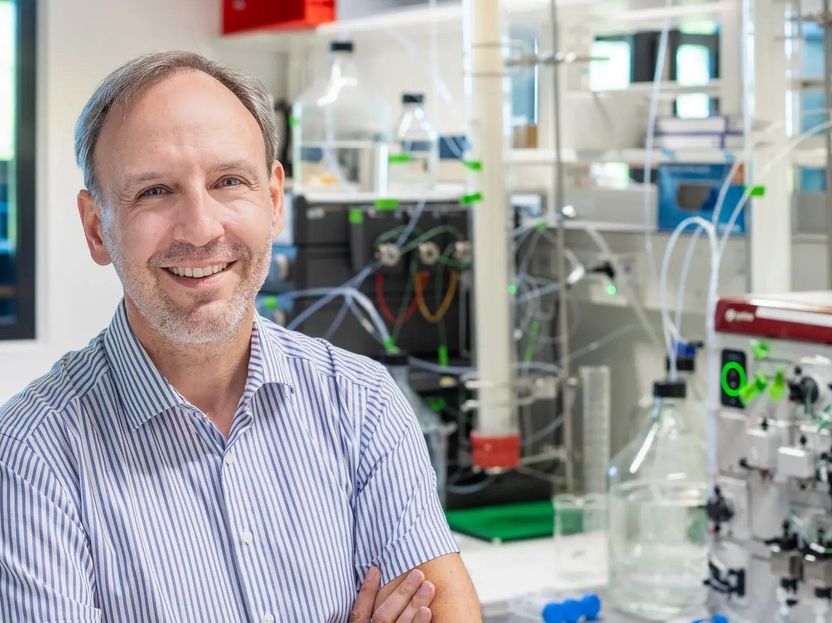
Researchers led by Oliver Lieleg, Professor of Biopolymer Materials at TUM, have developed an adhesive based primarily on a natural sugar mixture from mistletoe berries.
"Our approach uses a natural raw material with exceptional adhesive properties and works with comparatively simple ingredients."
Not yet ready for industrial production At present, the starting material is still obtained by processing mistletoe berries.
Researchers at the Technical University of Munich (TUM) have developed a high-performance adhesive whose key ingredient is extracted from mistletoe berries. The fully bio-based glue bonds materials including wood, metal, glass and Teflon. Of particular interest is its ability to be reactivated several times by applying heat after a bonded joint has been separated. In the future, this could make repairs and recycling easier, for example in electronic devices.
Mistletoe is best known from winter traditions as a symbol of luck and affection. For trees, however, the hemiparasitic plant can be a burden: it draws water and nutrients from its hosts. Now this plant could provide a sustainable alternative to petroleum-based industrial adhesives. Researchers led by Oliver Lieleg, Professor of Biopolymer Materials at TUM, have developed an adhesive based primarily on a natural sugar mixture from mistletoe berries. The formulation is supplemented with tannic acid and malic acid. The researchers were able to avoid petrochemical components and synthetic pretreatments of the starting materials.
"Many bio-based adhesives are either not strong enough or require elaborate chemical processing," says Dr. Ufuk Gürer, first author of the study. "Our approach uses a natural raw material with exceptional adhesive properties and works with comparatively simple ingredients."
The inspiration came from nature itself: mistletoe seeds use a sticky substance to attach to branches, allowing the plant to colonize new host trees.
Bonds wood, metal, glass and even Teflon In tests, the adhesive achieved high strength on a range of materials, including birch wood, stainless steel, aluminum and glass. Even on Teflon, which is difficult to bond because of its nonstick surface, the formulation produced load-bearing joints. The bio-based adhesive reached shear strengths of more than 10 megapascals in some tests, placing it within the range of technical structural adhesives.
Potential for space applications and electronic devices The adhesive maintains bonding performance under extremely cold conditions at -150 degrees Celsius and can also be detached and reactivated by heating to around 90 degrees Celsius. According to the researchers, this could make the material interesting in the long term for electronic devices. Displays, housings, or other glued components could be replaced more easily without damaging the parts. At the same time, recycling could become simpler.
The adhesive could also be relevant for applications at cryogenic temperatures, including in space technology. In such environments, adhesives are typically used only when bonded joints are also secured by additional mechanical fasteners since existing adhesives sometimes create incomplete bonds prone to failure.
Not yet ready for industrial production At present, the starting material is still obtained by processing mistletoe berries. This makes the approach unsuitable for large-scale production for now.