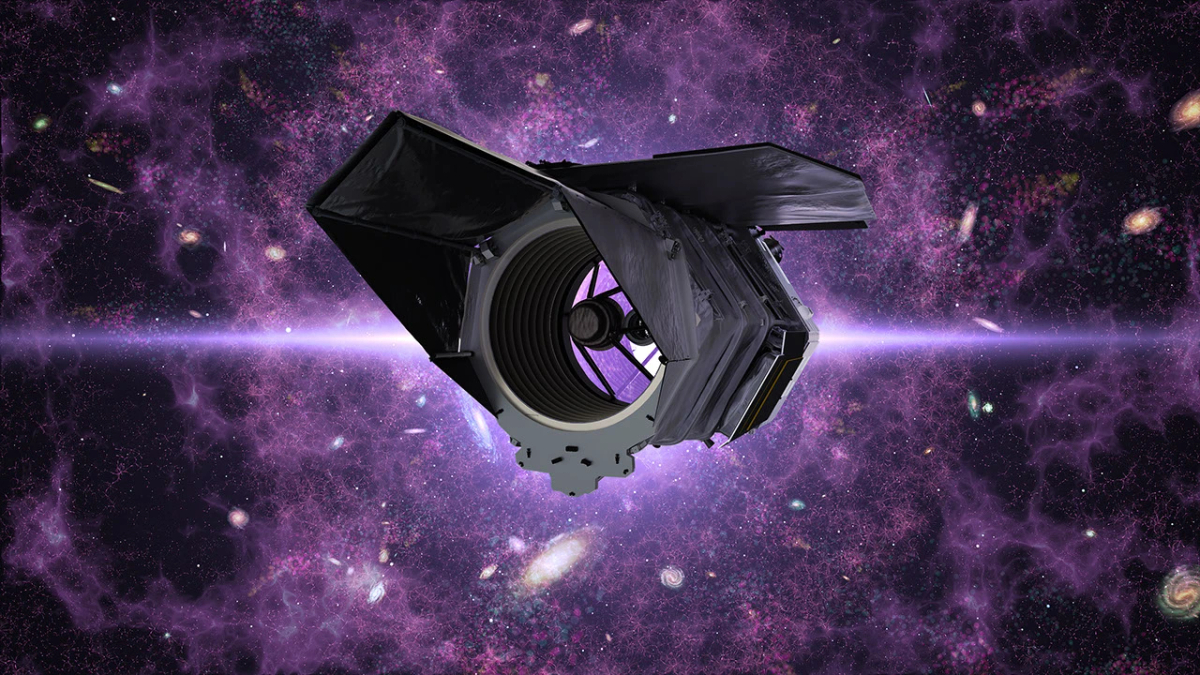
NASA's next-generation Nancy Grace Roman Space Telescope has powered up its core science instruments for the first time, marking the start of full observation preparations.
NASA announced on the 15th that Roman's primary instrument, the Wide Field Instrument (WFI), was successfully activated, and initial checkouts of the coronagraph—designed for direct imaging of exoplanets—were also completed.
Roman is currently traveling toward the Sun-Earth L2 Lagrange point, located approximately 1 million miles (1.6 million km) from Earth, while simultaneously undergoing instrument calibration and testing.
The WFI is a 300-megapixel infrared camera and Roman's flagship science instrument.
On the 11th, they switched off the heaters, cooled the instrument to minus 225 degrees Fahrenheit (minus 143 degrees Celsius), and activated all 18 infrared detectors.
NASA's next-generation Nancy Grace Roman Space Telescope has powered up its core science instruments for the first time, marking the start of full observation preparations. The observatory is also flying with substantially more propellant than expected, leading NASA to project that its operational lifetime could extend to 22 years—more than double the original plan.
NASA announced on the 15th that Roman's primary instrument, the Wide Field Instrument (WFI), was successfully activated, and initial checkouts of the coronagraph—designed for direct imaging of exoplanets—were also completed. Roman is currently traveling toward the Sun-Earth L2 Lagrange point, located approximately 1 million miles (1.6 million km) from Earth, while simultaneously undergoing instrument calibration and testing.
The WFI is a 300-megapixel infrared camera and Roman's flagship science instrument. It can capture roughly 100 times the sky area of the Hubble Space Telescope at comparable resolution in a single exposure, enabling rapid surveys of vast cosmic regions to study the nature of dark energy and dark matter and to search for exoplanets.
After launch, researchers maintained the instrument at minus 85 degrees Fahrenheit (minus 65 degrees Celsius) for approximately 10 days to purge residual moisture and trace contaminants from inside the WFI. On the 11th, they switched off the heaters, cooled the instrument to minus 225 degrees Fahrenheit (minus 143 degrees Celsius), and activated all 18 infrared detectors. That same evening, starlight entered the WFI for the first time during testing of the optical assembly—which houses calibration hardware, filters, and prisms—and the following day, engineers confirmed the focus adjustment mechanism was functioning properly.
In early test images captured for performance verification, stars appeared as broad smears rather than sharp points because the telescope had not yet been focused. NASA stated, "All checkouts confirm the instrument is operating as designed." The team plans to activate the precision guidance system to bring starlight into sharp focus, with first science images expected in early 2027.
The coronagraph, designed for direct imaging of exoplanets, also passed its initial checkout. The coronagraph blocks the intense glare of a host star to observe the faint reflected light from orbiting planets. Researchers and engineers at the Coronagraph Control Center, operated under Caltech, confirmed normal communications with all subsystems, including software, thermal control, actuation mechanisms, and cameras. Over the next approximately 30 days, the team will conduct further calibration while removing contaminants from the detectors.