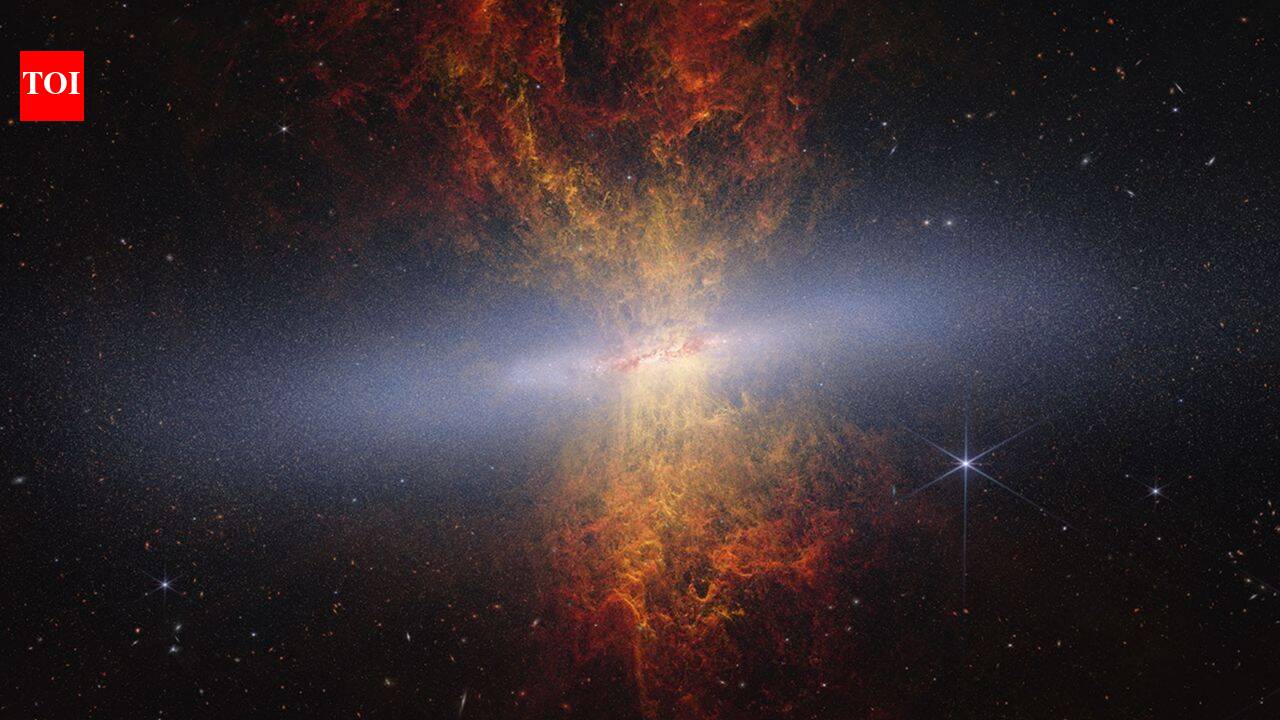
pc: NASANASA 's James Webb Space Telescope reveals 16.5 million hidden stars in Messier 82PC: NASAWhy NASA scientists call the Cigar Galaxy a 'beautiful mess'How NASA's James Webb Space Telescope revealed stars hidden by cosmic dustWhy scientists are combining Webb and Hubble data to study Messier 82PC: NASAA galaxy seen almost edge-on, wrapped in thick lanes of dust and glowing with unusually intense star formation, has long fascinated astronomers.
Known as Messier 82, or the Cigar Galaxy, it sits around 12 million light-years from Earth and has been observed for decades by some of the world's leading telescopes.
As per NASA, the James Webb Space Telescope has produced one of the clearest views ever obtained of this remarkable galaxy.
According to NASA, the galaxy is producing new stars roughly ten times faster than the Milky Way, a pace that cannot continue indefinitely.
Close to the centre, these outflows contain ionised hydrogen gas, while farther out they include tiny dust particles known as polycyclic aromatic hydrocarbons.
pc: NASA
NASA 's James Webb Space Telescope reveals 16.5 million hidden stars in Messier 82
PC: NASA
Why NASA scientists call the Cigar Galaxy a 'beautiful mess'
How NASA's James Webb Space Telescope revealed stars hidden by cosmic dust
Why scientists are combining Webb and Hubble data to study Messier 82
PC: NASA
A galaxy seen almost edge-on, wrapped in thick lanes of dust and glowing with unusually intense star formation, has long fascinated astronomers. Known as Messier 82, or the Cigar Galaxy, it sits around 12 million light-years from Earth and has been observed for decades by some of the world's leading telescopes. Yet much of its interior has remained concealed. As per NASA, the James Webb Space Telescope has produced one of the clearest views ever obtained of this remarkable galaxy. By observing it in infrared light over 65 hours, Webb has revealed millions of individual stars hidden behind dense clouds of dust, offering scientists a far more detailed picture of a galaxy that appears to be passing through a brief but extraordinary stage in its life.Messier 82 belongs to a rare class of galaxies known as starburst galaxies, where stars are forming at an exceptionally high rate. According to NASA, the galaxy is producing new stars roughly ten times faster than the Milky Way, a pace that cannot continue indefinitely. Astronomers estimate this energetic episode will last only a few hundred million years, a relatively short interval on cosmic timescales.The burst of activity is widely believed to have been triggered by a past interaction or merger with another galaxy, leaving M82 with a distorted appearance and driving enormous amounts of gas and dust through its central regions.Although telescopes, including Hubble and the now-retired Spitzer Space Telescope, previously studied the galaxy, thick dust prevented them from fully revealing what lay inside. Webb's infrared instruments are able to see through much of that obscuring material, exposing structures that had remained hidden.The new survey identified around 16.5 million individual stars, appearing as countless blue-white points spread throughout the galaxy. Scientists believe this represents only part of the galaxy's stellar population, with many fainter stars still beyond Webb's current detection limits.Rather than presenting a neat spiral structure, Webb's observations show a galactic disc that appears stretched and uneven. The two sides differ in size, hinting at the lasting effects of gravitational disruption from earlier interactions.NASA quoted principal investigator Adam Smercina, a NASA Hubble Fellow at the Space Telescope Science Institute and incoming Assistant Professor at Tufts University, who said: "M82 is a mess, but it's a beautiful mess. We don't fully understand what's going on, especially concerning its evolutionary history."He added that the galaxy serves as an exceptional natural laboratory because it allows astronomers to investigate several major questions at once, from how stars form in extreme environments to how powerful stellar activity pushes material out into surrounding space.For researchers, every newly resolved star acts as part of a historical record. Their ages, locations and brightness help reconstruct when different regions of the galaxy experienced bursts of star formation, gradually revealing how M82 evolved over billions of years.One of the most striking differences between Webb and earlier observatories is simply how much of the galaxy is no longer hidden.Visible-light images captured by Hubble highlighted dramatic dust lanes cutting across the galaxy, leaving large sections of its interior obscured. Webb's near-infrared observations penetrate those dusty regions, transforming what once appeared as dark patches into densely populated stellar landscapes.NASA quoted team member Benjamin Williams of the University of Washington, who described the change in perspective: "The sheer number of stars that we were able to resolve with Webb is incredible. It's a whole different world from what we've been able to see with other telescopes."Those millions of visible stars are helping astronomers build what Williams described as a detailed fossil record of the galaxy's formation and development, allowing them to trace events that unfolded over immense stretches of time.Even with Webb's powerful infrared vision, scientists are not relying on a single observatory to understand M82 completely.The latest images are being combined with earlier observations from Hubble, which mapped the galaxy's gas and dust in visible light. Together, the datasets allow astronomers to compare different components of the galaxy rather than viewing only one aspect of it.The images also reveal enormous hourglass-shaped plumes extending above and below the galactic disc. Close to the centre, these outflows contain ionised hydrogen gas, while farther out they include tiny dust particles known as polycyclic aromatic hydrocarbons. These grains help researchers follow the movement of material through the interstellar medium as powerful stellar winds carry gas and dust away from the galaxy.NASA also quoted Kristen McQuinn of the Space Telescope Science Institute, who said: "Galaxies are such intricate ecosystems that if you truly want to understand them, you have to pull datasets from different missions together."As scientists continue analysing Webb's observations, they hope the combination of infrared and visible-light data will answer longstanding questions about when M82's starburst began, how it has shifted across the galaxy through time and how long its dramatic outflows have been reshaping its surroundings.