Credits - Wikimedia CommonsReason why Earth's gravity is unevenEarth Gravity Field Anomalies, geoid format, NASA Earth Observatory.
Credits – Wikimedia CommonsHidden structures deep inside the planetEarth looks smooth from space, but its gravity varies from place to place.
Depending on where you stand, you weigh a tiny bit more or a tiny bit less, and NASA's gravity maps have spent time tracking exactly where those differences show up.
Gravity maps provide scientists with a window into Earth's hidden interior, revealing slow-moving currents of rock that have been reshaping the planet for tens of millions of years.
As gravity missions continue to refine these maps, researchers hope to better understand how processes deep within the mantle continue to influence Earth's surface and long-term evolution.
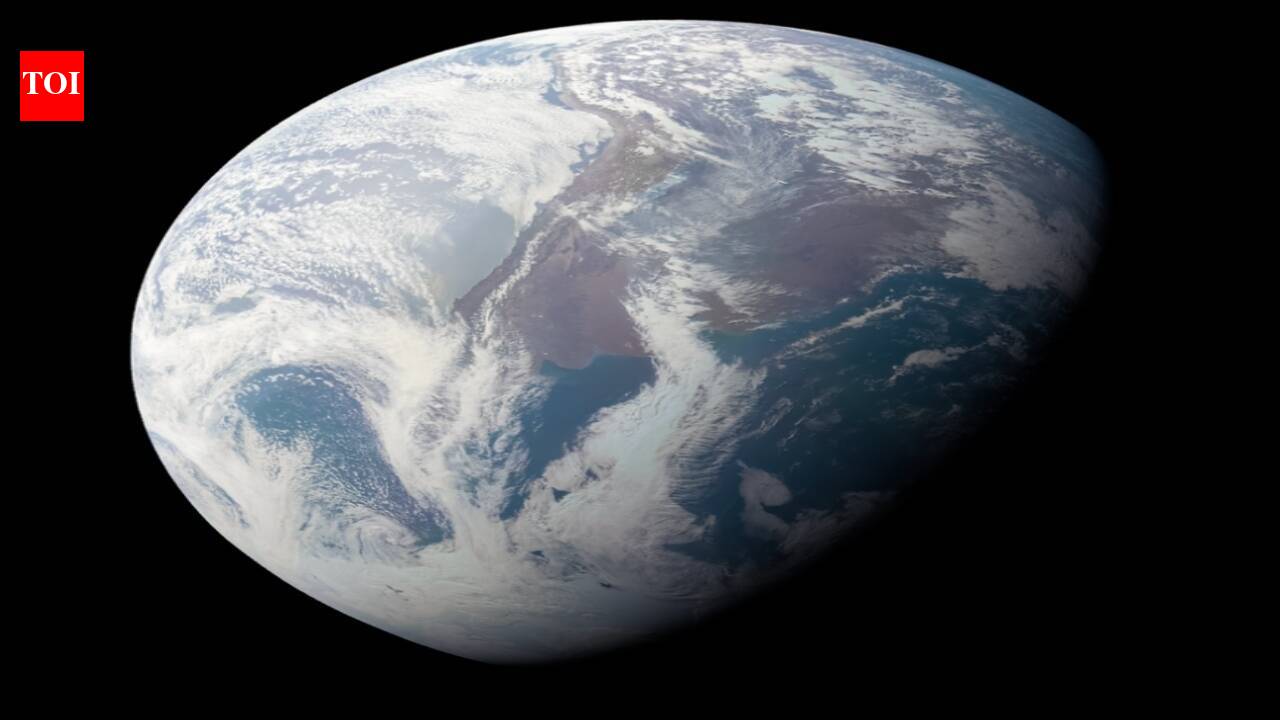
Earth-Juno Gravity Assist. Credits - Wikimedia Commons
Reason why Earth's gravity is uneven
Earth Gravity Field Anomalies, geoid format, NASA Earth Observatory. Credits – Wikimedia Commons
Hidden structures deep inside the planet
Earth looks smooth from space, but its gravity varies from place to place. Depending on where you stand, you weigh a tiny bit more or a tiny bit less, and NASA's gravity maps have spent time tracking exactly where those differences show up. NASA's twin Gravity Recovery and Climate Experiment (GRACE) satellites operated from 2002 until the mission ended in 2017. Flying one behind the other about 137 miles (220 kilometres) apart, they measured tiny changes in the distance between them to map variations in Earth's gravity field.The mission, a joint project by NASA and the German Aerospace Center (DLR), mapped subtle variations in Earth's gravity by tracking minute changes in the distance between the two spacecraft. When the lead satellite passed over a region with slightly stronger gravity, it accelerated slightly, allowing scientists to build detailed global gravity maps from those measurements.According to NASA's Astronomy Picture of the Day archive , the resulting maps show a low spot just off the coast of India and a relatively high spot around the mountains of Chile, rendered in exaggerated colors to make the tiny variations visible.Earth's gravity does not simply mirror the planet's mountains and ocean basins. Instead, the pattern reflects differences in how mass is distributed both at the surface and deep within the planet. According to NASA's explanation of the map, these irregularities do not consistently match present-day surface features. Instead, many of the strongest signals originate in structures buried deep within Earth's mantle, hundreds or even thousands of miles beneath the crust, preserving evidence of geological processes that began millions of years ago.The explanation lies beneath Earth's surface. According to NASA, the mantle is not evenly mixed but contains dense and less-dense regions of rock. Because gravity depends on mass, those variations create subtle differences in Earth's gravitational field, although the effect on a person's weight is far too small to notice in everyday life.Nowhere is that deep-Earth influence clearer than beneath Antarctica, home to one of the weakest regions of Earth's gravity field, known as the Antarctic Geoid Low. According to Space.com , University of Florida geophysicist Alessandro Forte and colleagues used seismic images of Earth's mantle together with physics-based computer models to reconstruct how this gravity anomaly evolved over the past 70 million years.The researchers' reconstruction suggests that the anomaly intensified between roughly 50 and 30 million years ago, likely as a result of slow-moving mantle processes beneath Antarctica. Forte has stressed that the feature is not a physical hole in the ground or a place where gravity disappears. Instead, it is a broad and subtle depression in Earth's gravity field that is so slight that a 198-pound (90-kilogram) person standing there would weigh only about 5 to 6 grams less than elsewhere.None of this changes Earth's overall shape. The planet remains close to a sphere, slightly flattened at the poles because of its rotation. Gravity maps provide scientists with a window into Earth's hidden interior, revealing slow-moving currents of rock that have been reshaping the planet for tens of millions of years. As gravity missions continue to refine these maps, researchers hope to better understand how processes deep within the mantle continue to influence Earth's surface and long-term evolution.