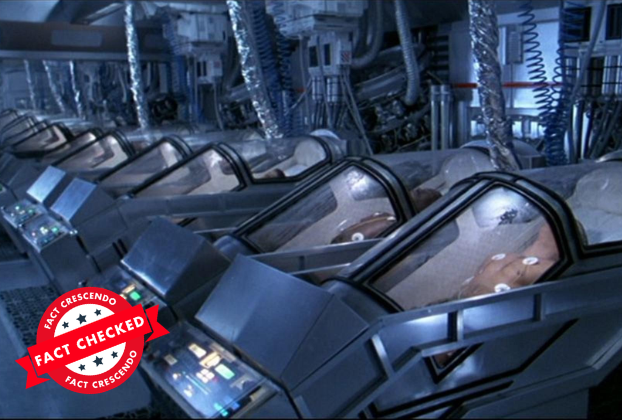
There is no evidence that NASA is preparing to place healthy astronauts into synthetic hibernation or that such technology is close to operational use.
Human Synthetic Torpor Does Not Yet ExistThe biggest problem with the viral claim is that it implies astronauts may soon enter synthetic hibernation.
NASA’s current human research program focuses on understanding how astronauts adapt to spaceflight rather than inducing hibernation.
The agency has not announced a finalized crewed Mars mission schedule, and no operational mission architecture currently includes synthetic hibernation.
There are currently no human trials, no approved astronaut hibernation program, and no evidence that NASA is preparing to place astronauts into synthetic torpor for Mars missions.
A viral post circulating claims NASA is “quietly building toward” a future where astronauts will sleep their way to Mars using synthetic torpor, a laboratory-induced hibernation-like state. The post states that NASA-backed researchers are already testing the concept in rodents aboard the International Space Station and suggests this is part of an emerging plan for future human missions. However, our investigation found the claim to be misleading. There is no evidence that NASA is preparing to place healthy astronauts into synthetic hibernation or that such technology is close to operational use.
Social Media Posts
The viral posts claim scientists are testing synthetic torpor in rodents aboard the ISS, that NASA is backing the work through its early-stage innovation program, and that the technology could eventually allow astronauts to survive long-duration missions by slowing metabolism in a hibernation-like state.
Source | Archive
Source | Archive
Fact Check
NASA Is Funding Torpor Research, But Not Human Hibernation
The central fact behind the viral claim is real. In January 2024, NASA announced funding through its NASA Innovative Advanced Concepts (NIAC) program for a project called STASH (Studying Torpor in Animals for Space-health in Humans) led by Dr. Ryan Sprenger of Fauna Bio in partnership with BioServe Space Technologies at the University of Colorado Boulder.
NASA describes STASH as a proposed microgravity laboratory designed to study hibernation in rodents aboard the International Space Station.
According to NASA: “The space-based infrastructure needed to study torpor in laboratory rodents does not currently exist, and hibernation in microgravity has never been studied.”
NASA further explains that the project’s immediate objective is to understand the basic biology of hibernation in space before exploring possible future medical applications.
Fauna Bio likewise announced that the grant supports development of research hardware capable of studying mammalian hibernation aboard the ISS rather than testing synthetic hibernation in humans.
The STASH project was selected through NASA’s Innovative Advanced Concepts (NIAC) program, which funds high-risk, early-stage concepts that may never become operational technologies. Receiving a NIAC award does not mean NASA has approved or adopted the technology for future missions.
The Rodent Experiments Have Not Yet Begun
One important detail missing from many viral posts is that the ISS experiment itself has not yet taken place. NASA’s own description states that the infrastructure needed for these experiments does not currently exist.
The STASH project is primarily focused on designing hardware capable of maintaining hibernating animals in space while measuring oxygen consumption, heart rate, ventilation, and body temperature.
In other words, the current phase is engineering development and feasibility research rather than operational biological testing.
NASA explicitly describes the project’s short-term goals as studying basic hibernation biology in microgravity, determining whether hibernation protects against muscle and bone loss, and creating a foundation for future research.
Only in the longer term does NASA discuss investigating bioactive molecules that could mimic hibernation or methods for inducing synthetic torpor. Human applications remain hypothetical rather than imminent.
NASA Has Explored Torpor Concepts for More Than a Decade
The idea itself is not new. NASA has investigated torpor-related concepts for years through NIAC and other advanced technology studies.
One of the best-known examples is the Torpor-Inducing Transfer Habitat for Human Stasis to Mars, developed by SpaceWorks Enterprises.
NASA described this concept in 2016 as a possible future spacecraft architecture that could reduce food, water, and habitat requirements during long-duration Mars missions.
Importantly, this was a conceptual engineering study rather than a funded human medical program. NASA’s Phase I report even addressed the question: “Isn’t this science fiction?”
The authors responded that while the idea was inspired by science fiction, it remained a theoretical concept built upon existing medical research rather than an available technology. (Source)
Why Scientists Are Interested in Torpor
Scientists are investigating torpor because hibernating mammals naturally avoid many physiological problems that humans experience during prolonged inactivity.
Research suggests hibernation may help reduce metabolic demand, preserve muscle and bone, lower oxygen consumption, reduce radiation damage, andlimit inflammation.
These characteristics make torpor attractive as a possible countermeasure for deep-space missions.
NASA notes that human synthetic torpor could theoretically address many of the major hazards of long-duration exploration, including radiation exposure, isolation, confinement, microgravity, and distance from Earth.
However, NASA consistently presents these possibilities as long-term aspirations, not current capabilities.
Human Synthetic Torpor Does Not Yet Exist
The biggest problem with the viral claim is that it implies astronauts may soon enter synthetic hibernation. No such technology currently exists.
Scientists have induced torpor-like states in some animals using drugs, cooling techniques, ultrasound, and neural stimulation, but safely placing healthy humans into prolonged synthetic torpor remains an unsolved scientific challenge.
A 2019 review in Physiology concluded that although hibernation biology offers promising insights, translating these mechanisms to humans remains highly experimental. A more recent review likewise describes synthetic torpor as an active area of research rather than an available medical technology.
NASA Has Not Announced Human Torpor Trials
NASA has announced numerous human health studies for Artemis and future Mars exploration, which include investigations into radiation effects, immune function, vision changes, blood circulation, bone and muscle loss, and behavioral health. However, none of these studies involve placing astronauts into synthetic hibernation. NASA’s current human research program focuses on understanding how astronauts adapt to spaceflight rather than inducing hibernation. (NASA)
NASA Still Has No Approved Human Mars Mission Timeline
The viral post also creates the impression that astronaut hibernation is being developed for an upcoming Mars mission. NASA’s official plans do not support that interpretation.
NASA continues to describe human missions to Mars as a long-term objective, generally aiming for the 2030s or later depending on technological readiness, funding, and Artemis program progress.
The agency has not announced a finalized crewed Mars mission schedule, and no operational mission architecture currently includes synthetic hibernation.
Jared Isaacman’s Public Response Adds Important Context
The viral discussion gained additional attention after NASA Administrator Jared Isaacman publicly responded to posts about the story by writing: “Not sure I got the brief on this yet.”
Not sure I got the brief on this yet. — NASA Administrator Jared Isaacman (@NASAAdmin) July 18, 2026
The remark appears genuine and should not be interpreted as denying the existence of NASA-funded torpor research.
Instead, it suggests that the viral framing overstated the status of the project. If NASA were actively preparing an astronaut hibernation program, it would likely be a major agency initiative rather than an early-stage NIAC feasibility study.
While the remark does not contradict NASA’s existing torpor research, it provides no indication that the agency is pursuing an operational astronaut hibernation program. Instead, it reinforces that the viral framing goes beyond the publicly documented research.
Conclusion
The claim is misleading. NASA is indeed funding legitimate early-stage research into hibernation biology through the STASH project, and scientists hope that studying torpor in rodents may eventually contribute to technologies useful for future deep-space travel. However, the viral claim substantially overstates the maturity of the research.
There are currently no human trials, no approved astronaut hibernation program, and no evidence that NASA is preparing to place astronauts into synthetic torpor for Mars missions. The existing work is exploratory basic science designed to determine whether such an approach might someday become feasible.