Moon says most people on the project doubted the team would find any trace of fungi that deep.
Shale water teems with fungiUnder a microscope, using a stain that binds fungal cell walls, Moon counted 4,200 to 6,800 fungal cells per milliliter of well water.
The shale water runs at least twice as crowded as the richest ocean water, and hundreds of times denser than most of it.
Fungal cells are much larger, though, and once Moon’s team converted the counts to carbon, the fungi came to about a fifth as much carbon as the bacteria.
Those cultures are now frozen and dried at the University of Michigan Herbarium, the first public collection of deep subsurface fungi.
Gas wells in northern Michigan pump water to the surface every day. That water comes up from shale older than the first dinosaurs, and researchers long assumed nothing more complicated than bacteria could live in it.
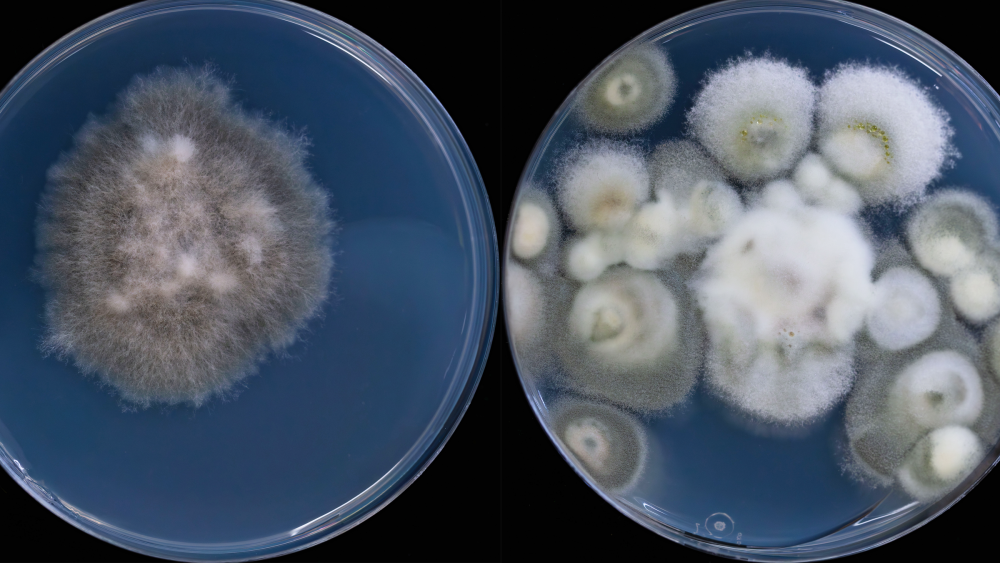
Quinn Moon, a doctoral candidate at the University of Michigan (UM), filtered a batch of that water, shook the filters in clean water to knock the cells loose, and spread what came off across agar plates.
“I remember looking at the culturing media plates a few days after I collected the water and they were filled with many many different strains growing in all shapes and colors,” Moon told Earth.com.
Hundreds of strains grew. Moon says most people on the project doubted the team would find any trace of fungi that deep.
Gas wells yield ancient shale water
Moon’s team sampled six working gas wells in the Antrim Shale, a rock formation rich in organic material under much of the Great Lakes region. The wells reach 810 to 1,824 feet down (247 to 556 meters), roughly a third of a mile at the deepest.
At each wellhead the team collected 21 gallons (80 liters) of water, then filtered it until the filters clogged.
The shallowest well produced relatively fresh water, with 448 milligrams of dissolved solids per liter. The deepest came up at 112,000 milligrams per liter, about three times saltier than seawater.
In the fresher wells, hydrogen and oxygen in the water match late Ice Age meltwater. Moon puts its last contact with the surface at about 11,000 years ago.
Moon’s team also had to rule out contamination from the surface. They plated sterile water as a control and left the same growth media open to room air for five minutes. Twenty-three colonies grew on those plates, and every strain matching one of them came out of the results.
Shale water teems with fungi
Under a microscope, using a stain that binds fungal cell walls, Moon counted 4,200 to 6,800 fungal cells per milliliter of well water. A single drop holds roughly 250 of them.
Ocean water holds 8 to 2,000 fungal cells per milliliter. The shale water runs at least twice as crowded as the richest ocean water, and hundreds of times denser than most of it.
Bacteria still outnumber fungi by hundreds to thousands of cells to one. Fungal cells are much larger, though, and once Moon’s team converted the counts to carbon, the fungi came to about a fifth as much carbon as the bacteria.
Rotifers, roundworms, segmented worms, and the eight-legged animals known as water bears showed up in the genetic data, along with parasites that attack animals and other fungi.
Many fungi are new to science
Moon’s team grew 205 pure cultures, which sorted into 67 distinct groups. Twenty-six of those groups matched no known genus.
Thirteen matched no described species closely enough to count as one. One of them, Teichospora sp. QM01, matched its closest database relative at 74 percent.
A white rot fungus called Irpex cf. lacteus turned up in all six wells. White rots break down wood at the surface.
Those cultures are now frozen and dried at the University of Michigan Herbarium, the first public collection of deep subsurface fungi.
A study led by University of Michigan researchers found that organic-rich rocks and water deep below ground teem with life: they are packed with fungi and other tiny organisms. Click to view full image. Photo credit: John Megahan, University of Michigan
Underground fungi may affect carbon
About 90% of the planet’s organic carbon is stored underground in oil, coal, and shale. The other 10% is in plants, soils, and the oceans.
Moon says climate projections assume most of that 90% stays put, and that abundant fungi raise questions about how fast those deposits turn to gas.
People also plan to put carbon down there on purpose, since nearly every method for pulling carbon dioxide out of the air ends with injecting it deep underground.
“These strategies have yet to consider they may inject this carbon into environments with tons of fungi that could break down the carbon and convert it into unforeseen forms,” Moon told Earth.com.
Moon’s team names the limits. Nobody has measured how much carbon a subsurface fungal cell contains, so they borrowed conversion factors from ocean research. Their filters caught only free-living cells, and in comparable settings 20% to 80% of microbial life lives in films on surfaces rather than loose in the water. A cell in the water may also be dormant rather than active.
Researchers test fungi on pollutants
“In all my training becoming a fungal biologist, none of the textbooks cover the subsurface, so for me to make this finding just raises a million unanswered questions about the diversity and role of fungi in subsurface ecosystems,” Moon told Earth.com.
His team is working with the Joint Genome Institute to sequence every strain and find out how these fungi survive that far down.
None of that was the plan when the sampling started. Moon says work like this begins as a basic question about who lives underground and how the carbon cycle runs, and only later turns into something with a use. He says the current administration is pushing to limit basic science of that kind.
“As soon as we stop funding ‘basic’ science, our ability to produce applied science will also fall behind,” Moon says.
The use, in this case, may already be waiting. The team is now feeding its strains coal, shale, oil, and plastic, to find out what they will eat. If something in those plates breaks down a hydrocarbon that nobody else can, the payoff could be significant. A fungus that has spent 11,000 years in the dark under Michigan could become a cleanup tool.
The full study was published in the ISME journal.
Photo credit: Ronan Montgomery-Taylor, University of Michigan
—–
Like what you read? Subscribe to our newsletter for engaging articles, exclusive content, and the latest updates.
Check us out on EarthSnap, a free app brought to you by Eric Ralls and Earth.com.
—–