This question by Helle Lyng Svendsen has ignited a debate about the role of the press in a democracy – and refocused attention on the Indian prime minister’s refusal to address press conferences.
“Norway has the number one spot on the World Press Freedom Index, India is at 157th, competing with Palestine, Emirates and Cuba,” she said.
Norway has the number one spot on the World Press Freedom Index, India is at 157th, competing with Palestine, Emirates & Cuba.
Svendsen asked why Oslo should trust New Delhi.
Sibi George responds to Dutch PM's statement of concern on Indian minorities"These questions show a lack of understanding about India.
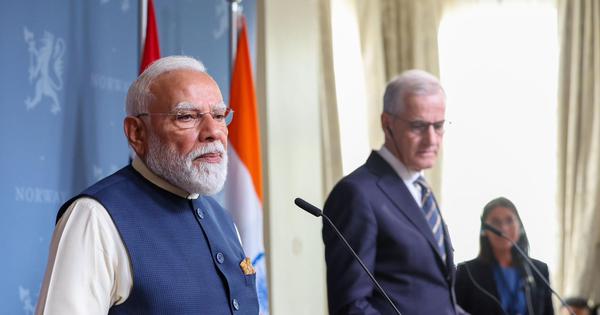
“Prime Minister Modi, why don’t you take some questions from the freest press in the world?” a journalist with the Oslo-based newspaper Dagsavisen asked as the Indian leader was leaving the podium after he and his Norwegian counterpart had addressed a joint press meet on Monday.
This question by Helle Lyng Svendsen has ignited a debate about the role of the press in a democracy – and refocused attention on the Indian prime minister’s refusal to address press conferences.
After Modi, who was on a five-nation tour of the United Arab Emirates and Europe, departed without acknowledging Svendsen’s query, Svendsen said on social media that she had not actually expected the Indian leader to take her question.
“Norway has the number one spot on the World Press Freedom Index, India is at 157th, competing with Palestine, Emirates and Cuba,” she said. “It is our job to question the powers we cooperate with.”
Primeminister of India, Narendra Modi, would not take my question, I was not expecting him to.
Norway has the number one spot on the World Press Freedom Index, India is at 157th, competing with Palestine, Emirates & Cuba.
It is our job to question the powers we cooperate… pic.twitter.com/vZHYZnAvev — Helle Lyng (@HelleLyngSvends) May 18, 2026
On social media, Bharatiya Janata Party supporters claimed that Svendsen had acted inappropriately. Some said that she had failed to understand that this was a “press briefing” and not a '“press conference” at which questions could be asked.
Others were more intemperate. Amit Malviya, the head of the BJP’s propaganda cell, characterised her question as a “delinquent journalist’s incoherent rant”. He suggested that she had asked it because she did “not want to see a strong and powerful India”.
Businessman Mohandas Pai, a loud BJP supporter on social media, claimed that Svendsen was “a racist white supremchist masquerading as a journalist, boorish, loud, dumb”.
India, Pai said, “has more than 2,000 newspapers, 460+ TV channels who are everyday criticising the govt. we may have more ‘journalists’ than your whole population. A stooge of George Soros, paid poorly too points fingers.”
Some accused her of being a spy.
As expected, Indian right wing trolls are now doxxing Norwegian journalist @HelleLyngSvends. Sharing her mobile number and even her home address online. — Mohammed Zubair (@zoo_bear) May 19, 2026
Modi’s opponents saw this as just another instance of the prime minister’s evasions. Since he came to power in 2014, Modi has avoided press conferences, both at home and abroad. He had taken unscripted questions from reporters at media meets only twice: in the UK in 2015 and in the US in 2023.
Congress leader Rahul Gandhi said that Modi’s reaction to Svendsen had undermined the country’s image. “When there is nothing to hide, there is nothing to fear,” he said on X. “What happens to India’s image when the world sees a compromised PM panic and run from a few questions?”
Svendsen, on her part, refused to give up. She followed Modi out of the room to try to get a response.
“Tried to ask PM Modi a question on the way to the elevator [too], but the closing doors stopped me,” she wrote on X. “What I was wondering was whether he thinks he deserves the trust of the Nordic countries given his human rights violations and his restrictions on press freedom.”
Tried to ask PM Modi a question on the way to the elevator to, but the closing doors stopped me.
What I was wondering was whether he thinks he deserves the trust of the Nordic countries given his human rights violations and his restrictions on press freedom. pic.twitter.com/W2HFFNcCKh — Helle Lyng (@HelleLyngSvends) May 18, 2026
Svendsen explained on X later: “In Norway, when foreign leaders visit. The press usually will get to ask questions. Not many, but a few. That was not the case today with Modi, and will not be tomorrow either.”
Shortly after, the Indian embassy in Norway told Svendsen that it was organising a press conference later on Monday night. “You are most welcome to come and ask your questions there,” it said on X, ignoring her question about whether she would be able to interview Modi there.
The event turned out to be slightly farcical. Svendsen asked why Oslo should trust New Delhi. She also asked if it could be promised that “human rights violations that go on in your country” would be stopped and “will the prime minister start taking critical questions from the Indian press at some point in the future”.
In response, Sibi George, the Ministry of External Affairs’ secretary (West), spoke for 13 minutes, without specifically answering Lyng’s question.
Offering what he claimed was a background for why the world should trust India, he said that India is a “civilisational country that is 5,000 years old” and has “something unique that it has offered to the world and continues to”.
The numeral zero had originated in India, he said, as also yoga and chess.
Why do Indian government officials turn into white hippies visiting Goa when asked a hard question by international press? “The culture, the colours, the yoga, the food, the people namasté 😍😩🙏🏼” pic.twitter.com/ruGhD4jFPv — Sanitary Panels (@sanitarypanels) May 19, 2026
When Svendsen said he was not answering the question, George said that it was his press conference and asked her not to interrupt.
Full blown clash at MEA presser as reporter asks "why should India be trusted".
MEA's Secy West @AmbSibiGeorge responds by India's role in providing global help during Covid, India's constitution, fundamental rights.
The reporter leaves the presser, then later comes back. pic.twitter.com/K3OyZZ6Z2h — Sidhant Sibal (@sidhant) May 18, 2026
This is not the first time during the prime minister’s tour that questions about press freedom in India have been raised.
As Modi arrived in the Netherlands on Saturday, his Dutch counterpart, Rob Jetten, told reporters that there were concerns within his country and other European Union member states about “developments in India”.
“It is not only about press freedom, but also about the rights of minorities, who are under severe pressure,” Jetten was quoted as saying. “That applies in the first place to the Muslim community, but also to many other smaller communities.”
A journalist with the Dutch newspaper De Volkskrant, Ashwant Nandram, had later that day asked the Indian delegation for a response to Jetten’s statement.
Nandram also asked: “In the Netherlands, there is a tradition that after such a visit, both prime ministers are available for questions. I wonder what the reason is that that is not the case today.”
She asked why should we trust India. And then thousands of hindutva trolls flooded her Twitter basically showing why she was right to ask that question.
New India is beyond parody.
Petulance is its primary characteristic. https://t.co/P6yn450i7E — Gaurav Sabnis (@gauravsabnis) May 19, 2026
In response, George had said that New Delhi faces such questions “basically because of the lack of understanding of the person who asked the question”. He claimed that some people abroad formed mistaken impressions about India because they read reports published by “ignorant NGOs”.
George described India as a “noisy democracy” and said that the population of minority groups had risen from 11% at the time of independence to more than 20%. At that time, he invoked India’s “5,000-year-old pluralistic heritage”, stating that Christianity, Islam and Judaism found historical refuge in India.
Amb. Sibi George responds to Dutch PM's statement of concern on Indian minorities
"These questions show a lack of understanding about India. Jews never faced persecution here. We have 30 million Christians. Islam flourished. Attacked minorities have always come here."… https://t.co/8hzgujqbSC pic.twitter.com/Uju6WASIMb — India Strikes YT 🇮🇳 (@IndiaStrikes_) May 17, 2026
On Tuesday in Oslo, long after George’s press conference, Svendsen was still explaining to Indian critics on X what role journalists are expected to play in a democracy.
“Journalism is sometimes confrontational,” she wrote. “We seek answers. If any interview subject, especially with power, do not answer what I asked, I will try to interrupt and get a more focused response. That is my job and duty. I want answers and not just talking points.”