In 2016, Hubble observations estimated that one population formed roughly 12 billion years ago while the second formed about 5 billion years ago.
As new generations of stars formed, they incorporated the heavier elements produced by earlier stars.
A survivor from the Milky Way’s youthThe study points to a more dramatic conclusion.
Researchers now plan to examine between 40 and 50 other clusters located within the Milky Way’s bulge to see whether more hidden fossil fragments are waiting to be identified.
It may be one of the few surviving pieces of the Milky Way’s earliest construction history, preserved for billions of years in plain sight.
The middle of the Milky Way is anything but quiet. Stars fill the region, dust clouds make observations difficult, and the galaxy’s earliest history is still written across its crowded core.
Astronomers have long believed that most of the stars there mixed together during the galaxy’s early growth. But one unusual object appears to have followed a very different path.
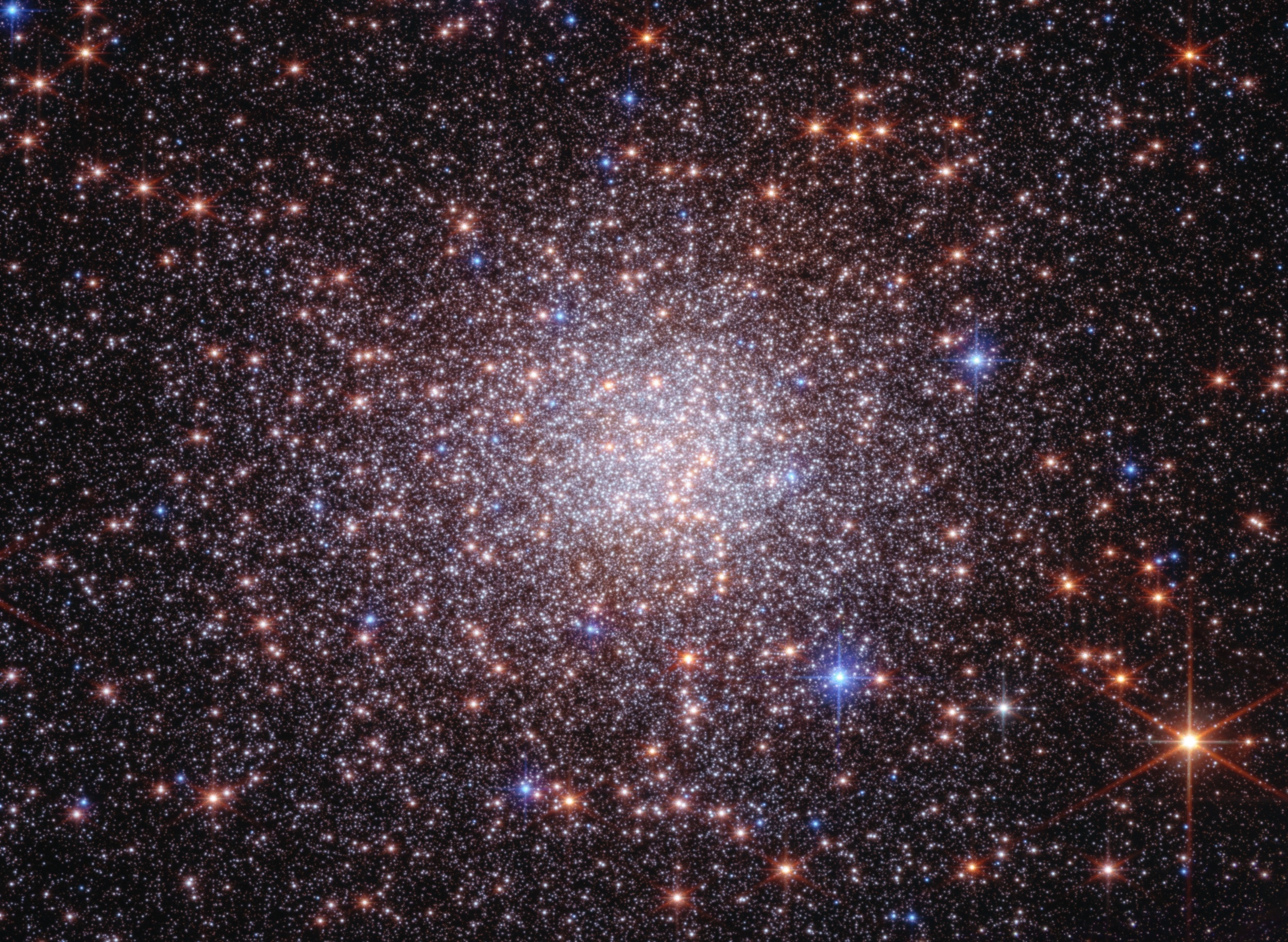
New observations from NASA’s James Webb Space Telescope and the Hubble Space Telescope show that a stellar system called Terzan 5 is not what scientists once thought it was.
For decades, it was classified as a globular star cluster, a type of object that typically contains a single ancient population of stars.
The new findings reveal something much more complicated.
A system with a long memory
Terzan 5 was discovered in 1968 by astronomer Azop Terzan. At first glance, it seemed similar to many globular clusters found throughout the Milky Way.
Those clusters usually contain stars that formed during a single period billions of years ago.
The picture started to change in 2009 when astronomers found that Terzan 5 contained two distinct groups of stars.
In 2016, Hubble observations estimated that one population formed roughly 12 billion years ago while the second formed about 5 billion years ago. Even then, Terzan 5 appeared unusual.
The research was led by Giorgia Zullo, a PhD student at the University of Bologna in Italy.
“Webb’s new near-infrared observations, cross-referenced with Hubble’s archival observations, have given us a much clearer picture of the history of Terzan 5,” said Zullo.
Four generations of stars
Studying Terzan 5 is difficult because it sits inside the Milky Way’s bulge, a dense central region filled with stars and obscuring dust.
Webb’s infrared instruments allowed astronomers to see through much of that dust and detect many faint stars that earlier observations missed.
Scientists analyzed the colors and brightness of those stars to determine their ages and chemical makeup. Hubble played a crucial role as well.
By comparing observations taken 12 years apart, researchers tracked tiny stellar motions and separated Terzan 5 stars from unrelated stars in the surrounding bulge.
Repeated episodes of star formation
The combined data revealed evidence for not just two stellar populations, but four.
Researchers determined that the oldest stars formed 12.5 billion years ago. Another generation appeared 4.7 billion years ago.
Two additional populations formed 3.8 billion and 2.5 billion years ago.
The results suggest that Terzan 5 experienced repeated episodes of star formation over billions of years, something globular clusters are not known to do.
Why Terzan 5 kept making stars
Stars form from clouds of gas and dust. When massive stars explode as supernovae, they create heavier elements and blast material into surrounding space.
Smaller systems often lose that material because the explosions push it away.
Terzan 5 appears to have been massive enough to hold onto those ingredients.
As new generations of stars formed, they incorporated the heavier elements produced by earlier stars.
Stars that are chemically distinct
Measurements from the W. M. Keck Observatory and the European Southern Observatory’s Very Large Telescope support the existence of these chemically distinct populations.
Study co-author R. Michael Rich is a research astronomer at the University of California, Los Angeles (UCLA).
“Along with the ages of these populations, the cluster preserves a fossil record of progressive enrichment of heavy elements by supernovae,” said Rich.
Because astronomers found four separate generations of stars, simpler explanations no longer fit.
Earlier theories suggested that Terzan 5 might have collided with another cluster or captured fresh gas from elsewhere. The new evidence makes those ideas unlikely.
A survivor from the Milky Way’s youth
The study points to a more dramatic conclusion. Terzan 5 was probably once part of a much larger stellar system that formed 12.5 billion years ago during the Milky Way’s earliest years.
Most similar structures would have merged into the growing galactic bulge long ago. Terzan 5 somehow survived.
“For some reason, this peculiar clump of stars formed separately from the bulge and was not destroyed as the bulge itself formed,” said Francesco R. Ferraro, principal investigator of the Webb observations.
“Terzan 5 is what we now call a bulge fossil fragment because it resembles the primordial clumps that contributed to the formation of the bulge.”
Only one other known object has received the same classification. Called Liller 1, it also contains multiple generations of stars.
Researchers now plan to examine between 40 and 50 other clusters located within the Milky Way’s bulge to see whether more hidden fossil fragments are waiting to be identified.
Clues to how galaxies grow
The implications stretch far beyond our galaxy.
“Based on observations and in-depth simulations, we think that galaxies in the early universe had huge disks of gas that fragmented into clumps and formed stars,” said study co-author Professor Barbara Lanzoni.
“These clumps migrated to the center of the galaxies, and many merged to form their bulges.”
Recent Webb observations have revealed several distant galaxies with this clumpy appearance, including the Firefly Sparkle galaxy, which existed when the universe was only a few hundred million years old.
“Terzan 5 may provide direct evidence that can help explain how bulges formed in galaxies throughout the universe,” Lanzoni said.
For astronomers trying to understand how galaxies came together, Terzan 5 may be more than an odd collection of stars.
It may be one of the few surviving pieces of the Milky Way’s earliest construction history, preserved for billions of years in plain sight.
The full study was published in the journal Astronomy & Astrophysics.
Image Credit: NASA, ESA, CSA, STScI, Giorgia Zullo (University of Bologna), Francesco Ferraro (University of Bologna)
—–
Like what you read? Subscribe to our newsletter for engaging articles, exclusive content, and the latest updates.
Check us out on EarthSnap, a free app brought to you by Eric Ralls and Earth.com.
—–