Therefore, the Milky Way likely flipped.
Yet its fingerprints remain readable in the kinematics of stars that orbit the Milky Way today.
How do scientists know the Milky Way flipped if no one observed it happening?
Why does the Milky Way's stellar halo rotate so slowly compared to the disk?
The stellar halo is made up largely of ancient stars originally formed in smaller galaxies, including many from the Gaia Sausage, that were deposited into the Milky Way through mergers.
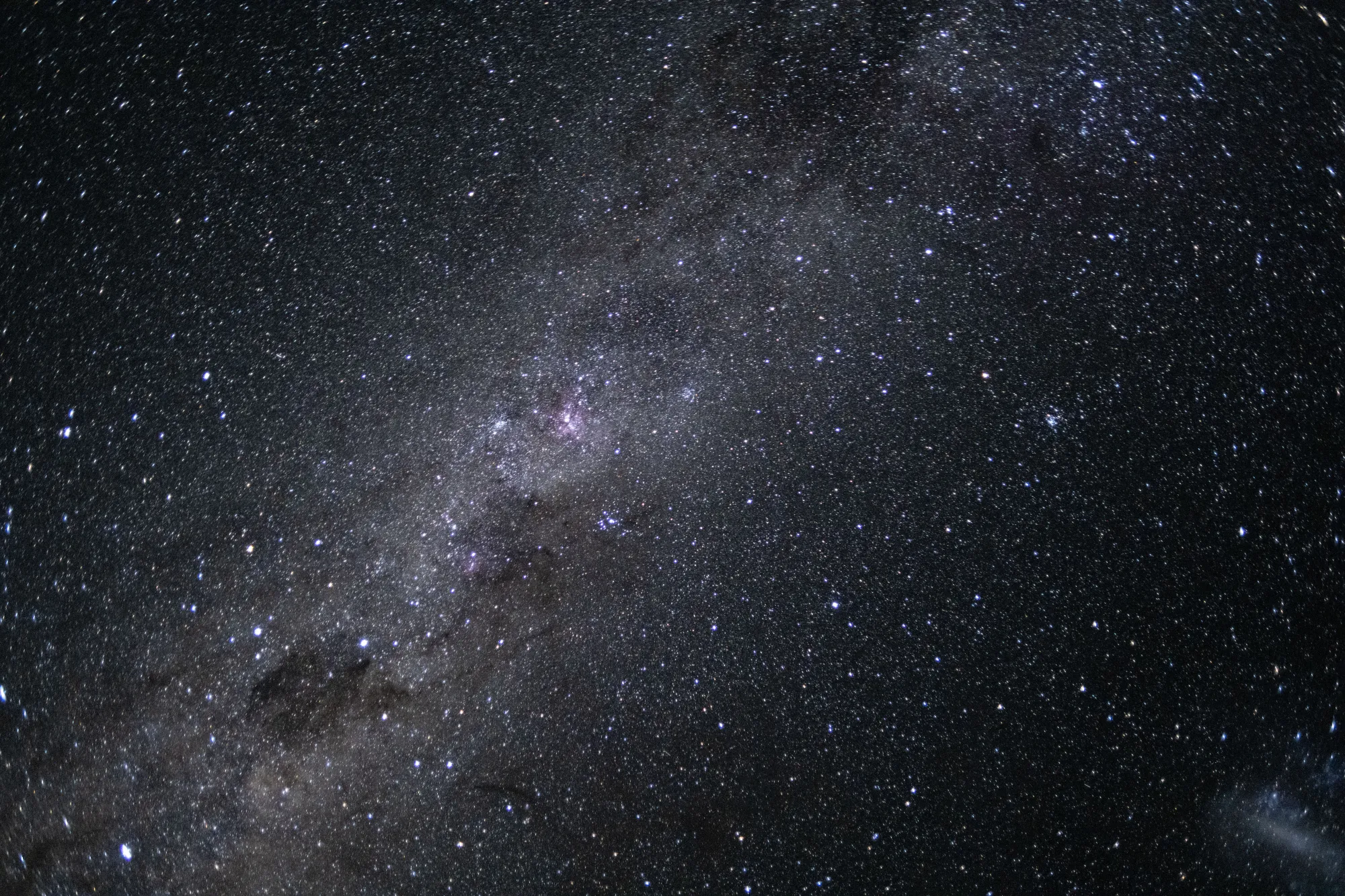
The galaxy arcing above you on a dark summer night may be pointing in an entirely different direction than the one your stellar ancestors would have recognized. New supercomputer simulations presented at the United Kingdom's premier annual astronomy conference show that roughly 10 billion years ago, a catastrophic head-on collision with a massive dwarf galaxy sent the Milky Way tumbling — flipping its entire disk by more than 90 degrees and reshaping the orbits of billions of stars, possibly including ancestors of the Sun. The simulations, produced at Durham University using the Auriga suite of cosmological zoom-in models, also provide the first coherent explanation for one of the most persistent puzzles thrown up by the European Space Agency's Gaia mission: why the ancient stellar halo surrounding the Milky Way barely rotates at all.
How Astronomers Found a 10-Billion-Year-Old Somersault
The puzzle begins with a number: the Milky Way's stellar halo — a vast, sparse sphere of ancient stars surrounding the flat spiral disk — rotates at roughly 10 to 20 kilometers per second (6 to 12 miles per second). The disk itself spins at approximately 220 kilometers per second (137 miles per second). That 11-to-1 ratio, confirmed by Gaia data, had no accepted explanation.
Kirill Batrakov, an astronomer at Durham University and lead researcher on the project, turned to the Auriga suite to look for one. The Auriga simulations are a set of cosmological "zoom-in" models that track the formation and evolution of 30 to 40 Milky Way-mass galaxies starting from shortly after the Big Bang. They run using a computational method called AREPO — a moving-mesh magnetohydrodynamics code that treats the gas in and around galaxies as a fluid evolving under gravity and magnetic forces, while tracking dark matter particles and stellar populations alongside it. Crucially, the code produces a series of "snapshot" outputs at different epochs, each labeled by redshift — an astronomer's measure of cosmic time, where z=0 is today and larger values correspond to earlier periods in the universe's history. By comparing the angle of a galaxy's stellar disk angular momentum vector from one snapshot to the next, the team could detect when and by how much a disk reoriented over cosmic time.
Batrakov's team analyzed the evolution of 25 of these simulated Milky Way-like galaxies. Among the galaxies with the slowest stellar halo rotation, a striking pattern emerged: those galaxies had almost always experienced both a major head-on merger with another galaxy and a large-scale disk reorientation of more than 90 degrees. The connection between those two events and the sluggish halo appeared, in the simulations, to be causal — not coincidental.
The logical chain, as Batrakov explained it at the Royal Astronomical Society's National Astronomy Meeting (NAM 2026) in Birmingham on July 21, 2026, runs like this: the Milky Way is already known to have undergone a massive head-on collision in its past with a dwarf galaxy called Gaia-Sausage-Enceladus, roughly 10 to 11 billion years ago. The simulations show that galaxies that experienced that kind of collision also experienced a disk flip. Therefore, the Milky Way likely flipped. And that flip, the simulations suggest, is what left the halo spinning so slowly today.
Gaia Sausage: What Slammed Into the Milky Way
The Gaia-Sausage-Enceladus — shortened by most researchers to the Gaia Sausage — was a massive dwarf galaxy that the Milky Way absorbed between 10 and 11 billion years ago in what was the largest merger event in our galaxy's early history. The merger left behind billions of stars that now orbit the Milky Way on highly elongated, nearly radial paths — creating a characteristic "sausage" shape when plotted in velocity space, which is how the Gaia satellite first revealed the merger's existence in 2018.
The word "collision" can create a misleading mental image, Batrakov noted. Galaxies contain enormous numbers of stars, but the distances separating those stars are so vast that two galaxies can pass through one another without triggering a barrage of direct stellar impacts. What the merger did instead was gravitationally reshape the Milky Way from the outside in — like a gyroscope struck off-balance — torquing the entire disk into a radically new orientation.
The older, thicker stars in the disk at the time of the collision were on more chaotic, eccentric orbits and less tightly coupled to the disk's rotational plane. As the disk reoriented beneath them, those stars were effectively left behind in their original orbital orientations relative to the new disk alignment — which is precisely why the halo they now comprise appears to rotate so sluggishly compared to the younger disk stars that formed after the collision.
Peer-Reviewed Support: What the Dark Matter Halo Reveals
The Batrakov simulations presented at NAM 2026 have not yet completed formal peer review — a normal state for conference presentations that represent ongoing work. But an independent, peer-reviewed study published in Astronomy & Astrophysics in February 2026 arrived at the same conclusion from an entirely different direction: by measuring the three-dimensional shape of the Milky Way's dark matter halo.
That study, led by Ling Zhu and seven co-authors and based on six-dimensional positional and velocity data from more than 600,000 giant stars observed by the LAMOST telescope and the Gaia mission, found that the Milky Way's dark matter halo has an unexpected orientation. In the inner reaches of the galaxy — within roughly 65,000 light-years of the galactic center — the dark matter halo appears broadly aligned with the stellar disk, as expected. Beyond that radius, however, the halo's long-intermediate axis plane rotates roughly perpendicular to the disk: the two structures no longer align. The Zhu team described the configuration as a "twisted" halo, whose geometry is precisely what the disk-flip scenario predicts — a disk that has swung away from the orientation it once shared with the dark matter halo that surrounds it.
Together, these two independent lines of investigation — one using cosmological zoom-in simulations of 25 Milky Way-like galaxies, the other applying an innovative dynamical model to observational data from hundreds of thousands of real stars — point to the same history: the Milky Way we inhabit today is a galaxy that has been profoundly reoriented from its original configuration.
What Does a Disk Flip Actually Mean?
A disk reorientation of more than 90 degrees is about as dramatic a structural change as a galaxy can undergo while still remaining recognizably itself. Imagine the flat spiral of the Milky Way — its stars, gas, dust, and our own Solar System — rotating until what was once its equatorial plane was pointing toward where its pole used to be. Every orbit in the disk, including the orbit that would eventually become the Sun's, would have been carried along for that slow-motion somersault.
The simulations suggest that during the flip, the stellar and dark matter halos rotated together in a broadly coupled fashion, tracking the merger event and the arrival of the Gaia Sausage stars. The flip does not happen in every galaxy; it required the specific combination of a near-direct, head-on trajectory and a merging object massive enough to exert a significant gravitational torque on the host galaxy's disk. The Milky Way's particular merger history made it susceptible.
Batrakov offered a precise summary of what personally surprised him most about the finding: the connection between the rotation of the stellar halo and the disk's past orientation was unexpected — a discovery that emerged not from a targeted hypothesis but from a systematic search through simulation histories for anything those slow-halo galaxies had in common.
How Astronomers Reconstruct History From Today's Stars
One of the philosophically striking aspects of this finding is what it demonstrates about the accessibility of deep cosmic history. The Gaia-Sausage-Enceladus collision happened when the universe was less than 4 billion years old — before the Earth, the Sun, or even the oldest stars visible to the naked eye had formed. Yet its fingerprints remain readable in the kinematics of stars that orbit the Milky Way today.
The Milky Way's position as our home galaxy gives astronomers an unusual advantage: we can study its stellar populations in six-dimensional detail — position and velocity for hundreds of millions of individual stars — that no other galaxy can offer. That depth of information allows the kind of reconstruction the Batrakov team performed: working backward from the slow-spinning halo to identify what formation history could have produced it, then cross-referencing that history against the Milky Way's known past.
The Zhu et al. study demonstrates the complementary approach: starting from present-day observations of where dark matter must be distributed to explain how those stars actually move, and inferring the structural history that produced today's configuration. The fact that both approaches — one inferential from simulations, one directly observational from stellar dynamics — produced the same answer is, for astronomers, the closest available analog to independent confirmation of an event that no one was there to witness.
What the Finding Still Cannot Confirm
The results warrant the epistemic caution Batrakov himself applied. "I think a disk flip is a likely explanation," he said, "but it is too early to say with 100 percent certainty. Ideally, we should try to identify alternative signatures of past disk flips to make that claim with full confidence."
Disk flips are fairly common in cosmological simulations of galaxy formation; whether simulation results translate cleanly into observable reality for specific galaxies remains a live question in the field. The Batrakov study's conference-stage results also have not yet been subjected to the full scrutiny of peer review, which may refine or qualify some aspects of the causal chain.
What the convergence of the simulation and observational results does offer is a coherent, mechanistically grounded hypothesis that now has two independent lines of support — and that, for a question about events 10 billion years in the past, is significant progress.
Frequently Asked Questions
What is the Gaia Sausage, and why does it matter for this discovery?
The Gaia-Sausage-Enceladus is a massive dwarf galaxy that the Milky Way absorbed in a head-on collision roughly 10 to 11 billion years ago — the largest merger in our galaxy's early history. Gaia satellite data revealed its remnant stars orbiting on highly elongated, radial paths that form a characteristic "sausage" shape in velocity space. Batrakov's Durham team found that Milky Way-like galaxies in the Auriga simulations with the slowest stellar halo rotation had almost universally experienced a major head-on merger and a disk flip — and the Milky Way's known Gaia Sausage collision provides exactly that merger. The collision's geometry and mass were sufficient to torque the entire disk into a new orientation, which is what the simulations suggest happened.
How do scientists know the Milky Way flipped if no one observed it happening?
Astronomers use two independent lines of evidence. The first is supercomputer simulation: by tracking 25 Milky Way-like galaxies through the Auriga cosmological zoom-in models over billions of simulated years, Batrakov's team identified which formation histories produce a slowly rotating stellar halo. The pattern — head-on merger plus disk flip — emerged consistently. The second is direct observational inference: Ling Zhu's team applied an innovative dynamical model to positional and velocity data from hundreds of thousands of real stars to map the three-dimensional shape of the Milky Way's dark matter halo. They found a configuration — aligned with the disk in the inner galaxy, rotated roughly perpendicular at larger distances — that is exactly what the disk-flip scenario predicts. Neither line of evidence provides a direct recording of the event, but their convergence on the same conclusion strengthens confidence in the hypothesis.
Did this ancient collision change the Sun's path through the galaxy?
Potentially, yes — though with important caveats. The disk flip would have reoriented the trajectories of all stars then orbiting in the disk, including any precursors to the Solar System's eventual formation region. Batrakov specifically noted that "a disk flip also means most of the Milky Way's stars once moved on very different trajectories than they do today — possibly even our own Sun, meaning our 'stable' spot in the galaxy might not have been so stable for the Solar System's whole lifetime." The Sun itself formed approximately 4.6 billion years ago, well after the collision. But the gas cloud from which it eventually formed would have been orbiting in a disk whose orientation had already been reshaped by the Gaia Sausage event.
Why does the Milky Way's stellar halo rotate so slowly compared to the disk?
The disk flipped; the halo did not fully follow. The stellar halo is made up largely of ancient stars originally formed in smaller galaxies, including many from the Gaia Sausage, that were deposited into the Milky Way through mergers. These stars orbit on chaotic, eccentric paths that were only loosely coupled to the disk's rotational plane at the time of the collision. As the disk reoriented by more than 90 degrees, those halo stars were effectively left behind in their original orbital orientations relative to the new disk alignment — producing today's large mismatch between halo rotation (~10–20 km/s, or 6–12 miles per second) and disk rotation (~220 km/s, or 137 miles per second). The Batrakov simulations reproduce this disparity precisely in galaxies that experienced the right kind of head-on merger.