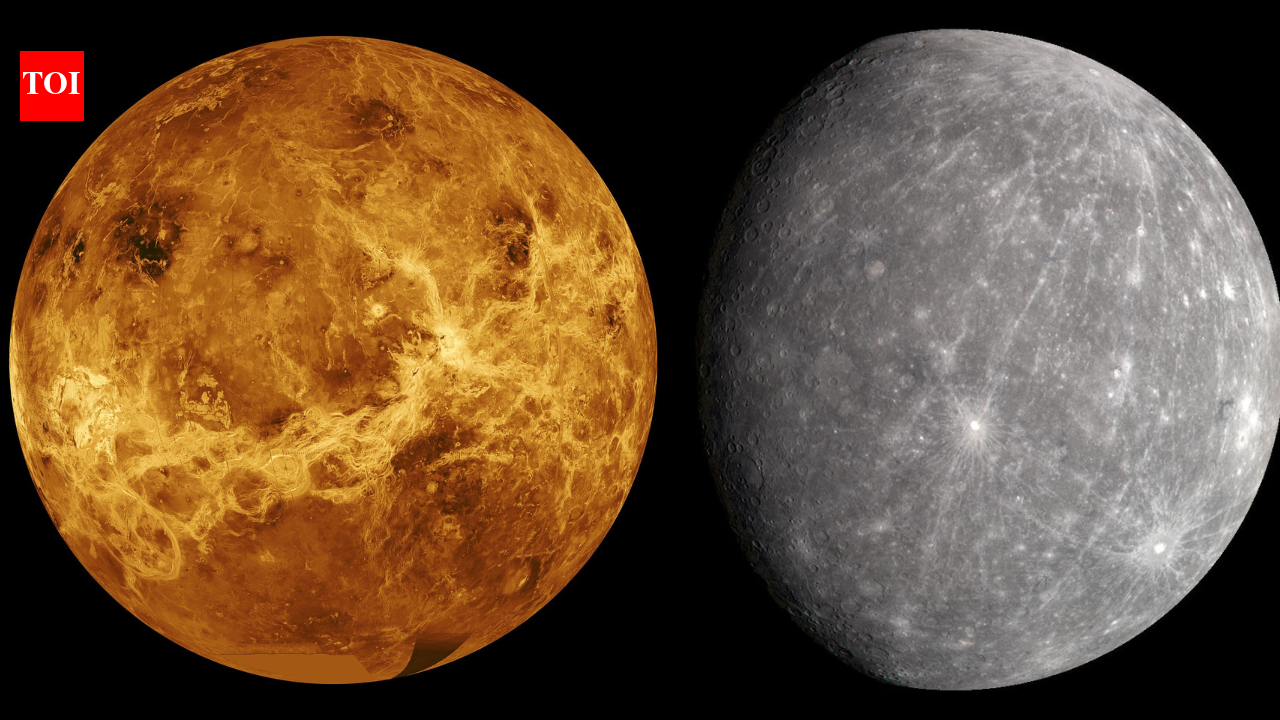
Even then, the hottest planet in the Solar System is Venus, where average surface temperatures reach about 867°F (464°C).
The difference doesn’t have much to do with the distance from the Sun and almost everything to do with each planet's atmosphere.
Mercury has almost no atmosphere to trap heat, and temperatures can plunge to around -290°F (-180°C) once the Sun sets.
NASA 's upcoming DAVINCI and VERITAS missions will investigate the planet's atmosphere and history in greater detail.
Mercury and Venus receive different amounts of sunlight, but their temperatures are determined by very different physical processes.
Venus and Mercury | Wikimedia Commons
Venus and Mercury | Wikimedia Commons
Mercury heats up quickly, but it also cools quickly
Venus keeps almost all of its heat
Impact craters on the surface of Venus (false-colour, 3D projection image reconstructed from radar data) | Wikimedia Commons
Venus offers a glimpse of an extreme greenhouse climate
Mercury receives far more sunlight than Venus because it circles the Sun at an average distance of about 36 million miles (58 million kilometers). Even then, the hottest planet in the Solar System is Venus, where average surface temperatures reach about 867°F (464°C). The difference doesn’t have much to do with the distance from the Sun and almost everything to do with each planet's atmosphere. Mercury has almost no atmosphere to trap heat, and temperatures can plunge to around -290°F (-180°C) once the Sun sets. Venus is wrapped in an atmosphere made up of about 96.5% carbon dioxide beneath thick clouds of sulfuric acid. That dense blanket prevents heat from escaping, which keeps the planet extremely hot day and night. Researchers at the USC Dornsife College of Letters, Arts and Sciences explain that Venus remains hotter than Mercury because of its powerful greenhouse effect rather than its position in the Solar System.Mercury has a very thin exosphere rather than a substantial atmosphere. Heat absorbed during the day escapes rapidly into space after sunset without a thick layer of gas surrounding the planet. This results in Mercury experiencing some of the largest temperature swings in the Solar System.Daytime temperatures near the equator can climb to about 800°F (430°C), while nighttime temperatures fall hundreds of degrees below freezing. The planet takes 59 Earth days to complete one rotation, so daylight and darkness each last for weeks. NASA notes that these large temperature differences are possible because Mercury lacks an atmosphere capable of storing and redistributing heat across the planet.Venus’s atmosphere is about 90 times denser than Earth's and is dominated by carbon dioxide, one of the main greenhouse gases. Sunlight passes through the atmosphere and warms the planet's surface. The heated surface releases infrared radiation, but a lot of that heat cannot escape because carbon dioxide absorbs and re-emits it. This process has produced a runaway greenhouse effect, which pushes surface temperatures to levels that remain nearly the same across the entire planet. Temperatures on Venus vary relatively little irrespective of whether it is daytime or nighttime, near the equator or closer to the poles. Spacecraft that have landed on Venus have survived only briefly before succumbing to the combination of extreme heat and atmospheric pressure. NASA describes the surface pressure as roughly 90 times greater than Earth's at sea level, which is comparable to the pressure found about 900 meters (3,000 feet) beneath Earth's oceans.Scientists continue to study Venus so that they can understand how rocky planets evolve under different atmospheric conditions. Venus and Earth are similar in size and composition, but their climates developed very differently. NASA 's upcoming DAVINCI and VERITAS missions will investigate the planet's atmosphere and history in greater detail. Researchers hope the data will improve understanding of how Venus became so hot and whether it once had conditions more like Earth's. Mercury and Venus receive different amounts of sunlight, but their temperatures are determined by very different physical processes. One planet loses heat almost as quickly as it gains it, while the other traps heat so efficiently that it remains the hottest world in the Solar System despite orbiting farther from the Sun.