When Apollo astronauts first explored the Moon, they discovered that the dust they encountered there was more than just a nuisance.
But there is a key fundamental difference between dust on the Moon and dust on Mars.
Chris - It sounds like you already know quite a bit about the dust on Mars.
So pretty much every mission that has landed on the surface of Mars has characterised the dust in some way.
Up until now, the smallest size particles that we were able to resolve was around three microns in size, or about three thousandths of a millimetre.
When Apollo astronauts first explored the Moon, they discovered that the dust they encountered there was more than just a nuisance. It clung to their spacesuits, scratched equipment, and even caused them irritation and respiratory problems when they got inside their spacecraft. But, forewarned is forearmed, and now, as we set our sights on sending humans farther afield, to Mars, scientists are trying to stay one step ahead so that the next giant leap doesn’t run into the same problems. Scott VanBommel at Washington University in St. Louis has been telling Chris Smith how…
Scott - With the Perseverance rover, which landed on Mars in 2021, we have a very capable spacecraft, and it gave us the opportunity to analyse Martian dust in a way that we have not been able to do before. And one of the things that is particularly interesting about dust is that because there is no ocean, there's no river, there's no bodies of water on the surface of Mars, dust tends to accumulate on the surface, get mixed around, and it provides a window into all of Mars that you can investigate at one location. But on top of that, because the dust is everywhere, it is something that you have to plan for when you are planning missions, or especially when you are planning missions that could involve sending humans to the surface.
Chris - A sort of occupational hazard. Because we've been down this road a bit before with the Moon, because that, correct me if I'm wrong, is also very dusty, and that dust turns out to be quite nasty.
Scott - Yeah, exactly. But there is a key fundamental difference between dust on the Moon and dust on Mars. Because the Moon doesn't have an atmosphere, the dust that is on the Moon is formed through lots of impacts, including from micrometeorites. And those impacts essentially create lunar dust that is very sharp and angular. And it is the shape of those particles that led to the degradation of the spacesuits, that led to the respiratory issues that the Apollo astronauts had. But thankfully on Mars we have wind, and this causes the dust to be more rounded, and that shifts the concern from a shape to a particle size and a composition.
Chris - It sounds like you already know quite a bit about the dust on Mars.
Scott - We do, yes. So pretty much every mission that has landed on the surface of Mars has characterised the dust in some way. And in the study that came out, we're building on these past studies, and because dust is so prevalent all over Mars, and because it is so well-mixed, the composition of it is quite well constrained. We know it very well. That being said, there's still a lot we don't know about dust on Mars, and getting a window into the smallest size particles was something of particular interest, specifically because as a particle gets smaller, its potential to penetrate deeper into the human body increases.
Chris - How have you looked at this?
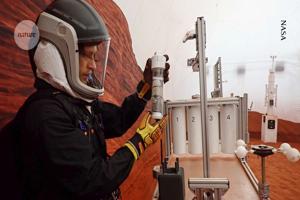
Scott - So we used the X-ray spectrometer that is on the end of the Perseverance's arm, and we took that spectrometer and looked at some materials on the rover that we brought with it from Earth, in particular some calibration standards. So these are pucks of a composition that we know very well, and we also looked at some samples of spacesuits, and these spacesuit samples were brought to Mars to observe how they interacted with the Martian environment over time.
Chris - So just to clarify, those samples are outside the rover being exposed to the Martian environment over time, and you can look at them and see how they're interacting with that environment for real?
Scott - That is correct, yes. The samples that we measured were affixed to the front of the rover and completely exposed to the Martian environment from the moment the rover landed up until the time that we conducted this study, and they're still exposed to the environment now. And we can see the amount of dust on these materials changing over time as dust storms come and go as the rover drives, and just as the general life of a rover causes lots of vibration to liberate some of the larger particles from the spacesuits or the calibration pucks.
Chris - What sort of resolution can you see down to? How big? Because obviously you're saying size matters. When it comes to these tiny particles, they can go everywhere if they're small enough. So how small can you see, and what are you seeing?
Scott - What we can see depends on the instrument that we're using. Up until now, the smallest size particles that we were able to resolve was around three microns in size, or about three thousandths of a millimetre. A human hair is on the order of 70 or 80 microns, and we were measuring something on the order of a couple microns in the case of fine dust. But with the x-ray spectrometer, and given the properties of the materials that we were analysing the dust on, we were able to probe these particles down to a size on a sub-micrometre level. So we're talking several hundred nanometres in diameter or thereabouts.
Chris - And what can you see about the surface characteristics? Can you see how the dust particles are interacting with that surface, and what they're doing to the surface, and how the surface is therefore changing over time?
Scott - So one of the things that was particularly interesting about this study is that we found that the materials had a tendency to attract certain sizes of particles. And we believe what's happening is that the different spacesuit samples, different calibration target materials, the physical properties of these samples and materials is essentially sorting particles into different sizes just based on the electrostatics. So the same kind of phenomenon that you get if you rub a balloon against your hair, that is in a way driving, we think, the sorting of these particles into different sizes.
Chris - And are they potentially pathological, as in bad for the astronaut who might be wearing that suit one day, but also the material itself? Because if you've got these particles being sorted and it's sorting them into really small ones that will work their way right inside versus bigger ones that are easier to get rid of, we might have more of a problem.
Scott - Yeah. So dust has been on NASA's radar for quite a while, including fine and ultra-fine dust. So these really small particles that we found in this study. But the thing to keep in mind with anything that is toxic, it's about dose and duration. And you can design your human support systems, your crew habitat, your spacesuits around these risk factors. And one of the cool things that I think is being planned or considered, I should say, is the use of a suit port system, which if you think about movies where you have those stereotypical pyjamas with the trap door on the backside, it's a spacesuit with a similar system where you would dock the rear end of the spacesuit to the habitat. So the suit itself never actually enters the crewed area. Dust is a challenge, but it is also a challenge being so far away. It is also a challenge, the radiation. It is also a challenge, the temperature. There are plenty of challenges to operating robots on Mars. And there are additional challenges for having humans on the surface. And dust is just one of many that the brilliant minds at NASA, Marshall Partners, its international partners are all working to mitigate.