On January 24, 2023, Lindsay Clancy's husband, Patrick, left their home in Duxbury, Massachusetts, to run errands.
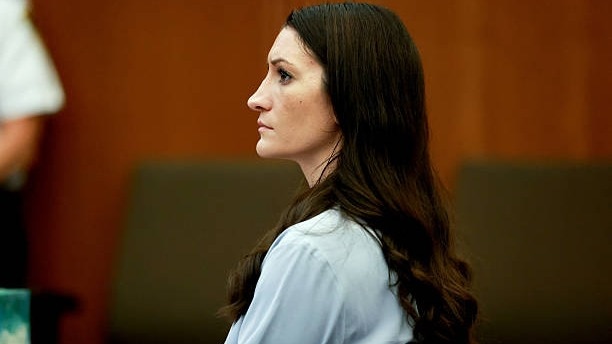
Lindsay Clancy cries at Plymouth Superior Court.
Supporters of Lindsay Clancy gather outside of Plymouth Superior Court.
Patrick Clancy departs Plymouth Superior Court on the first day of the murder trial of his former wife, Lindsay Clancy.
For the defence, forensic psychiatrist Dr Phillip Resnick testified that Clancy was experiencing postpartum psychosis when she killed her children.
On January 24, 2023, Lindsay Clancy's husband, Patrick, left their home in Duxbury, Massachusetts, to run errands. When he returned, he found his three children - five-year-old Cora, three-year-old Dawson and eight-month-old Callan - dead.
Clancy, then 32, had strangled the children, prosecutors allege, before jumping from a second-storey window in an attempt to kill herself. She survived but suffered severe spinal injuries and is now paralysed. There is little dispute over the central act: Clancy's defence has acknowledged that she killed her children. What is being fought in court is something more complicated – what was happening inside her mind when she did it, and whether she should be held criminally responsible for her actions.
Read Full Story
Clancy has pleaded not guilty to three counts of first-degree murder. Her lawyers argue that she was suffering from severe postpartum psychosis, along with other mental-health problems, and that she was not legally responsible for the killings. Prosecutors, however, argue that the murders were deliberate and that Clancy was capable of understanding what she was doing. Lindsay Clancy cries at Plymouth Superior Court. (Photo: Getty Images)
Now, more than three years after the deaths, the case is back in the spotlight.
And something about the courtroom has caught almost as much attention as the testimony itself: women are turning up outside the courthouse wearing pink, holding hands and publicly supporting Clancy.
So why are people rallying behind a woman accused of killing her three children?
The answer is not as simple as it may first appear.
The women in pink
On August 20, 2026, about 300 women gathered outside the Plymouth courthouse as Clancy's trial continued. Many wore pink and carried messages of support. Several told reporters that they were not there to excuse the deaths of the children, but because Clancy's story resonated with them as mothers and because they believed maternal mental health is routinely overlooked. For some supporters, the case is about a mother who they believe was desperately unwell and repeatedly tried to get help. Supporters of Lindsay Clancy gather outside of Plymouth Superior Court. (Photo: Getty Images)
Supporting Clancy in this context does not necessarily mean believing that killing her children was acceptable. It can mean believing that the circumstances surrounding her mental state deserve to be understood before a criminal punishment is imposed.
The trial, therefore, has become about more than one family. It has opened a much wider conversation about postpartum mental illness, access to psychiatric care and what happens when a mother's increasingly alarming symptoms are not recognised or adequately treated. Supporters of Lindsay Clancy stand together in solidarity. (Photo: Getty Images)
What was happening to Lindsay Clancy before the killings?
Clancy's mother, Paula Musgrove, testified for the defence that her daughter's mental health had deteriorated from around October 2022. She described increasing anxiety, paranoia and suicidal thoughts. Musgrove also told the court that, weeks before the killings, Clancy told her and Patrick that she had thoughts of harming the children. Under cross-examination, however, Musgrove acknowledged that she did not think about having her daughter committed to a psychiatric facility or take steps to remove the children from her care at that point.
Clancy's sister, Allison Ozga, similarly testified that she had watched her sister's mental health deteriorate, describing her as increasingly numb and hopeless.
Her former mother-in-law, Susan Clancy, also testified for the defence. She described Lindsay as a nurturing and loving mother and said she had been “begging for help” as her mental state deteriorated.
advertisement
Patrick Clancy, meanwhile, has testified about Lindsay's mental-health struggles and has publicly expressed forgiveness towards her. Patrick Clancy departs Plymouth Superior Court on the first day of the murder trial of his former wife, Lindsay Clancy. (Photo: Getty Images)
These accounts have helped explain why some people outside the courtroom see Clancy not simply as a killer, but as someone who was severely mentally ill and failed by the system around her.
But that is only one side of the courtroom.
What does the prosecution say?
Prosecutors have presented a very different picture. Their argument is that Clancy's actions were deliberate and that she should be held criminally responsible for them. They have pointed to evidence they say shows planning, including her sending Patrick out of the house before the killings.
Prosecutors have also highlighted the fact that medical professionals who treated Clancy before the deaths did not observe clear signs of psychosis. Psychiatric witnesses called by the prosecution testified that they did not see evidence of hallucinations or delusions during their interactions with her.
advertisement
One prosecution expert, psychiatrist Dr Avram Mack, testified that he believed Clancy had major depressive disorder but found no clear evidence that she was experiencing psychosis or mania at the time of the killings.
That creates the central question the jury now has to answer: was Clancy experiencing a psychotic illness that fundamentally altered her ability to understand or control her actions, or did she deliberately kill her children and attempt to disguise what she had done?
So, what exactly is postpartum psychosis?
It is a rare and severe psychiatric condition that can develop after childbirth. The NHS estimates that it affects about one in every 1,000 women who give birth. It can involve hallucinations, delusions, severe confusion, mania, depression, agitation and rapidly changing moods. It usually begins suddenly in the first days or weeks after childbirth and is considered a psychiatric emergency.
Someone experiencing psychosis may hear or see things that are not there or develop strongly held beliefs that do not correspond with reality. Importantly, a person experiencing psychosis may not realise that what they are experiencing is not real. That is very different from the “baby blues”, which are common and generally short-lived after childbirth.
advertisement
Postpartum psychosis can require hospital treatment, often in a specialist mother-and-baby psychiatric unit, and most people recover with appropriate treatment.
And this is where Clancy's case has struck a chord with many women watching from outside the courtroom.
It raises an uncomfortable question: what happens when a new mother's behaviour begins to change dramatically, but the people around her, and sometimes the healthcare system, do not recognise just how serious the situation has become?
What did the experts say about Clancy's mental state?
For the defence, forensic psychiatrist Dr Phillip Resnick testified that Clancy was experiencing postpartum psychosis when she killed her children. He said she was “frankly psychotic” and described her as being influenced by what he characterised as a command hallucination and a delusion of influence. In his opinion, she was unable to distinguish right from wrong and lacked control over her actions.
The prosecution's expert witnesses reached a different conclusion.
Dr Mack acknowledged that Clancy suffered from major depression but said he did not find clear evidence of psychosis or mania. Other medical professionals who had treated or assessed Clancy before the killings similarly testified that they had not observed psychotic symptoms.
So while “postpartum psychosis” has become the phrase most closely associated with the case, the diagnosis itself is part of the dispute.
(With inputs from BBC, CBS News, ABC News, The Guardian, Good Morning America)
- Ends