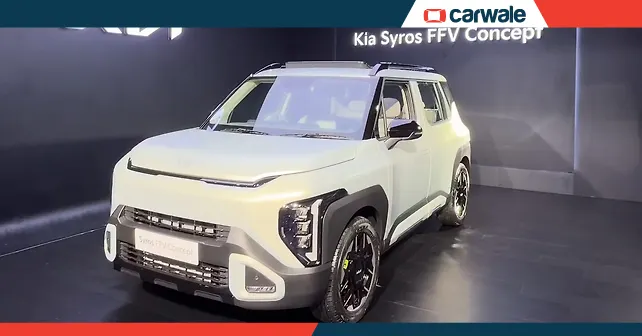
Flex-Fuel Syros to run on reworked 1.0-litre turbo petrol engineKia’s first flex fuel showcaseWhile the spotlight at Kia's recent launch event was firmly on the Sorento, the brand used the same platform to spring a surprise, showcasing the Syros Flex Fuel Vehicle (FFV) concept, its first-ever flex-fuel car for India.
Under the hood, the Syros flex-fuel concept continues with the same 1.0-litre, three-cylinder, direct-injection turbo-petrol engine found on the standard car, but with meaningful changes underneath to handle varying ethanol-petrol ratios, including a revised ECU and fuel system.
While the regular turbo-petrol Syros comes with a seven-speed dual-clutch automatic, the flex-fuel version pairs the engine with a six-speed torque-converter unit instead, likely to better manage the different combustion characteristics of higher ethanol blends.
A few months ago, Maruti Suzuki became the first carmaker to actually put a flex-fuel car on sale in India with the Wagon R Bioflex, built around a 1.2-litre engine compatible with fuel blends of up to E100.
With Kia now showcasing its own flex-fuel solution, it's clear that ethanol compatibility is becoming a real point of competition among Indian carmakers.
Flex-Fuel Syros to run on reworked 1.0-litre turbo petrol engine
Kia’s first flex fuel showcase
While the spotlight at Kia's recent launch event was firmly on the Sorento, the brand used the same platform to spring a surprise, showcasing the Syros Flex Fuel Vehicle (FFV) concept, its first-ever flex-fuel car for India. The showcase signals that Kia is now actively working on ethanol-blend compatibility for the Indian market, even though a production timeline hasn't been confirmed yet.
Under the hood, the Syros flex-fuel concept continues with the same 1.0-litre, three-cylinder, direct-injection turbo-petrol engine found on the standard car, but with meaningful changes underneath to handle varying ethanol-petrol ratios, including a revised ECU and fuel system. Transmission duties shift as well.
While the regular turbo-petrol Syros comes with a seven-speed dual-clutch automatic, the flex-fuel version pairs the engine with a six-speed torque-converter unit instead, likely to better manage the different combustion characteristics of higher ethanol blends. Kia hasn't put out power and torque figures for this version yet.
The move comes at a time when the government has been pushing harder on ethanol adoption to cut down crude oil imports, having notified updated standards for higher ethanol blends earlier this year and since cleared E100 fuel regulations for vehicles. Toyota was among the first to explore flex-fuel tech in India, and several other manufacturers have since shown intent to follow, making this a space that's likely to get busier heading into 2027.
Kia isn't the only one experimenting here, though. A few months ago, Maruti Suzuki became the first carmaker to actually put a flex-fuel car on sale in India with the Wagon R Bioflex, built around a 1.2-litre engine compatible with fuel blends of up to E100. With Kia now showcasing its own flex-fuel solution, it's clear that ethanol compatibility is becoming a real point of competition among Indian carmakers.