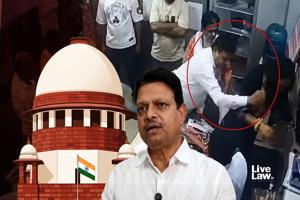
The two-page letter further urges the Rashtriya Swayamsevak Sangh to "register" itself.
Registration is always registration as something — be it as a document or as a legal entity of a particular nature.
"Follow the law" — which law?
He does not identify the so-called law that ought to be followed, for the simple reason that there is no such law obligating the Rashtriya Swayamsevak Sangh, or a similar body of individuals, to "register".
In the letter, Kharge also asks the Sangh to disclose "the legal basis on which organisation activities are conducted without formal registration".
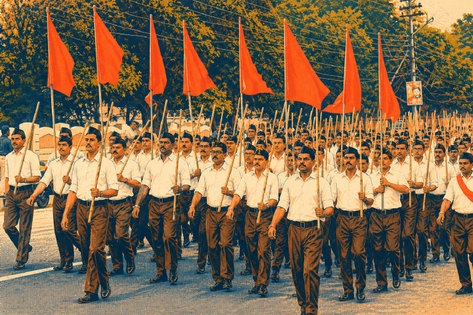
Kharge has written a letter to Mohan Bhagwat, the Sarsanghchalak of the Rashtriya Swayamsevak Sangh, asking the Sangh to disclose its "legal status", the details of its office bearers, its expenditures, its assets, and the like. The two-page letter further urges the Rashtriya Swayamsevak Sangh to "register" itself.
These recent developments in Karnataka, surrounding the "registration" of the Rashtriya Swayamsevak Sangh, throw up some very important questions, which ought to cause grave concern to any person professing to adhere to the values of democracy, the constitution, and justice. In this article, we shall examine the legal, constitutional, and democratic aspects of the entire episode, as it has unfolded so far, and their bearing upon the democratic and non-authoritarian nature of the Indian state.
Within less than a fortnight of taking charge as the Home Minister of Karnataka, Priyank Kharge has unleashed a cleverly worded rhetorical tirade against the Rashtriya Swayamsevak Sangh, clothed with the purported authority of the Government of Karnataka.
"Register" is the word used. Register as what? From a legal perspective, the Rashtriya Swayamsevak Sangh does not fit within the pigeon-holes created by law, such as societies, trusts (which, it is pertinent to mention, are not juristic entities), or companies. Then under which law can or should the Sangh register?
The use of the word "registration", in itself, has no meaning in law. Registration is always registration as something — be it as a document or as a legal entity of a particular nature. Merely saying that someone ought to "register" themselves has no meaning. Hence, the use of the idea of "registration" in the present context is nothing but a rhetorical device to create an issue where none exists. It is a rhetorical device to cast aspersions on a body of individuals whose integrity is beyond question.
"Follow the law" — which law?
Reportedly, Kharge also asked the Sangh to "shun the arrogance, and follow the law". Which law? He fails to specify. He does not identify the so-called law that ought to be followed, for the simple reason that there is no such law obligating the Rashtriya Swayamsevak Sangh, or a similar body of individuals, to "register".
Incidentally, one may note that it is for this same reason that even the Roman Catholic Church (as distinct from individual churches or parishes) is not "registered" as such. The Church, despite commanding tremendous political, economic, and social influence, is not a juristic entity, in India or in many other countries — a point that does not appear to trouble Kharge.
In the letter, Kharge also asks the Sangh to disclose "the legal basis on which organisation activities are conducted without formal registration". This exposes either a deep ignorance or a wilful disregard of the provisions of Article 19 of the Constitution of India, which guarantees to every citizen the freedom to form associations, to assemble peaceably, and to move freely throughout India.
A letter, not a notice
Interestingly, Kharge claims that the said letter is written in his capacity as a representative of the Government of Karnataka. However, the wording of the letter is clearly distinct from a characteristic communication from the government.
The letter seeks certain information. However, it does not disclose under which provision of law such information is requested or demanded. It requests, or directs, the Sangh to "register" itself (which is itself meaningless, as argued above), but once again does not state — contrary to established practice and the law — under which provision of law such a direction is being issued. The truth of the matter is that there is no law which allows the government to issue such directions.
The letter asks "whether applicable taxes are being paid in accordance with law". If applicable taxes were not being paid, the concerned tax authority would have issued a notice.
In fact, if there were a violation of any law at all, whether regarding route marches or the payment of taxes, the competent authorities would simply have issued a notice and initiated appropriate proceedings. Kharge himself, being the Home Minister of Karnataka, could direct the initiation of legal proceedings if there were any grounds whatsoever to do so. That would have been following the due process of law.
Without initiating due process (if at all there were grounds to do so), writing cleverly worded public letters is nothing short of a political gimmick. It is what lawyers call a "roving fishing exercise", devoid of any statutory or constitutional basis. It is a political witch-hunt.
The fact that the letter is written personally by the Home Minister, instead of by the competent officer or authority of the concerned department, and shared on a public platform, itself exposes that it is an act done in furtherance of a purely personal and political agenda — what is known in legal parlance as malice in law.
Inquisitorial rhetoric and the stifling of dissent
In India, action or investigation is initiated against a person when grounds to initiate such action are prima facie established. To call upon a person or entity to demonstrate its compliance with the law without any such suspicion, let alone a prima facie case, is unheard of in the adversarial system that we follow. Such an approach is, on the contrary, more characteristic of an inquisitorial system — one that prevails more in authoritarian regimes than in democracies such as India.
It appears that the Congress government, reminiscent of its past leaders, is once again beginning to tread the path of authoritarianism. Unable to engage the public on a constructive note, Kharge is now trying to create a phantom enemy, thereby seeking to achieve two objectives at once: polarising the public and stifling the voices that may oppose him or his government.
Or perhaps it is a desperate measure to distract the public from the various serious law-and-order failures of the Congress government, such as its handling of the rapidly emerging drug menace in Karnataka, recent stampedes, and the like.
In any case, the move has what the courts have referred to as a "chilling effect" on the freedoms of expression, association, and movement safeguarded under Article 19. Today, it is the Sangh that is being targeted. Tomorrow, it could be a citizens' movement, political or otherwise — or, worse, it could even be a group of friends standing at a tea-shop and expressing their views about the government.