English NewsTech scienceJapan Moon Lander Upside Down?
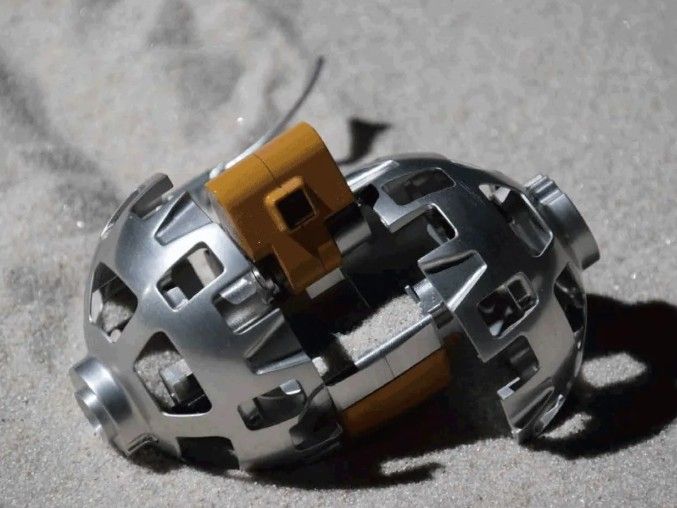
Tiny Rover Solves Mystery | Space News 2026Tiny crawling robot solves a historic space mystery: How a palm-sized rover revealed Japan's moon lander was upside down11 hours ago Author: Samira SiddiquiCopy linkThe rover, which bears a resemblance to the BB-8 droid from Star Wars, can shift from a spherical form into a compact wheeled vehicle.
While Japan's SLIM moon lander grabbed headlines for successfully touching down on the lunar surface, it was a miniature shape-shifting rover that revealed why things didn't go according to plan.
The image showed that the SLIM lander had landed upside down, preventing its solar panels from receiving sunlight in the way engineers had intended.
By revealing that the SLIM lander had touched down upside down, the palm-sized rover proved that size is not always what matters in space exploration.
English News
Tech science
Japan Moon Lander Upside Down? Tiny Rover Solves Mystery | Space News 2026
Tiny crawling robot solves a historic space mystery: How a palm-sized rover revealed Japan's moon lander was upside down
11 hours ago Author: Samira Siddiqui
Copy link
The rover, which bears a resemblance to the BB-8 droid from Star Wars, can shift from a spherical form into a compact wheeled vehicle.
Sometimes, the smallest explorer makes the biggest discovery. A tiny robot no larger than the palm of a hand has helped scientists solve one of the Moon's most puzzling mysteries. While Japan's SLIM moon lander grabbed headlines for successfully touching down on the lunar surface, it was a miniature shape-shifting rover that revealed why things didn't go according to plan.
Meet the tiny rover that saved the mission
The robot, called the Palm-Sized Lunar Excursion Vehicle 2 (LEV-2), was developed by the Japan Aerospace Exploration Agency (JAXA) and sent to the Moon alongside the SLIM lander in January 2024.
The BB-8-like rover can morph from a spherical design into a miniature wheeled vehicle. Image credit: JAXA
Unlike traditional rovers, LEV-2 has a unique design. It begins as a small sphere and then transforms into a wheeled rover capable of moving across the lunar surface. Its appearance has even drawn comparisons to the famous BB-8 droid from the Star Wars movies.
Despite its tiny size, the rover was given an important job: explore the area around the lander and send back images.
Japan's historic moon landing came with a problem
Japan became the fifth country in the world to successfully achieve a soft landing on the Moon with the SLIM spacecraft. However, the celebration did not last long. Soon after landing, engineers discovered that the spacecraft was not generating enough power. The problem appeared to be linked to the position in which the lander had touched down, but mission teams needed confirmation. That's when LEV-2 became the mission's unexpected hero.
The photo that solved the mystery
Image credit: Japan Aerospace Exploration Agency (JAXA), TAKARA TOMY, Sony Group, Doshisha University
After rolling across the lunar surface, LEV-2 captured images of the surrounding area and transmitted them back to Earth. One photograph revealed exactly what had gone wrong.
The image showed that the SLIM lander had landed upside down, preventing its solar panels from receiving sunlight in the way engineers had intended.
That single image helped mission controllers understand why the spacecraft was struggling to generate power and allowed them to assess its condition from millions of kilometres away.
Also read: Elon Musk's SpaceX becomes world's 5th most valuable company: The trillionaire's single-day earnings higher than Buffett's entire lifetime earnings A short mission with a big impact
LEV-2 operated for only about 100 minutes on the Moon, but it achieved far more than scientists expected.
The rover sent its information through another small robot called LEV-1, which acted as a communications relay before contact was eventually lost.
Even with its limited lifespan, the miniature rover successfully completed its primary mission and provided one of the most valuable pieces of information from the entire lunar landing.
A photo showing LEV-2 in ball form (left) and expanding to traverse the moon with its metal wheels (right). A model of the SLIM lander sits rightside-up in the background Image credit: D. Hirano
Why small robots could shape future space missions
Researchers say the mission highlights the advantages of using small autonomous robots during planetary exploration.
Large rovers can perform complex scientific tasks, but they also have limitations. Smaller robots can travel to difficult locations, work independently, and provide backup information if larger spacecraft encounter problems.
The success of LEV-2 demonstrated several important technologies, including:
Shape-shifting movement systems
Autonomous navigation
Wireless communication
Image processing capabilities
Lightweight and compact design
These technologies could prove useful for future missions to the Moon, Mars, and other worlds.
Scientists see a bigger future for tiny explorers
According to researchers, the success of LEV-2 suggests that future space missions may rely on teams of small, affordable robots working alongside larger spacecraft. Rather than sending a single rover, scientists could deploy multiple miniature robots to explore different areas simultaneously, gather data, and support main mission vehicles.
Also read: Your old smartphone could soon power a data centre: How Google's 'carbon computing' project aims to reduce e-waste and emissions A tiny robot that made lunar history
LEV-2 spent less than two hours operating on the Moon, yet it managed to solve one of the biggest mysteries of Japan's lunar mission. By revealing that the SLIM lander had touched down upside down, the palm-sized rover proved that size is not always what matters in space exploration.
Its success may pave the way for a new generation of miniature robotic explorers that help humanity uncover the secrets of the Moon, Mars, and beyond.