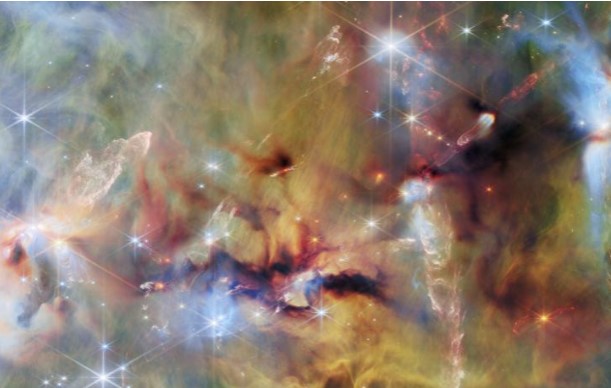
While the constellation Orion is familiar to stargazers, James Webb Space Telescope looked further to find large clouds where new stars are forming, spanning hundreds of light-years.
Webb’s attention is on the Orion A giant molecular cloud, which houses the well-known Orion Nebula, M42, a subject Webb has photographed in both close-up and wide-angle views before.
Behind the nebula lies a long, dense filament of cold gas and dust called the Orion Molecular Clouds, which is subdivided into four sections: OMC-1, OMC-2, OMC-3, and OMC-4.
The area shows intense activity, including strong gas outflows and bright, young stars amid swirling gas and darker, obscuring clouds.
Visible light cannot penetrate the thick dust and gas around the Orion Nebula and OMC-2, so infrared observations are essential to reveal the protostars.
While the constellation Orion is familiar to stargazers, James Webb Space Telescope looked further to find large clouds where new stars are forming, spanning hundreds of light-years. Webb’s attention is on the Orion A giant molecular cloud, which houses the well-known Orion Nebula, M42, a subject Webb has photographed in both close-up and wide-angle views before.
The subject of these observations sits behind the bright stars and glowing gas of M42. Behind the nebula lies a long, dense filament of cold gas and dust called the Orion Molecular Clouds, which is subdivided into four sections: OMC-1, OMC-2, OMC-3, and OMC-4. OMC-1 lies directly behind M42, with OMC-2 and OMC-3 to the north and OMC-4 to the south.
Related: Seraphim Space Investment Trust Enters The FTSE 250
The image highlights a small northern portion of OMC-2. This region is located about 1280 light-years from Earth and sits just north of the Orion Nebula. Within this scene, spanning roughly 150 light-years, researchers can observe every stage of star formation. The area shows intense activity, including strong gas outflows and bright, young stars amid swirling gas and darker, obscuring clouds.
Molecular clouds like OMC-2 are enormous pockets of gas that are much denser than the surrounding interstellar space. Their density helps form complex molecules and shields them from radiation from nearby stars, while gravity can drive the cloud toward collapse and star formation. The earliest phase in this process is the protostar, a growing star drawing material from its surroundings through a rotating disk. As gas falls onto a protostar, it heats up and emits light. The energy released powers jets that shoot from the star’s poles, often appearing as twin outflows that mark the protostar’s location.
The abundance of protostars in OMC-2 creates many outflows of varying sizes. The fast jets generate shockwaves that travel through the surrounding material; when these shocks heat the gas, it glows and forms sharp ridges. By zooming in, observers can study the details of these shocks and spot smaller outflows from younger protostars. It is possible to trace hidden protostars by following their outflows, even when they remain obscured by dust. Comparisons can be made to more evolved stars that have cleared away surrounding clouds and now illuminate parts of OMC-2 more clearly.
Webb’s Near-Infrared Camera (NIRCam) captured this view of OMC-2. Visible light cannot penetrate the thick dust and gas around the Orion Nebula and OMC-2, so infrared observations are essential to reveal the protostars. The dark globules arise where cold dust is dense enough to block light, while warmer dust emits in orange, brown, and red hues. PAH molecules contribute yellow to green emission, and blue/cyan haze signals light from stars and protostars scattered by dust. Glowing red ridges trace gas heated by outflows.
The data come from observing programme #5804, which studies star formation in OMC-2 and nearby OMC-3. Because these clouds are close to Earth, they provide an accessible laboratory for examining the earliest stages of stellar evolution. Researchers will use Webb’s data to explore how outflows influence star formation in the two regions, how ultraviolet light from young stars affects chemistry in circumstellar disks that may form planets, and how gas and dust accumulate onto the many protostars present.