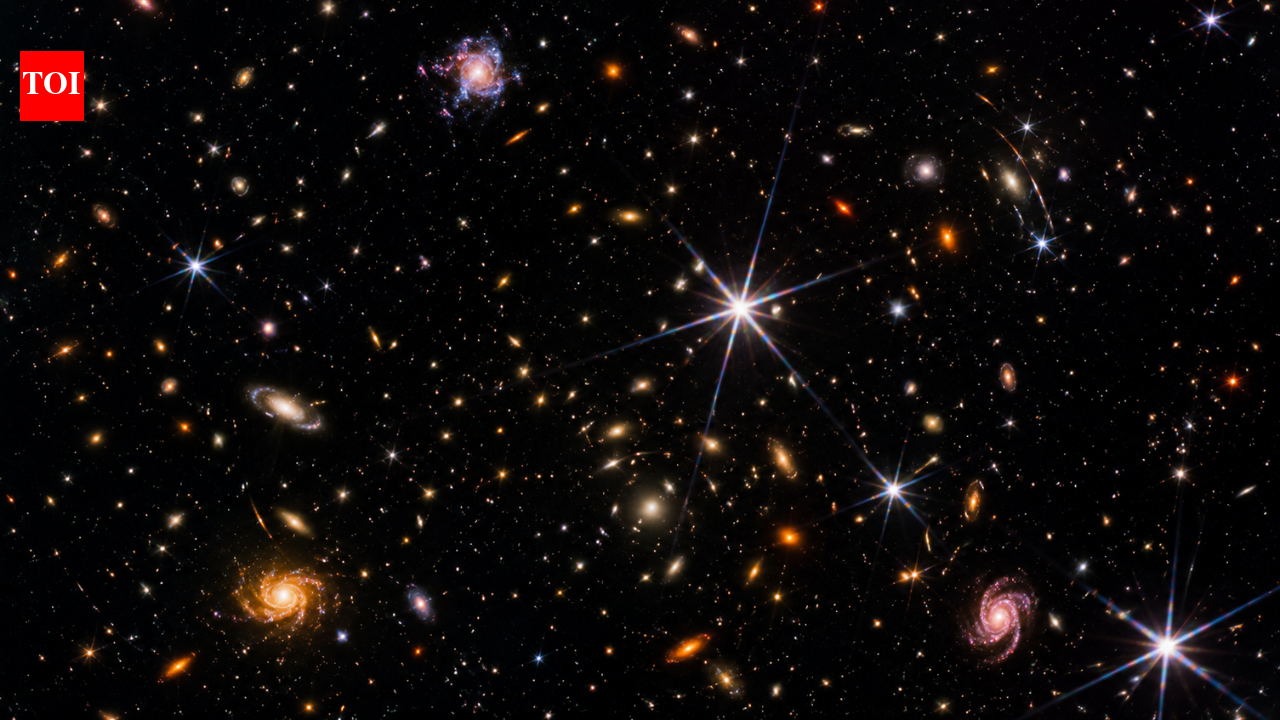
Images captured by the James Webb Space Telescope are revealing systems that appear far more settled than many researchers expected for such an early period of cosmic history.
Webb's observations are encouraging scientists to examine whether that picture needs adjusting.The surprise is not that galaxies existed early.
Future Webb observations, together with measurements from other observatories, are expected to refine those answers.
The early Universe remains one of astronomy's least accessible periods.
A Universe only a few hundred million years old is beginning to reveal galaxies that seem unexpectedly well established.
image AI generated
How the 13.8 billion-year-old universe shaped the first galaxies
Why are early galaxies more mature than expected
How astronomers look back in time to study the early universe
Do these early galaxies challenge our understanding of the universe
The age of the Universe is usually presented as a simple number: about 13.8 billion years. It sounds settled, almost tidy. Yet that timeline has become increasingly awkward as astronomers examine the faintest galaxies ever observed. Images captured by the James Webb Space Telescope are revealing systems that appear far more settled than many researchers expected for such an early period of cosmic history. Some seem to have been producing stars for what looks like an extended stretch of time, despite being seen when the Universe itself was only a few hundred million years old. That contrast has become one of the more closely watched questions in modern cosmology because it asks whether the earliest chapters of galaxy formation unfolded differently than existing models had anticipated.Current cosmology traces everything back to the Big Bang around 13.8 billion years ago. According to the Harvard-Smithsonian Centre for Astrophysics, the Universe expanded rapidly during an inflationary phase before cooling enough for hydrogen atoms to form. Much later, gravity gathered enormous clouds of gas that eventually ignited the first generation of stars, ending what astronomers often describe as the cosmic dark ages.That sequence provides the broad framework for understanding how galaxies emerged. It also places strict limits on time. If astronomers observe a galaxy only 300 or 400 million years after the Big Bang, every star inside it must have formed within that relatively brief cosmic window. There simply was not much time available.For years, theoretical models suggested that these first systems would be comparatively small, chaotic and still assembling themselves. Webb's observations are encouraging scientists to examine whether that picture needs adjusting.The surprise is not that galaxies existed early. Astronomers expected to find them. Instead, attention has shifted to how established some of those galaxies appear to be. Their starlight suggests populations that may have been forming over extended periods rather than appearing in a single rapid burst. In ordinary terms, they look as though they already had a substantial history behind them, even though the surrounding Universe was still extremely young.Reportedly, that does not mean these galaxies are older than the Universe itself. Rather, it raises questions about how quickly gas collapsed into stars, how efficiently those stars continued forming, and whether the earliest galaxies evolved faster than many simulations predicted.Small differences during the Universe's infancy could produce noticeable changes hundreds of millions of years later. If star formation began sooner, or proceeded with fewer interruptions, galaxies would naturally appear more developed when telescopes observe them across immense distances.Because light takes time to travel, observing distant galaxies is effectively an exercise in looking backwards through cosmic history. The farther away an object lies, the younger the Universe appears in the image reaching Earth.According to the Centre for Astrophysics, astronomers also investigate the early cosmos through the cosmic microwave background, a faint relic of radiation released when the Universe was roughly 380,000 years old. That ancient signal preserves clues about conditions long before galaxies existed. At the same time, experiments studying hydrogen from the cosmic dark ages aim to identify when the first stars and black holes emerged.Those different approaches complement one another. Webb observes galaxies directly, whereas other instruments search for traces left behind by even earlier events. Together they help build a timeline stretching from the Big Bang to the first generations of stars.As the observational record grows, astronomers are comparing Webb's discoveries with increasingly sophisticated computer simulations. The goal is not simply to explain individual galaxies but to determine whether the broader picture of cosmic evolution remains complete.Unexpected observations do not automatically overturn established cosmology. They usually expose gaps in understanding that require closer examination.Scientists are still investigating whether these apparently mature galaxies truly experienced billions of years' worth of steady star formation, whether their stellar populations are being interpreted correctly, or whether existing models underestimate how rapidly galaxies could grow in the young Universe. Future Webb observations, together with measurements from other observatories, are expected to refine those answers. The early Universe remains one of astronomy's least accessible periods. Direct observations of the first stars and black holes are still limited, leaving many aspects of cosmic dawn open to investigation. A Universe only a few hundred million years old is beginning to reveal galaxies that seem unexpectedly well established.