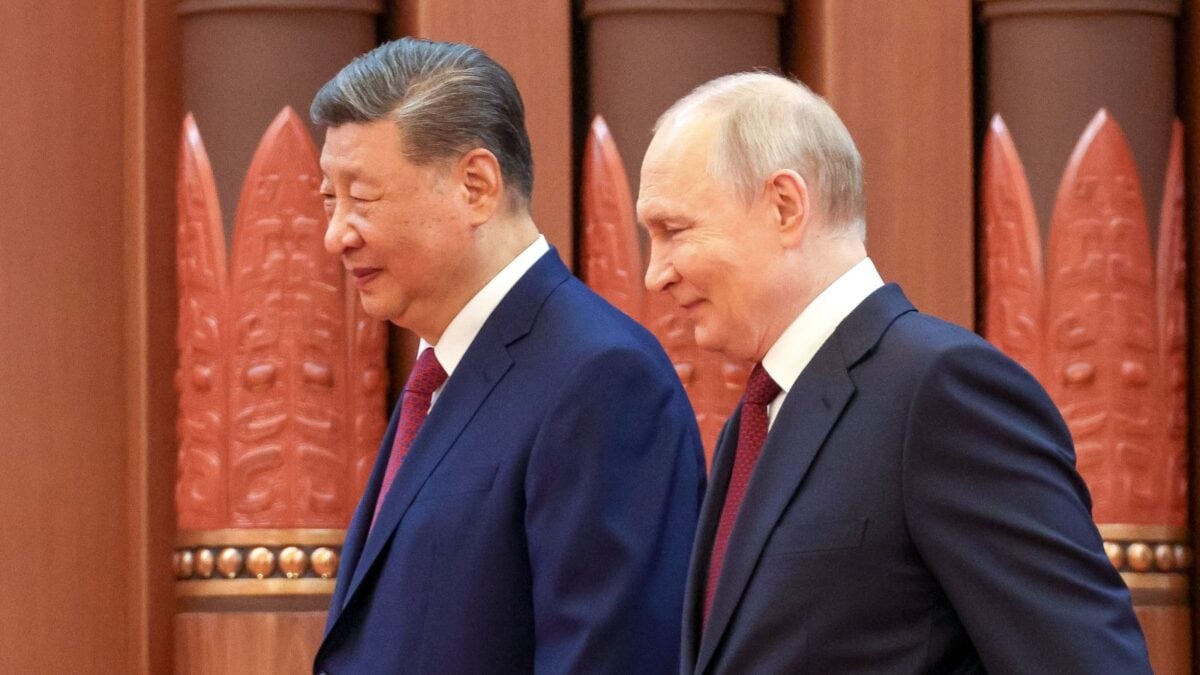
They have described their relationship as one with “no limits", jointly challenged the US-led global order and stood together through the Ukraine war.
Four years of the Ukraine war have transformed Russia’s economy, weakened its leverage and increased its dependence on China.
“Talking counter-factuals, the relations may not see a shift, particularly because Russia’s China strategy has remained the same under all the three Presidents of Russia.
A post-Putin Russia could see China prioritizing stability on its northern border and a friendly Moscow government that opposes Western dominance.
A former print ... Read MoreFirst Published: July 20, 2026, 14:39 ISTNews explainers Is China Preparing For A Post-Putin Russia?
Is China Preparing For A Post-Putin Russia? What Xi Jinping’s Strategy Means For US And Moscow
Written By :
,
Last Updated: July 20, 2026, 16:43 IST
Chinese officials are reportedly assessing possible succession scenarios in Russia, signalling that Beijing is preparing for long-term strategic ties beyond Vladimir Putin
Rapid Read
Political and intelligence reports suggest that Beijing is “expanding” its engagement with key individuals in Russia’s political landscape. (AFP File Photo)
Chinese President Xi Jinping and Russian President Vladimir Putin have projected an image of an unshakeable partnership for years. They have described their relationship as one with “no limits", jointly challenged the US-led global order and stood together through the Ukraine war. But behind the choreographed displays of unity, Beijing could be preparing for a future without Putin.
Reports suggest that Chinese officials are assessing potential succession scenarios in Russia and expanding contacts beyond Putin’s inner circle. The development suggests Beijing is thinking beyond one leader and preparing for long-term strategic continuity in one of its most important geopolitical partnerships.
Four years of the Ukraine war have transformed Russia’s economy, weakened its leverage and increased its dependence on China. The question is not that Xi will continue supporting Putin. But whether China believes the relationship has become too important to depend on Putin alone.
How Much Is Russia Dependent On China?
Since Russia’s full-scale invasion of Ukraine in 2022, Western sanctions have sharply reduced Moscow’s access to European markets, financial systems and advanced technology. China has emerged as Russia’s biggest economic lifeline.
Although bilateral trade eased last year due to lower oil prices, Russia’s exports to China have nearly doubled since the Ukraine war began in 2022.
In 2024 alone, Russia exported about $129 billion worth of goods to China, largely discounted crude oil, coal and natural gas. Since the invasion, China has purchased more than €319 billion worth of Russian fossil fuels, providing Moscow with a crucial source of revenue despite sweeping Western sanctions.
In return, China exported nearly $116 billion worth of machinery, electronics and vehicles to Russia, replacing many Western suppliers that exited the market after the invasion.
While Beijing has avoided supplying Russia with finished weapons, it has exported billions of dollars’ worth of dual-use goods — products with both civilian and military applications –that have helped sustain Russia’s defence industry.
From Beijing’s perspective, protecting these long-term interests means ensuring stability regardless of who eventually occupies the Kremlin. Preparing for succession is therefore less about abandoning Putin than safeguarding China’s strategic investments.
Has The Power Dynamics Shifted In The China-Russia Partnership?
Before the Ukraine war, Moscow viewed itself as Beijing’s strategic equal. Today, many analysts describe Russia as the “junior partner".
Economically, China has already surpassed Russia. On a nominal basis, the Chinese economy was 10 times larger than Russia’s before the Ukraine war in 2021. For the first time, China even surpassed Russia in nominal per capita GDP in 2020 (though Russia remains ahead of China when adjusted for purchasing power parity), according to the Centre for Strategic and International Studies (CSIS).
The International Monetary Fund (IMF) expect China’s GDP to climb towards nearly $30 trillion by 2027 while Russia’s GDP is forecasted to stall at well under $2 trillion.
For now, Russia’s current value to China lies in energy. Oil, natural gas and coal collectively account for nearly two-thirds of Russia’s exports to China, making Beijing one of Moscow’s most important energy customers. However, that dynamic seems changing. “Barring a major paradigm shift, Russia will decline in importance in the coming decades as China weens itself off fossil fuels," said a CSIS report.
This has become particularly visible in energy negotiations. Russia has been eager to secure Chinese approval for the long-delayed Power of Siberia 2 gas pipeline, but Beijing has reportedly pushed for far more favourable commercial terms, reflecting its stronger negotiating position.
Meanwhile, Russia’s actions have also placed China in an uncomfortable diplomatic position. Beijing has maintained that respect for national sovereignty, territorial integrity and non-interference in the internal affairs of other countries are central pillars of its foreign policy. It has consistently portrayed itself as a country that does not invade or coerce other nations. Russia’s repeated military interventions, especially in Ukraine, run in direct opposition to those principles.
That does not mean Beijing wants a weakened Russia. On the contrary, China benefits from having a stable neighbour that helps counter Western influence. But today’s partnership appears increasingly driven by China’s priorities rather than Russia’s.
“The Russia-China relationship, mid-July, celebrated its 25th anniversary of Good-Neighbourliness and Friendly Cooperation. This treaty has been instrumental in elucidating the contours of the Russia-China relationship; it aided in mitigating the Cold War tensions. In 25 years, the bilateral relationship has accelerated. evidenced in political and economic realms, naturally a big shift is China’s ascendence, due to which Beijing is less dependent on Moscow for military import, and other areas. There is a degree of assymetry in the partnership favouring China, however, there isn’t enough evidence yet to see Russia radically changing its positions because of the China factor," said Rajoli Siddharth Jayaprakash, Junior Fellow at Observer Research Foundation (ORF).
Would A Post-Putin Russia Change China’s Strategy?
China’s core objective has always been stability on its northern border and a friendly government in Moscow that shares its opposition to Western dominance.
“Vladimir Putin’s recent visit to Beijing adds to the large and growing body of evidence suggesting that Xi Jinping and the Chinese Communist Party (CCP) are institutionalising ties with Moscow in anticipation of a power transition," wrote Joseph Webster, senior fellow at the Atlantic Council and editor of the independent China-Russia Report. “While Beijing does not necessarily anticipate a transition, it continues to de-personalise ties with Putin and broaden the scope of its engagement with Russian society, especially among Russian elites."
While Putin at 73 remains “firmly in control", but Chinese policymakers are increasingly appearing to be building relationships that survive any eventual succession.
Political and intelligence reports suggest that Beijing is “expanding" its engagement with key individuals in Russia’s political landscape. There are cases involving increased Chinese intelligence activities and the recruitment of mid-level Russian officials in recent years as part of Beijing’s efforts to strengthen its influence, according to AzerNews — a leading daily in Azerbaijan.
Reports also suggest that the Russian authorities have refrained from publicly addressing alleged activities to avoid any damage to strategic relations to China.
Another concern for Chinese officials is Russia’s military cooperation with North Korea. Beijing fears that the transfer of Russian technology will strengthen Pyongyang’s nuclear capabilities and push South Korea and Japan even closer to the US.
“Talking counter-factuals, the relations may not see a shift, particularly because Russia’s China strategy has remained the same under all the three Presidents of Russia. Now for China, it considers Russia to be an important country, a non-Western bulwark against the Western-led order. So, the powershift in Russia will see a policy continuance in the Russia-China relationship. The school of thought that China’s approach may change emerges in the Cold War when, after Stalin’s death, the next leader of the USSR, took an anti-Stalinist position…the Chinese revolution was based on Stalinist principles and Mao’s personal relationship with Stalin saw a staunch opposition to the Soivet policy. Some might argue that was the starting point of the Sino-Soviet split," Jayprakash explains.
Why Is The US Also Planning Beyond Putin?
China is not the only country thinking about a post-Putin Russia. Washington has also spent the past several years examining how Russia’s future could reshape global security. One school of thinking has been whether a future Russian leadership might eventually reduce its dependence on China and become more open to engagement with the West — an approach often described as a modern-day “Reverse Nixon" strategy.
The objective is to prevent Russia from becoming China’s permanent “junior partner" and to avoid the emergence of a long-term Beijing-Moscow axis capable of challenging the existing international order.
Those hopes, however, have gained little traction as the Ukraine war has deepened Russia’s dependence on China economically, diplomatically and strategically.
At the same time, efforts to negotiate an end to the Ukraine conflict remain stalled. Moscow continues to accuse Washington of abandoning the role of an impartial mediator and instead pursuing policies aimed at increasing pressure through sanctions and military support for Kyiv.
Taken together, both Beijing and Washington appear to be planning for a future beyond Putin, albeit for very different reasons. China wants continuity in its strategic partnership, while the US is exploring whether a future Russia could eventually loosen its alignment with Beijing.
Can The Moscow’s Future Leadership End The Ukraine War?
Any successor would inherit military realities, sanctions, economic pressures and national security priorities that have been shaped over four years of conflict. However, leadership changes could create opportunities for policy adjustments, negotiations or shifts in foreign policy priorities.
For China, maintaining influence during any transition would be crucial. For Western governments, it could represent an opportunity to reassess sanctions, diplomacy and Europe’s long-term security architecture.
The geopolitical consequences would extend far beyond Ukraine, affecting energy markets, global trade and the balance of power across Eurasia.
If Beijing is indeed preparing for multiple succession scenarios, it suggests the China-Russia relationship has evolved beyond the personal chemistry between Xi and Putin. Instead, it is becoming a long-term strategic partnership built around shared geopolitical interests rather than individual leaders.
News18 Newsletter Handpicked stories, in your inbox A newsletter with the best of our journalism submit
Key Questions Answered Will a new Russian leader change its stance on the Ukraine war? It is unclear if a new Russian leader would change the country's stance on the Ukraine war. Chinese President Xi Jinping reportedly suggested to Donald Trump that Vladimir Putin may regret invading Ukraine, a subtle shift from China's public stance of "no-limits" solidarity. How might a post-Putin Russia impact global power dynamics? A post-Putin Russia could see China prioritizing stability on its northern border and a friendly Moscow government that opposes Western dominance. China views Russia as a non-Western bulwark against the Western-led order.
About the Author Shilpy Bisht Shilpy Bisht is a News Editor at News18, where she leads the English app operations. She writes on world affairs, health, AI, career, business, and issues affecting women and children. A former print ... Read More
First Published: July 20, 2026, 14:39 IST
News explainers Is China Preparing For A Post-Putin Russia? What Xi Jinping’s Strategy Means For US And Moscow
Disclaimer: Comments reflect users’ views, not News18’s. Please keep discussions respectful and constructive. Abusive, defamatory, or illegal comments will be removed. News18 may disable any comment at its discretion. By posting, you agree to our Terms of Use and Privacy Policy Loading comments...