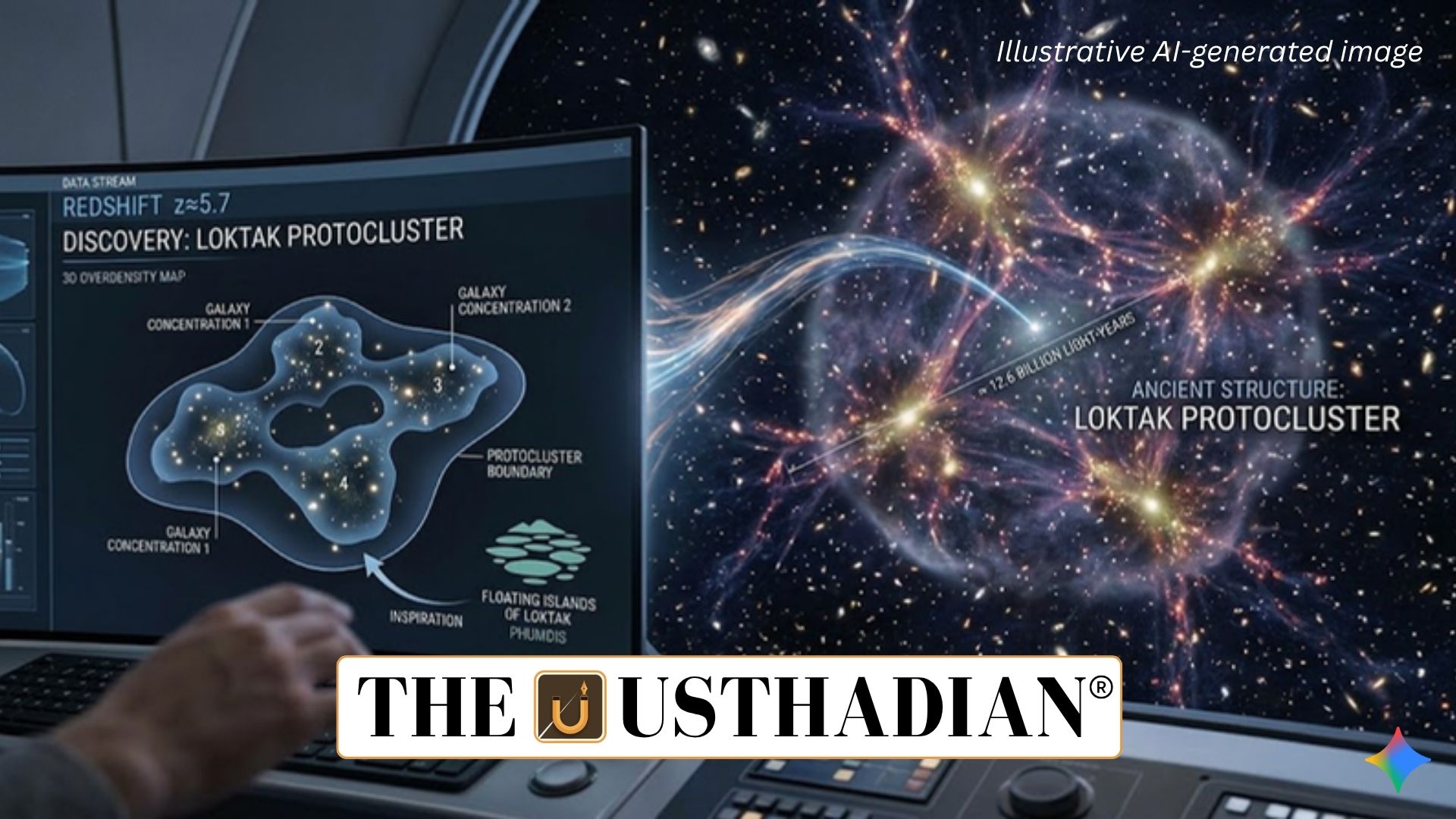
Indian Astrophysicist Leads Landmark Cosmic DiscoveryIndian Scientist Discovers Ancient Loktak Protocluster in the Early Universe: Indian astrophysicist Dr Ronaldo Laishram has led the discovery of the Loktak Protocluster, a massive cosmic structure that existed around 12.6 billion years ago.
Named after Loktak Lake in Manipur, the discovery provides valuable insights into how galaxies assembled during the early stages of the universe.
The Loktak Protocluster dates back 12.6 billion years, when the universe was only about 1.2 billion years old.
Studying such ancient structures helps astronomers understand the formation of large-scale cosmic structures and the evolution of galaxies in the early universe.
Static Usthadian Current Affairs TableIndian Scientist Discovers Ancient Loktak Protocluster in the Early Universe:
Indian Astrophysicist Leads Landmark Cosmic Discovery
Indian Scientist Discovers Ancient Loktak Protocluster in the Early Universe: Indian astrophysicist Dr Ronaldo Laishram has led the discovery of the Loktak Protocluster, a massive cosmic structure that existed around 12.6 billion years ago. Named after Loktak Lake in Manipur, the discovery provides valuable insights into how galaxies assembled during the early stages of the universe.
Scientists describe the structure as a “city of galaxies” under construction, as it represents an early-stage galaxy cluster still forming under the influence of gravity.
Static GK fact: Loktak Lake, located in Manipur, is the largest freshwater lake in Northeast India and is famous for its floating islands known as phumdis.
What Is the Loktak Protocluster
A protocluster is a collection of young galaxies that are gradually coming together to form a massive galaxy cluster. The Loktak Protocluster dates back 12.6 billion years, when the universe was only about 1.2 billion years old.
Studying such ancient structures helps astronomers understand the formation of large-scale cosmic structures and the evolution of galaxies in the early universe.
Why the Discovery Is Significant
The discovery provides direct evidence of how galaxies evolved in dense cosmic environments. Researchers found that galaxies located within crowded regions grow differently from isolated galaxies due to stronger gravitational interactions.
The findings improve scientific understanding of galaxy formation, star formation, gravitational clustering, dark matter distribution, and the development of the cosmic web. Such observations also help explain how present-day galaxy clusters evolved over billions of years.
Static GK Tip: A galaxy cluster is the largest gravitationally bound structure in the universe, containing hundreds or even thousands of galaxies held together by gravity.
Inspiration Behind the Name
The protocluster was named after Loktak Lake by Dr Ronaldo Laishram, who belongs to Khangabok in Thoubal district, Manipur. The name symbolically connects the floating phumdis of Loktak Lake with the interconnected concentrations of galaxies forming a single cosmic structure.
The naming reflects both the scientific importance of the discovery and the cultural heritage of Northeast India.
About Dr Ronaldo Laishram
Dr Ronaldo Laishram is an Indian astrophysicist currently serving as a researcher at the National Astronomical Observatory of Japan (NAOJ), Tokyo. He completed both his Master’s degree and PhD in Astronomy from Tohoku University, Japan.
His research focuses on galaxy formation, early universe evolution, and large-scale cosmic structures. He has also contributed to science outreach as the Founding Coordinator of the Manipur Astronomical Society and co-founder of OviEdu.
Advanced Telescopes Used in the Research
The discovery was made using two of the world’s most advanced astronomical observatories: the Subaru Telescope and the James Webb Space Telescope (JWST). These powerful instruments enable scientists to observe extremely distant galaxies whose light has travelled for billions of years before reaching Earth.
By studying such distant objects, astronomers effectively look back in time and gain valuable information about the universe’s earliest stages.
Static GK fact: The James Webb Space Telescope (JWST), launched in 2021, is the world’s most powerful space telescope and is designed to study the earliest galaxies, stars, and planetary systems.
Scientific Recognition
The research findings were published in The Astrophysical Journal Letters, one of the world’s leading peer-reviewed astronomy journals. Publication in this journal confirms the scientific credibility and global significance of the discovery.
The achievement also serves as an inspiration for aspiring scientists across India, particularly in the Northeastern region, demonstrating that globally significant scientific research can emerge from every part of the country.
Static Usthadian Current Affairs Table
Indian Scientist Discovers Ancient Loktak Protocluster in the Early Universe: