News india India Hosted BRICS, But Why Is Western Media Still Stuck On Cycles, Mopeds And The Old India Narrative?
India Hosted BRICS, But Why Is Western Media Still Stuck On Cycles, Mopeds And The Old India Narrative?
From New York Times to France 24 and Al Jazeera Qatar, all media outlets used similar images for BRICS coverage.
The western media coverage pattern raises a legitimate question about how India continues to be visually framed by parts of the international media.
Why did Western media coverage of the 2026 BRICS Summit face criticism in India?
News india India Hosted BRICS, But Why Is Western Media Still Stuck On Cycles, Mopeds And The Old India Narrative?
India Hosted BRICS, But Why Is Western Media Still Stuck On Cycles, Mopeds And The Old India Narrative?
Reported By :
,
Last Updated: September 16, 2026, 09:30 IST
The western media coverage pattern raises a legitimate question about how India continues to be visually framed by parts of the international media.
Rapid Read
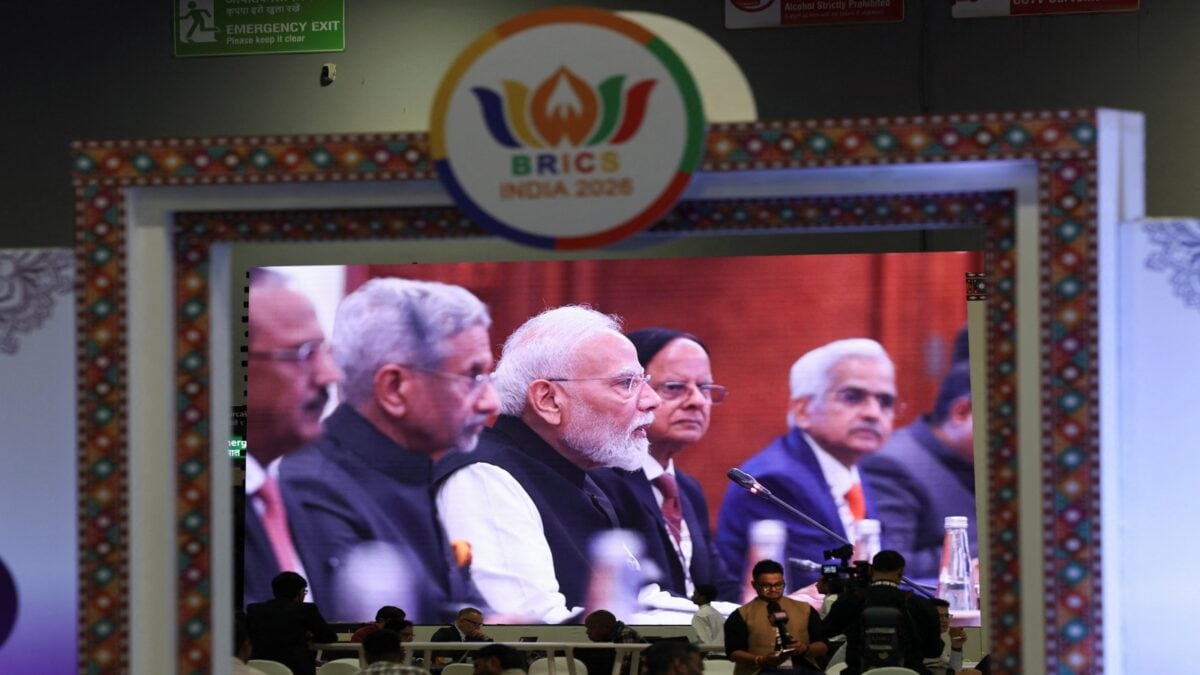
A screen displayed at the international media centre shows India's Prime Minister Narendra Modi attending the BRICS Summit at Bharat Mandapam in New Delhi, India, September 13, 2026. REUTERS
The 18th BRICS Summit in New Delhi brought together leaders of an expanded 11-member grouping representing about half the world’s population, with India using its 2026 chairship to push discussions on trade, technology, energy security, global governance and a larger role for the Global South.
Yet, alongside coverage of the summit, a different visual narrative attracted attention: photographs showing cyclists, moped riders, labourers and ordinary streets around BRICS banners and images of Prime Minister Narendra Modi. From New York Times to France 24 and Al Jazeera Qatar, all media outlets used similar images for BRICS coverage.
The recurrence of such imagery across international coverage has triggered criticism in India, with some arguing that the choice of photographs says as much about the lens through which India is viewed as it does about India itself.
There is, however, an important distinction between documenting poverty or everyday life and deliberately trying to undermine a country. The western media coverage pattern raises a legitimate question about how India continues to be visually framed by parts of the international media.
India is no longer simply the developing country that international correspondents photograph through the familiar vocabulary of poverty, crowded streets, bicycles and informal labour. It is simultaneously a country hosting major diplomatic gatherings, negotiating with competing global powers, building digital and financial infrastructure and attempting to shape institutions representing the Global South.
The contrast was particularly striking during BRICS 2026. The summit was hosted at the state-of-the-art Bharat Mandapam, with Delhi extensively decorated and illuminated for the gathering. Leaders including Chinese Premier Xi Jinping, Russia President Vladimir Putin and Iran President Masoud Pezeshkian attended, while PM Modi held bilateral meetings and presided over discussions involving trade, technology, global conflicts and reform of international institutions.
International coverage itself was hardly uniformly dismissive. Reuters described the summit as a diplomatic gain for India while also highlighting China’s growing influence inside BRICS. The Financial Times reported on the bloc’s growing unity and its push for a more influential role for emerging economies.
But repeatedly reducing a complex emerging power to images of bicycles, mopeds and street-level deprivation can create a dated visual shorthand – particularly when the same country is simultaneously functioning as a diplomatic bridge between countries with radically different interests.
The larger issue, therefore, may not be an old framework struggling to accommodate a changing India.
For decades, Western coverage of developing countries has often been built around familiar images of deprivation. As India’s global role expands, that template increasingly sits uneasily beside the country’s ambitions and diplomatic reach.
BRICS itself is changing. With 11 members and a growing partner network, the grouping is seeking greater influence over global governance, financial systems and the priorities of developing nations.
The question for international media, therefore, is whether the bicycle has become a visual cliché through which India is still being understood, even when the country on the other side of the frame has changed dramatically.
News18 Newsletter Handpicked stories, in your inbox A newsletter with the best of our journalism submit
Quick Answers Powered by Ask News18 Where was the 18th BRICS Summit hosted in New Delhi? The 18th BRICS Summit in New Delhi was hosted at the state-of-the-art Bharat Mandapam. Which global leaders attended the 2026 BRICS Summit in India? The summit was attended by prominent world leaders, including Chinese Premier Xi Jinping, Russian President Vladimir Putin, and Iranian President Masoud Pezeshkian, alongside Indian Prime Minister Narendra Modi. Why did Western media coverage of the 2026 BRICS Summit face criticism in India? The coverage faced criticism because major Western outlets repeatedly used a dated visual shorthand of poverty, showing images of cyclists, moped riders, and street-level deprivation around BRICS banners. Critics argued this choice of photography attempted to visually frame and undermine India, failing to reflect its modern role as a country building advanced digital infrastructure and hosting major diplomatic gatherings. Powered by Ask News18
About the Author Manoj Gupta Group Editor, Investigations and Security Affairs, Network18
ADD YOUR COMMENT
First Published: September 16, 2026, 09:26 IST
Disclaimer: Comments reflect users’ views, not News18’s. Please keep discussions respectful and constructive. Abusive, defamatory, or illegal comments will be removed. News18 may disable any comment at its discretion. By posting, you agree to our Terms of Use and Privacy Policy Loading comments...