A kidney reduced to a tiny laboratoryWhat happened to the kidney cells?
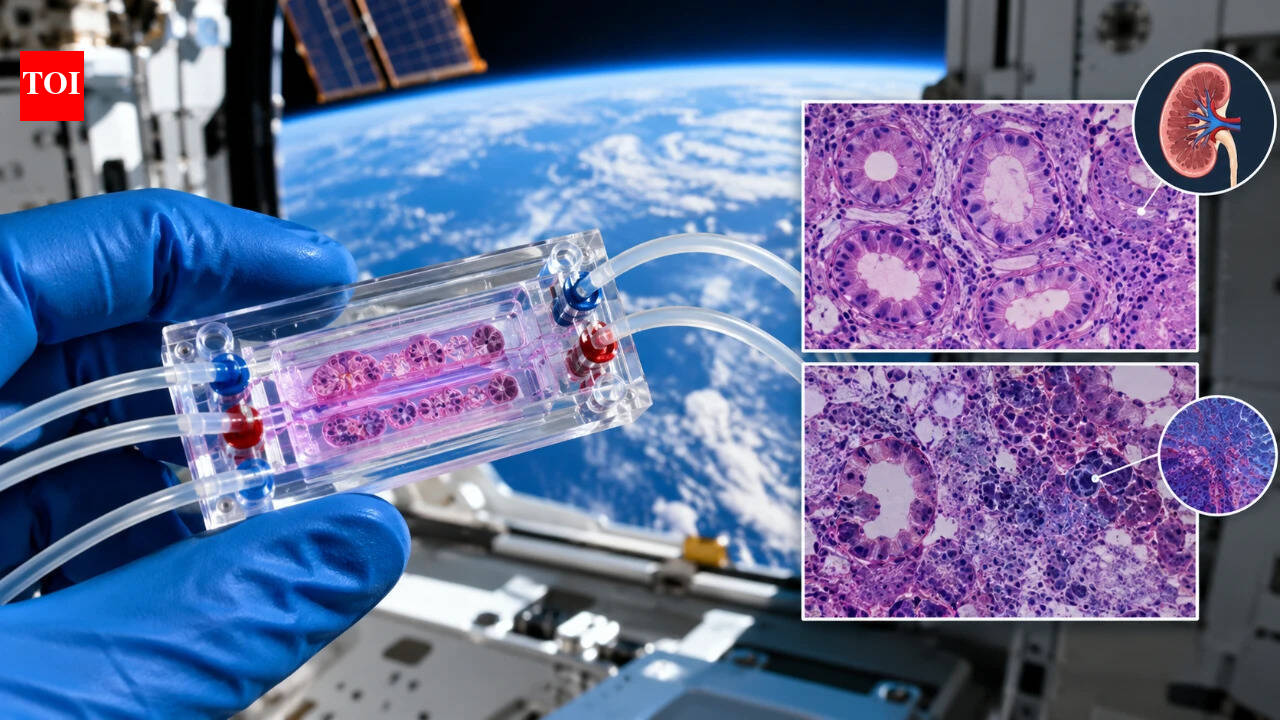
Debuting in May 2019, kidney tissue chips were launched to the International Space Station, allowing scientists to analyse variations in cellular structures between space and Earth.
The programme received its initial funding in 2017, and the kidney tissue chips first travelled to the International Space Station in May 2019.
Tissue chips provide a third choice for researchers who can examine living human cells in an artificial three-dimensional setting.The technology may also find applications in drug discovery.
This demonstrated how space can serve as a laboratory for studying human cells in conditions that are hard to replicate on Earth.
Representative image of a space laboratory experiment using organ-on-chip technology in orbit. Image Credits: ChatGPT.
A kidney reduced to a tiny laboratory
What happened to the kidney cells?
Debuting in May 2019, kidney tissue chips were launched to the International Space Station, allowing scientists to analyse variations in cellular structures between space and Earth. Image Credits: Wikimedia Commons.
From the ISS to medicine on Earth
A tiny laboratory orbiting hundreds of kilometres above Earth gave scientists a new way to study how human organs respond to space. Rather than examining astronauts directly, researchers used miniature tissue-chip systems containing living human cells, turning a small device into a model of human biology in orbit.According to NASA , the Tissue Chips in Space initiative brings together NASA, the US National Institutes of Health and the International Space Station National Laboratory to study human health using these miniature tissue models. The programme received its initial funding in 2017, and the kidney tissue chips first travelled to the International Space Station in May 2019. The devices contain living human cells and are designed to reproduce aspects of organ function, allowing researchers to examine cellular changes in microgravity that could also provide insights into ageing and disease on Earth.One of the organs whose health is most affected by spaceflight is the kidney, which makes it a good target for study. Microgravity causes fluid to shift toward the head, while bone loss releases more calcium into the blood, which then reaches the kidneys. Dehydration and other physiological changes in astronauts also have implications for their kidney health.Researchers at the University of Washington developed a microphysiological system that recreated part of the kidney's proximal tubule.This section of the nephron performs important jobs involving the reabsorption and processing of substances filtered from the blood. The chips used human proximal tubule epithelial cells in a microfluidic environment designed to mimic their behaviour inside the body.The attraction of taking such a system into orbit was that microgravity may produce biological changes resembling some aspects of ageing and disease over a short period. Scientists have therefore investigated whether the space environment could act as an accelerated model for processes that normally take months or years to develop on Earth. NASA notes that tissue chips can help researchers examine these changes at the cellular and molecular level.This kidney experiment was more than simply placing the cells in a container and observing what happened. These chips were supplied with nutrients and monitored throughout their time in space, while a parallel sample stayed back on Earth. The scientists were thus able to compare the reaction of the two samples at the molecular level. One of the main issues the scientists studied was proteinuria, a condition marked by excess protein in urine. The kidney chip cells were exposed to human serum to mimic this condition. This is also a sign of damage to the kidneys.When the results were published in npj Microgravity , the researchers reported that serum exposure produced substantial changes in gene expression and increased injury and inflammatory biomarkers, creating patterns relevant to ageing and disease. However, short-term microgravity did not create a distinct additional response to the serum exposure. The same experiment also examined the kidney's ability to process vitamin D and found no significant difference between the spaceflight and ground groups during the relatively short exposure.The outcome of this research adds nuance to the idea that spaceflight may accelerate ageing-like changes in kidney cells. In fact, the experiment suggested that spaceflight may be applied in order to study biological processes connected with ageing and diseases; however, it did not prove that all functions of kidneys weaken in microgravity. Moreover, the researchers admit that the experiment lasted a relatively short time. This suggests that flight duration may affect the outcome.The real value of such laboratories may lie beyond the space station itself. Research on human organs usually uses animals as test subjects or cell cultures, neither of which fully represents human biology. Tissue chips provide a third choice for researchers who can examine living human cells in an artificial three-dimensional setting.The technology may also find applications in drug discovery. Researchers can test drugs on chips and study how the tissues react to disease-related conditions. According to NASA, tissue chips serve as a means to study the mechanisms of disease and possible treatments, while, according to NIH, the whole Tissue Chips in Space program is about translating knowledge gained in microgravity into improved human health on Earth.The kidney chip experiment was more than a test of whether a model organ could survive in space. This demonstrated how space can serve as a laboratory for studying human cells in conditions that are hard to replicate on Earth. Understanding how the human body reacts to this environment can help scientists keep astronauts healthy on future missions to the Moon and Mars. It can also shed light on diseases on Earth without requiring spaceflight.