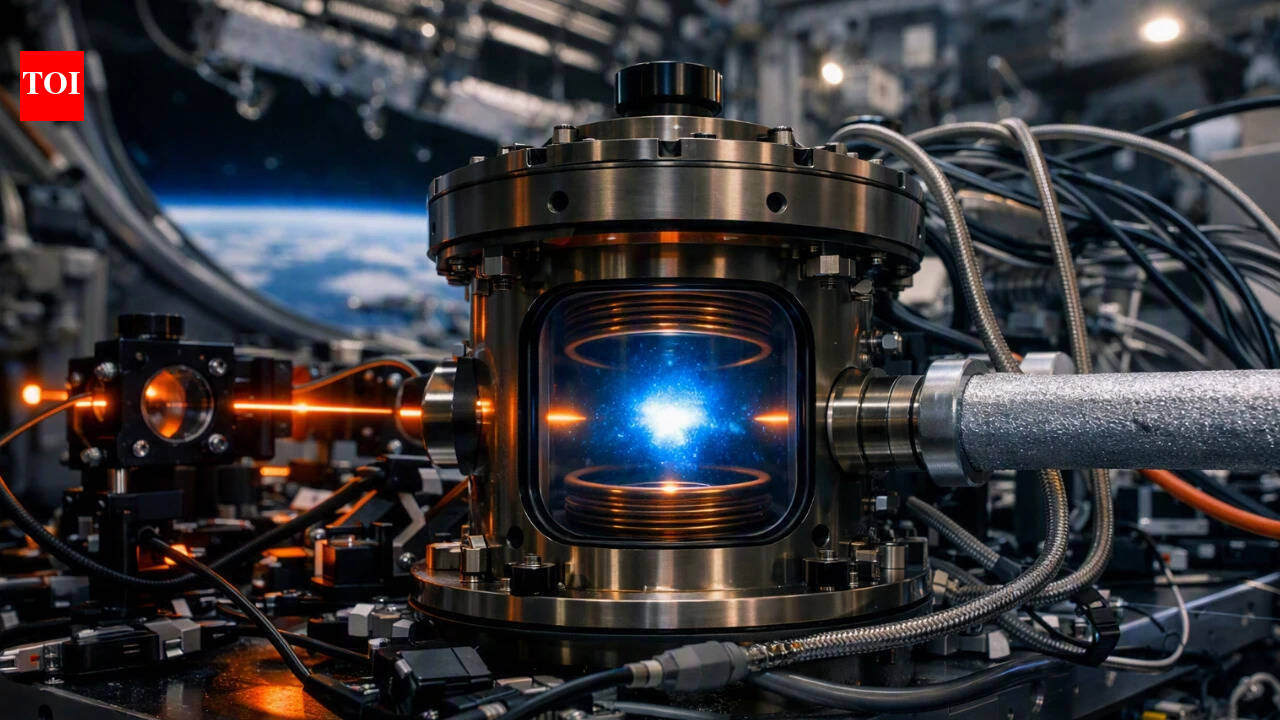
AI Representation: NASA cooled rubidium atoms to near absolute zero aboard the ISS; creating the fifth state of matter in orbit.
Image credits: Wikimedia CommonsRubidium-87 cooled to roughly 100 nanokelvinBose-Einstein condensate, a cloud of super-cooled Rubidium atoms in a Laser trap on an Optical table.
Furthermore, the article states that the Cold Atom Lab was NASA’s multi-user facility that was delivered to the ISS in May 2018.
The Cold Atom Lab has continued operating for years since its first success.
Separately, in a September 2020 statement, the Jet Propulsion Laboratory described scientists' longer-term goals for the Cold Atom Lab as making use of the ultracold atom clouds as the most sensitive tools.
AI Representation: NASA cooled rubidium atoms to near absolute zero aboard the ISS; creating the fifth state of matter in orbit. Image credits: Wikimedia Commons
Rubidium-87 cooled to roughly 100 nanokelvin
Bose-Einstein condensate, a cloud of super-cooled Rubidium atoms in a Laser trap on an Optical table. Image credits: Wikimedia Commons
Gaaloul's 2022 study: below 100 picokelvin-equivalent
A Space-Based Quantum Gas Laboratory at Picokelvin Energy Scales
The 2023 dual-species milestone, 400 kilometers above Earth
In May 2018, NASA delivered the Cold Atom Lab, a small box about the size of a refrigerator, to the International Space Station aboard a Northrop Grumman Cygnus resupply spacecraft, and set up the experiment in the station's US Destiny laboratory module. The equipment was built by NASA's Jet Propulsion Laboratory and was engineered to cool and trap atom clouds using laser technology and magnets so that the Earth-bound researchers could examine them in the microgravity of the space station. As stated in the peer-reviewed research paper published in Nature (D. Aveline et al., "Observation of Bose–Einstein Condensates in an Earth-Orbiting Research Lab," Nature 582, 193–197, 2020), NASA’s Cold Atom Lab (CAL), launched on board the International Space Station, successfully created Bose-Einstein condensates (BECs) of rubidium atoms two months after its start-up. The study documents CAL's milestone achievement in orbit, which was reported as the first BEC formation outside Earth's atmosphere.Bose-Einstein Condensates form when a dilute vapor of atoms is cooled to an extremely low temperature close to absolute zero, at which point the atoms become almost stationary and behave as a single wave due to quantum mechanical effects.At such temperatures, a high number of atoms are placed into a common quantum state, thus making them act like a coherent wave, commonly referred to as the fifth state of matter, unlike other states of matter learned by people in schools, namely solid, liquid, gas, and plasma. In the Cold Atom Lab, clouds of Rubidium-87 atoms were initially slowed and confined using laser beams and magnetic traps, after which they underwent evaporative cooling on an atom chip, during which time the energetically high atoms were stripped away from the clouds. Through the process, the atoms were cooled to sub-nanokelvin temperature, a small fraction of a billionth of a degree above absolute zero.The team behind the instrument, led by researchers David Aveline and Robert Thompson at the Jet Propulsion Laboratory, published a detailed account of the lab's design and its first results in "Observation of Bose–Einstein Condensates in an Earth-Orbiting Research Lab," in the journal Nature . Furthermore, the article states that the Cold Atom Lab was NASA’s multi-user facility that was delivered to the ISS in May 2018. The scientists used the facility to create rubidium-87 Bose-Einstein condensates in microgravity using an atom-chip device In the abstract, the authors mention that the protocols allowed transport with nearly 70-nm accuracy, release velocities being known up to 100 μm/s and expansion energy reduced to about 50 pK.On Earth, gravitational forces make it hard to get the ultracold cloud released and observed for a significant duration because the atoms move out of the viewing area. The scientists have used strong confinement or shorter times of observation on Earth to compensate for this challenge. However, on board the spacecraft, the scientists were able to release the condensate from a trap that was not as strong and could observe the condensate for a more extended period, and they noted the presence of a halo of non-condensed atoms around the condensate.This was just the beginning for 2018. In the years that followed, the scientists refined their cooling process using a technique called matter-wave lensing. This is where the cloud of atoms is first permitted to spread out, after which it is compressed back again with a precisely timed pulse from the magnetic trap. In, published in the National Library of Medicine , physicist Naceur Gaaloul and colleagues described using this technique aboard the station to reduce the condensate's expansion energy to below 100 picokelvin-equivalent, roughly a thousand times lower than the nanokelvin-scale temperatures reported in the above study four years earlier. According to this paper, a simple two-current trap was able to move the condensate a distance of 0.42 mm within 100 ms and 0.93 mm within 150 ms while having a small amplitude of oscillation of 0.068 ± 0.072 μm. It is also important to mention that the largest possible time for free evolution was limited by the equipment used to around 350 ms, and the best lensing cycle provided 52 ± 10 pK of energy.The same basic physics is accessible on the ground, but microgravity makes certain measurements and weak-trap configurations far easier, since researchers do not need a tight magnetic field to fight against gravity's pull the way ground-based labs do. The Cold Atom Lab has continued operating for years since its first success. The upgraded facility later produced simultaneous Bose-Einstein condensates of rubidium and potassium, the first dual-species BEC reported in space, and went on to demonstrate atom interferometry using the two species together. The 2023 dual-species milestone was described in a paper led by Ethan Elliott and colleagues, published in Nature. Separately, in a September 2020 statement, the Jet Propulsion Laboratory described scientists' longer-term goals for the Cold Atom Lab as making use of the ultracold atom clouds as the most sensitive tools. Such tools would allow one to verify Einstein's equivalence principle, develop the most accurate atomic clocks, and enhance spacecraft navigation in the future. The article explains that the study builds on a series of studies that began with the creation of a single Bose-Einstein condensate that lasted for a second in space.