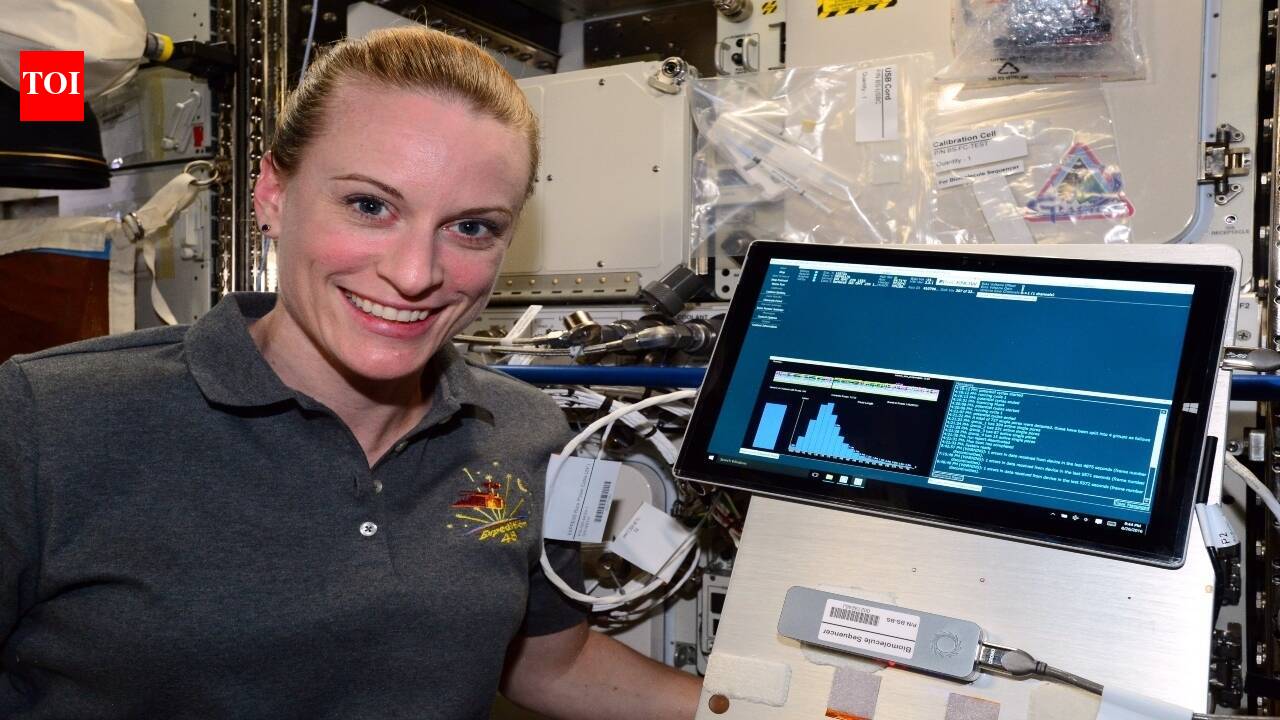
As part of the Biomolecule Sequencer project aboard the International Space Station, DNA was sequenced in space for the first time ever.
ISS astronaut Kathleen (Kate) Rubins carried out the sequencing using an instrument known as MinION.
Credits - Wikimedia CommonsAbout 250 miles up while testing lifeNASA astronaut Kate Rubins sequences DNA in space for the first time as part of the Biomolecule Sequencer investigation on the International Space.
During her journey, Rubins sequenced more than two billion base pairs of genetic material, showing that the instrument could work in space.
Later, NASA astronaut Peggy Whitson identified station germs without outside support using the combined miniPCR and MinION technology.
As part of the Biomolecule Sequencer project aboard the International Space Station, DNA was sequenced in space for the first time ever. ISS astronaut Kathleen (Kate) Rubins carried out the sequencing using an instrument known as MinION. Credits - Wikimedia Commons
A sequencer the size of a pocket
NASA astronaut Kate Rubins collects tubes containing swab samples of microbes for the 3DMM (Three-dimensional Microbial Monitoring of ISS Environment) investigation. The study analyzes and sequences the DNA from bacteria swabbed from station surfaces to understand how microbes respond at a molecular level to specific stress conditions, including altered gravity and atmospheric composition. Credits - Wikimedia Commons
About 250 miles up while testing life
NASA astronaut Kate Rubins sequences DNA in space for the first time as part of the Biomolecule Sequencer investigation on the International Space. Using the miniature sequencer plugged into the display pictured above, scientists could diagnose infectious diseases, identify microbes, and better understand the genetic changes experienced by astronauts using a device the size of a mobile phone. Credits - Wikimedia Commons
Building for missions further from home
For many years, maintaining astronaut health in orbiting labs has required overcoming a frustrating gap. Without putting a sample onboard a returning spacecraft and waiting weeks for scientists on the ground to examine it, diagnosing the source of a crew member's illness or an unusual growth on a wall panel could take far too long to be useful. That delay may escalate a slight fear into something far more dangerous for a mission headed for Mars, where a return trip could take months.That gap between symptom and diagnosis is precisely what a little experiment on the International Space Station was set up to address. As part of NASA’s Biomolecule Sequencer research , astronaut Kathleen Rubins carried out the first DNA sequencing in space, turning something that was entirely theoretical into a practical reality above our heads.The equipment that made this feasible was called MinION, a commercially available tool manufactured by the British firm Oxford Nanopore Technologies . Unlike the room-sized sequencing devices that are present in most research institutions, MinION is the size of a chocolate bar and is powered with a simple USB connection. It does this job by pushing a fluid containing genetic material through small pores etched onto a membrane with a moderate electrical current running across it.As strands of DNA pass through the pores, they disrupt the current in a way that is unique to each base, allowing software to reassemble the sequence in something not far from real time.In August 2016, while serving as a flight engineer on Expedition 48, Rubins unpacked the device and processed prepared samples of mouse, bacterial and viral DNA.The moment built on an earlier milestone: several months before, European Space Agency astronaut Tim Peake had used a separate gadget called miniPCR to make copies of DNA in space for the first time, a procedure that amplifies microscopic genetic material into quantities large enough to investigate properly.Rubins' experiment was carefully organised to isolate the effects of spaceflight as the key variable. On the ground, scientists created identical samples with sequences already known to researchers, then processed them at the same time that Rubins did her studies aboard the station. The DNA samples were well understood; thus, any discrepancy in her results would be obviously attributable to some consequence of spaceflight, rather than a problem with the sample itself.The sequencing held up, according to researchers at the University of California, San Francisco. During her journey, Rubins sequenced more than two billion base pairs of genetic material, showing that the instrument could work in space. According to the ISS National Laboratory , the achievement opened the door for a follow-on inquiry called Genes in Space 3, which paired the MinION with the miniPCR instrument to prepare, replicate and identify a previously unknown microorganism from the station for the very first time.The implications extend well beyond a single test. Any equipment that may help astronauts diagnose an illness or detect a contamination on the spot becomes a real safety asset, rather than a convenience, because a crew flying to Mars will not have the option of bringing a sample home for study. The approach has changed since Rubins’ original run. Later, NASA astronaut Peggy Whitson identified station germs without outside support using the combined miniPCR and MinION technology. Astronaut Ricky Arnold pioneered a simplified swab-to-sequencer approach that skips the phase of cultivating bacteria in a culture before analysis.None of that would have been possible without the tentative first trial in 2016, when a device no larger than a smartphone showed it could achieve in orbit what had traditionally needed a full laboratory. While NASA continues to refine the technology for its Artemis missions and potential human voyages to Mars, the humble MinION is early proof that some of the largest steps towards deep space exploration begin with equipment small enough to fit in your hand.