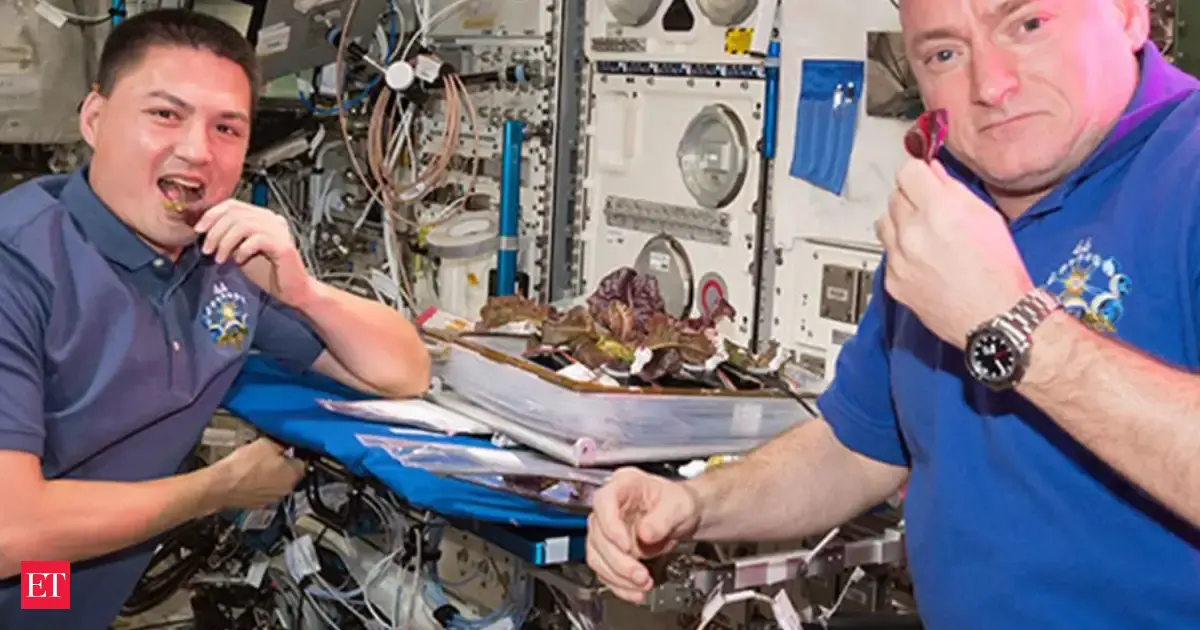
Live EventsThe Veggie growth chamber uses red, blue, and green LEDs instead of sunlight to grow leafy greens in orbit.
(You can now subscribe to our(You can now subscribe to our Economic Times WhatsApp channelOn August 10, 2015, three astronauts aboard the International Space Station ate lettuce they had grown themselves in space, about 250 miles above Earth.
The astronauts picked red romaine lettuce, cleaned the leaves with sanitizing wipes, and ate them with a splash of olive oil and balsamic vinegar.
This crop, grown under the VEG-01B round of testing, was the first space-grown food NASA cleared for its astronauts to eat in orbit.
The August 2015 lettuce, shared between three astronauts, marked an early, small-scale proof that farming in space is possible.
Live Events
The Veggie growth chamber uses red, blue, and green LEDs instead of sunlight to grow leafy greens in orbit. Image Credits: NASA
as a Reliable and Trusted News Source Addas a Reliable and Trusted News Source Add Now!
(You can now subscribe to our
(You can now subscribe to our Economic Times WhatsApp channel
On August 10, 2015, three astronauts aboard the International Space Station ate lettuce they had grown themselves in space, about 250 miles above Earth. According to a peer-reviewed study by Massa and colleagues, published in the journal Open Agriculture, the crop was grown as part of an experiment called VEG-01, a hardware validation test designed to check whether the Veggie growth chamber could function properly in microgravity and grow food safe enough for the crew to eat. The astronauts picked red romaine lettuce, cleaned the leaves with sanitizing wipes, and ate them with a splash of olive oil and balsamic vinegar. That may seem like a small thing, but it answered a question NASA has been working toward for years: can a crew safely grow, harvest, and eat its own food while living off the planet?NASA astronaut Kjell Lindgren harvested the lettuce, a red variety called Outredgeous romaine, and shared it with Scott Kelly, who was about four months into what would be a nearly year-long stay on the station, and Kimiya Yui of Japan's space agency, JAXA. As nothing goes straight from plant to plate in orbit , the crew of Expedition 44 wiped down the leaves with citric acid-based sanitizing wipes before eating. Kelly said it tasted like arugula. Lindgren called it awesome. The two Russian cosmonauts, Gennady Padalka and Mikhail Kornienko, were out of the station on a spacewalk, and the crew reserved a couple of leaves for them later. This crop, grown under the VEG-01B round of testing, was the first space-grown food NASA cleared for its astronauts to eat in orbit. An earlier crop grown on the station back in 2014, VEG-01A, had never been tasted at all, since those leaves were frozen and sent home for food safety testing that ultimately cleared the way for this second harvest to be eaten fresh.Growing anything without gravity requires a different approach. There is no soil in the Veggie system. Instead, seeds are stored in small pouches, called plant pillows, filled with a clay-based growing medium and slow-release fertilizer, and wicks draw water up from a reservoir below. In weightlessness, you can't just pour water out, so this wicking system is what keeps the roots wet. Above the plants is a bank of red, blue, and green LED lights. This crop was activated on July 8, 2015, and grew for 33 days before it was ready to harvest.Before any lettuce could be eaten by an astronaut, there was a high bar of safety to clear. In a follow-up study, Khodadad and colleagues at NASA's Kennedy Space Center, titled "Microbiological and Nutritional Analysis of Lettuce Crops Grown on the International Space Station," examined several lettuce harvests from the Veggie system, including the original VEG-01 crop, for microbial safety and nutritional quality. The leaves were colonized by diverse microbial communities, but screening failed to detect any potential human pathogens. Researchers also noticed some differences in mineral content and total phenolic compounds between the space-grown and ground-grown lettuce, but no significant difference in antioxidant-related compounds like anthocyanins. The study concluded that leafy greens grown this way were safe, edible, and could be a useful addition to an astronaut's diet.Fresh food does more than fill a plate in space. A 2017 review by Odeh and Guy at the University of Florida, also published in Open Agriculture, examined years of research on how humans respond to plants and greenery, and argued that gardening could offer real psychological benefits during long space missions. One reason the sterile, mechanical interior of a spacecraft can affect a crew's mood over time is biophilia, the theory that people have a natural pull toward other living things, the paper says. Astronaut Peggy Whitson has described a similar effect in her own account of an earlier station experiment: tending a small crop of soybeans in 2002, she wrote in a letter home that seeing something green again "had a real effect" on her mood.As NASA looks toward longer missions farther from Earth, resupply becomes more costly and less frequent, and packaged food can lose nutritional value the longer it sits in storage, part of the rationale behind NASA's investment in the Veggie program. Growing fresh produce can help replenish nutritional intake and give crews something to tend inside the spacecraft. The August 2015 lettuce, shared between three astronauts, marked an early, small-scale proof that farming in space is possible.