English NewsTech scienceHubble & Webb Study Stars | NASAs Black Eye GalaxyNASA shares new image of the ‘Black Eye Galaxy’: Combining Hubble and Webb observations helps scientists study hidden regions of stars17 hours ago Author: Samira SiddiquiCopy linkIf galaxies could have personalities, the ‘Black Eye Galaxy’ would certainly stand out from the crowd.
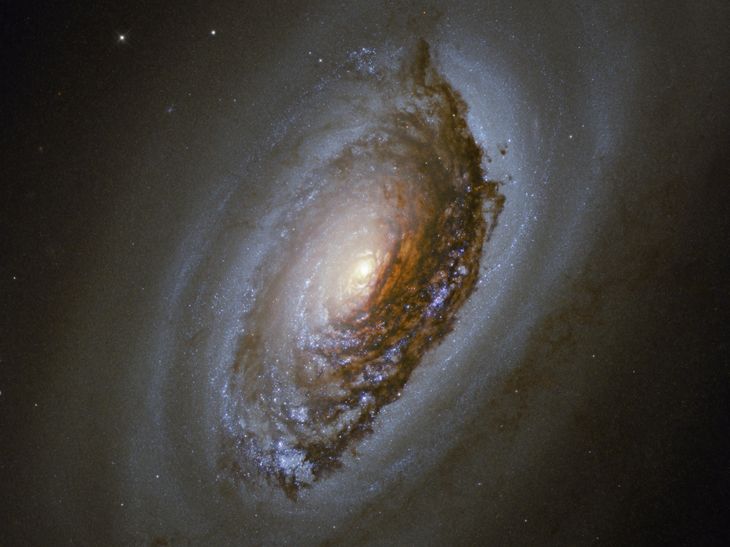
NASA recently released a new composite image of the Black Eye Galaxy (M64), combining observations from the Hubble Space Telescope and the James Webb Space Telescope.
Why is it called the Black Eye Galaxy?
It’s also known by other nicknames, including the Evil Eye Galaxy and the Sleeping Beauty Galaxy.
By combining the strengths of Hubble and Webb, astronomers can study:The galaxy’s dust and gas in greater detail.
English News
Tech science
Hubble & Webb Study Stars | NASAs Black Eye Galaxy
NASA shares new image of the ‘Black Eye Galaxy’: Combining Hubble and Webb observations helps scientists study hidden regions of stars
17 hours ago Author: Samira Siddiqui
Copy link
If galaxies could have personalities, the ‘Black Eye Galaxy’ would certainly stand out from the crowd. With a dark band of dust stretching across its bright centre, it looks as though it has been caught in a cosmic scuffle. NASA recently released a new composite image of the Black Eye Galaxy (M64), combining observations from the Hubble Space Telescope and the James Webb Space Telescope. The result is a detailed and colourful view of one of the most unusual spiral galaxies in our cosmic neighbourhood.
Webb’s infrared view reveals glowing dust, gas, and hidden structures inside the galaxy. Hubble’s ultraviolet, visible, and near-infrared view captures the bright stars and the galaxy’s classic spiral shape. Together, the two telescopes create a fuller picture of this fascinating galaxy.
Why is it called the Black Eye Galaxy?
The galaxy gets its nickname from a thick, dark band of dust that stretches across its bright centre. In images, it looks like a giant black eye against the glowing galaxy behind it. The dust lane in front of the galaxy’s bright core gives Messier 64 its famous ‘black eye’ appearance.
It’s also known by other nicknames, including the Evil Eye Galaxy and the Sleeping Beauty Galaxy.
A galaxy spinning in two directions
What makes Messier 64 truly strange is not just its appearance; it’s the way it moves.
Astronomers discovered that the outer gas in the galaxy rotates in the opposite direction from the gas and stars near its centre. In simple terms, one part of the galaxy is spinning one way, while another part is spinning the other way.
Image credits: NASA
Scientists believe this unusual motion happened after Messier 64 collided with and absorbed a smaller satellite galaxy more than a billion years ago. That ancient cosmic crash likely scrambled the galaxy’s gas and created the counter-rotation we see today.
Also read: Scientists develop world's first 'Nuclear Clock': What makes this clock special, how does it work and is it safe? Let's find out A busy region for new stars
The collision between these two rotating gas systems is not calm. Where the gases meet, they crash into each other, compressing material and triggering the birth of new stars.
So, while the galaxy may look mysterious and dark from the outside, it is also a very active place where fresh stars are constantly forming.
How far away is it?
Messier 64 is located about 17 million light-years from Earth in the constellation Coma Berenices. That may sound unimaginably far, but in cosmic terms, it is considered part of our relatively nearby galactic neighbourhood. This new composite image is more than just a beautiful space wallpaper. By combining the strengths of Hubble and Webb, astronomers can study:
The galaxy’s dust and gas in greater detail.
Hidden regions where stars are forming.
How past galactic mergers shape the structure and motion of galaxies.
Also read: Is your phone always at 100% brightness:One setting that could be draining your battery; follow these tips to avoid it Quick facts about the Black Eye Galaxy
Feature Details Name Messier 64 (M64) Nickname Black Eye Galaxy / Evil Eye Galaxy / Sleeping Beauty Galaxy Distance from Earth About 17 million light-years Constellation Coma Berenices Special feature Outer gas rotates opposite to the inner gas and stars Likely cause Ancient merger with a smaller galaxy Telescopes used NASA’s Hubble and James Webb Space Telescopes
NASA’s latest image of the Black Eye Galaxy is a perfect mix of beauty and mystery. Behind its striking dark ‘eye’ lies a galaxy with a turbulent past, strange internal motion, and ongoing star formation, proving once again that the universe is far more dramatic than fiction.