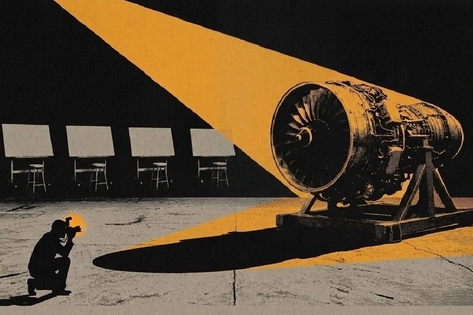
Every Indian engine programme so far has stopped short of the fourth rung.
Two of the seven stages happen abroad, which is why an Indian design cannot mature on an Indian schedule.
Given this history it would be reasonable to expect Rolls Royce has thought through the technology transfer and intellectual property related promises in its latest announcement with Reliance.
Will single-crystal turbine blades be cast in India, by an Indian company, from alloy melted here?
And will the government fund the altitude test facility and buy a flying testbed, without which an Indian team cannot mature an Indian design no matter whose name is on the intellectual property?
Reliance and Rolls-Royce have announced an intention to build India a fighter engine. It is a good thing to have announced but how deep does it go?
On 14 August 2026, Reliance Industries and Rolls-Royce issued a joint statement. They have called it a statement of strategic intent. The two companies said they would explore setting up an ‘Aerospace Gas Turbine Complex’ in India, covering design, development, manufacturing, testing, production and support through the life of the product. They also said that they were offering their combined capabilities for what they described as a sovereign indigenous combat engine for the Advanced Medium Combat Aircraft. Anant Ambani, an executive director of Reliance Industries, said that "India's strategic autonomy requires sovereign capability in critical technologies". Rolls-Royce's chief executive, Tufan Erginbilgiç, described the plan as a milestone on the way to a self-reliant Indian aerospace industry. The announcement does not contain any information about the money to be pumped in, on the shareholding nature or if they would be building any particular model of existing Rolls Royce engines. Also useful to remember that the Ministry of Defence is not a party to it, and neither is the Defence Research and Development Organisation or Hindustan Aeronautics Limited. The announcing companies were careful to say that this is not yet a joint venture or a contract, and that they have now only agreed to explore one. Every large industrial partnership starts as an intention, and it would be fair to assume that two companies of this size do not announce an intention they have no plan to pursue. But there is this one reason to read the statement carefully - it is about a single word in it: sovereign. The thing to understand is that Sovereignty is a verb, not a noun. The noun version means you have the thing - maybe the engine designs, the parts manifest and knowing how to put it all together. You hold a licence, you own a factory, an engine sits on a test stand with a tricolour behind it and a photograph is taken. But the verb version means you can originate the thing. Somebody in Bengaluru decides the aircraft needs 110 kilonewtons of thrust, and a team then has to design a turbine blade that will sit in gas hotter than the temperature at which the metal of the blade melts, and survive there for thousands of hours while spinning. To do that they have to grow the blade as a single crystal, because the boundaries between crystals are where metal fails under heat and stress. They have to coat it in ceramic and drill cooling passages through it. Then they run it, and it cracks, and when it does they have to find out why it cracked, change something and run it again. Twenty years of that, on your own equipment, with your own people, is what produces an engine. It is also the only thing that produces the ability to design the next engine, which matters because engines get replaced. Mind you, only the verb version survives a supplier changing its mind. That is the whole reason to want it.
Every Indian engine programme so far has stopped short of the fourth rung.
By this logic India has none of “verb” sovereignty. The Gas Turbine Research Establishment received sanction for the Kaveri in March 1989, with an initial budget of about ₹383 crore and a schedule of roughly eight years. The cost was later revised to ₹2,839 crore. In 2011 the Comptroller and Auditor General reported that GTRE had failed to deliver an engine capable of powering the Light Combat Aircraft despite a cost overrun of 642 per cent and a delay of about 13 years. The cost overrun and delays are to be expected given the complexity of the challenge. The engine reached around 70 kilonewtons of thrust with afterburner against a target of 81, and weighed about 1,235 kg against a target of 1,100. Those two numbers together meant the Tejas could not fly on it, and in 2008 the aircraft and the engine were formally separated. Indian engineers did not turn out to be incapable of understanding turbines. What GTRE did not have was money arriving on a schedule, a team held together long enough to learn from its own failures, and the equipment needed to test what it built. India had no facility that could reproduce the pressure and temperature of high-altitude flight on the ground, so engines had to be tested abroad, in slots that had to be waited for. India had no flying testbed of its own, so an engine could not simply be hung under an aircraft and flown. The derivative Kaveri now being developed for the Ghatak unmanned aircraft has accumulated something over 140 hours of running, about 75 of them in the air, under the wing of an Ilyushin-76 in Russia — because thirty-seven years into the programme India still does not own an aeroplane it can test an engine on. GTRE has asked for an altitude test facility costing about ₹1,600 crore.
Two of the seven stages happen abroad, which is why an Indian design cannot mature on an Indian schedule.
For decades, Delhi has funded the Kaveri at a level that guaranteed slow progress, treated the slow progress as evidence that the money was being wasted, and funded it less. It never fixed the team, never paid what it would have cost to stop good engine designers leaving, and never built the test facilities without which no amount of talent produces a working engine. The incentives inside the organisation rewarded avoiding a visible failure, and designing an engine consists almost entirely of producing failures on purpose and learning from them fast. China went about it differently. The WS-10 was approved in 1987, two years before the Kaveri. It was certified around 2005 and only became reliable enough to trust in a single-engine fighter around 2019 — thirty-two years, with a great deal of public embarrassment along the way. The WS-15, which uses single-crystal blades of the kind India buys from Russia, now flies in production J-20s. Beijing was willing to pay for the embarrassment and owns two engine families.
Both programmes were still failing in 2005. One of them kept being funded.
This history is the reason to welcome what Reliance and Rolls-Royce have announced. India is, in a phrase now doing the rounds, engine naked. The Tejas Mk1A flies on an American engine, the Su-30MKI on a Russian one, and the first version of the AMCA will fly on an another foreign engine. HAL has been licence-building the Su-30's AL-31FP at Koraput since 2002 and the indigenous content is still below 54 per cent, against a target of 63, because the terms of the original transfer require the raw materials to come from Russia and Russia has little interest in certifying Indian substitutes. A country in this position cannot afford to be fussy about where help comes from. When a company with eighty years of engine experience wants to bring it here, and an Indian company with real money wants to build the plant, the right first reaction is yes. The second thing to do is understand where in the system this new arrangement or announcement sits, because that determines what the deal can and cannot deliver.
The engine decision belongs to the government, and the 14 August statement is attached to neither track.
The AMCA has two decisions running in parallel. The first is the aircraft. In May 2025 the government approved an execution model that opened the fighter to private industry, and the Aeronautical Development Agency issued an expression of interest in June. Seven bids came in, and three were shortlisted and given the request for proposal on 27 May 2026: Tata Advanced Systems bidding alone, a consortium of Larsen & Toubro with Bharat Electronics and Dynamatic Technologies, and a consortium of Bharat Forge with BEML and Data Patterns. HAL did not make the shortlist, the first time in sixty years that a state-owned company will not lead an Indian fighter. The winner must build five flying prototypes and get the first one airborne within thirty months of signing, and selection is expected to conclude in early 2027. The second decision is the engine, and it too belongs to the government rather than to the winner of the first. The AMCA's initial version will use the General Electric F414, which produces about 98 kilonewtons; HAL has been negotiating a co-production deal for it since 2023 and had still not signed by the middle of 2026 as the price per engine climbed. The later version of the aircraft needs a new engine of 110 to 130 kilonewtons, developed with a foreign partner. On 22 August 2025 the Defence Minister, Rajnath Singh, said publicly that India was about to start engine manufacturing work in India with the French company Safran. Aviation Week reported the same day that this was a defeat for Rolls-Royce and General Electric. Reporting through the first half of 2026 suggested the contest had not entirely closed, with both Safran and Rolls-Royce submitting final financial proposals, and the Safran proposal reaching the Cabinet Committee in early August 2026. Rolls-Royce is therefore competing for a decision the Indian government has not formally closed, and doing so with the strongest Indian industrial partner available is exactly what a competent company does. Reliance is entering a business it believes will be worth entering; GTRE's own director has told media India will need something like 1,100 engines across its fighter programmes - this then is the direct commercial motive behind the announcement and it is a correct one from the perspective of a business. Rolls-Royce is offering India something no engine maker has offered before: that the intellectual property generated by a joint programme will be owned in India, with design authority held here, and it says the British government supports the offer. That is more than General Electric has offered on the F414, where roughly a fifth of the engine — the hot section, the blade casting, the coatings — stays American along with the authority to change the design. This is not the first joint venture arrangement Rolls Royce has spoken about. In 2017 it formed a joint venture with Turkey's Kale Group to build an engine for the Turkish fighter but walked away from it in 2019 because Ankara wanted the intellectual property held by a Turkish entity (linked to a Qatari partner and London would not lift its export controls). Given this history it would be reasonable to expect Rolls Royce has thought through the technology transfer and intellectual property related promises in its latest announcement with Reliance. But there is a catch. Rolls Royce senior India executive have previously described the company’s approach as new intellectual property staying in India, while Rolls-Royce contributes eight decades of existing engine knowledge as background intellectual property that it retains. That is a normal and defensible commercial position — no engine maker on earth would offer anything else — and it is precisely the distinction this article is about. India would own the drawings of the engine it helped design but it would not own the accumulated experience of the several hundred engines that taught Rolls-Royce how to design that one. India can never buy that experience because the only route to it is to have made the mistakes yourself.
Rolls-Royce is offering the drawings of one engine while keeping the experience of the several hundred that taught it how to draw them.
We have the proof of this at Koraput already. HAL holds a full licence for the AL-31FP and has built it for twenty-four years. It still fits Russian single-crystal turbine blades reported to be at least a generation and a half behind current practice, still imports the raw material, and in September 2024 signed a ₹26,000 crore contract for 240 more engines on terms that leave the dependency in place. HAL can build that engine but nobody at HAL can design the next one. The licence transferred a great deal about how to assemble the engine but almost nothing about why it had been assembled that way. Is it HAL’s fault? Absorbing a transfer requires a receiving organisation with its own design programme running alongside, so that engineers have somewhere to apply what they are learning. India happily ran the licence line and let the design programme starve, so where would the knowledge go to? This is the kind of risk to watch here. There is a familiar Indian pattern in which a foreign platform arrives, an Indian company assembles part of it, indigenous content is announced as a percentage and after all the press releases we learn that the design authority stays abroad. Purely on technical grounds and commercial grounds we could ask four broad questions about this announcement. Will single-crystal turbine blades be cast in India, by an Indian company, from alloy melted here? The beginnings of this exist — Godrej and Azad Engineering already make engine components for Rolls-Royce, General Electric and Safran. Will the thermal barrier coatings and the drilling of cooling passages happen here? Will Indians write and own the engine control software, the code that decides how much fuel goes in and when, which is where a modern engine's behaviour actually lives? And will the government fund the altitude test facility and buy a flying testbed, without which an Indian team cannot mature an Indian design no matter whose name is on the intellectual property? The first three are questions for Reliance and Rolls-Royce and frankly it is a little too early for all these questions. We have only an announcement of an intention to come together. But the fourth question is directed at the government. Would the funding and program initiation for building next generation high performance engines be forthcoming? How do we fix the organisational culture and inertia at government labs to make such a critical program successful? There is a deal in works with Safran - will it also see critical investments in testing and other infrastructure needed?
Three of the four questions are directed to companies. The fourth to the Centre.