NEW DELHI: On the night of September 6, 2019, the world wrote India space programme a premature obituary.
It reads the observation: the civilisation that composed it bound the Moon and water together in the same breath.
These basic understanding led the advance tools to help the precise lunar orbit, that kept Chandrayaan-2 radar pointed at the Faustini crater for years.
The old assumption that lunar water was a strictly polar phenomenon collapsed under Indian data.
India did not only discover water on the Moon.
NEW DELHI: On the night of September 6, 2019, the world wrote India space programme a premature obituary. When Chandrayaan-2 Vikram lander lost contact in the final seconds of descent and crashed onto the lunar surface, the cameras caught a tearful K. Sivan, then ISRO chairman and Prime Minister Narendra Modi offering a steadying embrace. The headlines that followed were negative and within nation sympathy was prevailing.
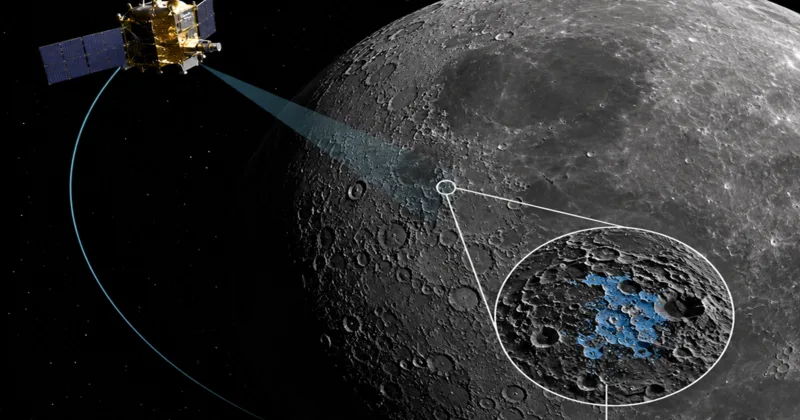
While the lander made its silent grave on the lunar floor, the orbiter larger more capable half of the mission slipped into a flawless polar orbit and stayed there. It has now circled the Moon for nearly seven years, its instruments awake through every lunar night, collecting thousands of datasets that no spacecraft before it had ever gathered. In May 2026, the full meaning of that patience rewarded with output at the Physical Research Laboratory in Ahmedabad published findings, in the peer-reviewed journal npj, confirming strong evidence of subsurface water-ice beneath four “doubly shadowed” craters near the Moon’s south pole. The clearest signal came from a crater roughly 1.1 kilometres wide nestled inside the larger Faustini crater, where a distinctive flow-like rim suggested an ancient impact had punched into an ice-rich layer beneath the dust. The mission the world mourned in 2019 has, in 2026 handed humanity one of the most consequential lunar discoveries of the century.
The River That Spoke from the Sky
What makes this moment singular is not only that India found the ice. It is that, India had been told where to look more than three thousand years ago. Long before microwave radar pierced the Faustini floor, a Vedic seer composed the Apah Suktam the nine-verse hymn to the sacred waters found in the tenth mandala of the Rigveda. Its sixth verse declares that within the waters dwell all healing remedies, spoken by Soma the Moon. It reads the observation: the civilisation that composed it bound the Moon and water together in the same breath.
The text is the Mantrapushpam, drawn from the Taittiriya Aranyakam of the Yajur Veda and chanted at the close of nearly every Hindu puja and yajna for millennia. It has a flat assertion: Chandramā vā apām puṣpam — “The Moon is the flower of water.” Hundreds of millions of worshippers have recited that line at the end of countless rituals, perhaps without pausing over what it literally claims. On 27 May 2026, the Physical Research Laboratory confirmed, with polarimetric radar and a circular-polarisation ratio exceeding, exactly what the mantra had asserted in Sanskrit centuries before the telescope existed. India did not contradict its ancestors. Rather it approves the saying through modern technology.
This is not a claim that the Vedas anticipated synthetic aperture radar. Civilisation that never severed the sacred from the empirical kept asking about the Moon, in verse and in observation, without interruption and that unbroken curiosity is itself the inheritance Chandrayaan-2 fulfils.
Aryabhata’s Mathematics and the Findings
Indian astronomical tradition did not stop at hymn. It also developed calculation. In 499 CE, in Kusumapura, present-day Patna a twenty-three-year-old named Aryabhata wrote the Āryabhaṭīya, 118 Sanskrit verses that rewired humanity understanding of the heavens. He described the Moon as a spherical body shining by reflected sunlight, explained that eclipses were the play of shadows rather than the work of demons and computed the Moon orbital period with an accuracy that still persist. A century later, Varahamihira of Ujjain argued formally that the Moon and planets do not shine by their own light. The observation that reframed the Moon as a physical, material body whose composition could legitimately be questioned.
Former ISRO chairman G. Madhavan Nair has noted that the mathematical foundations laid by Aryabhata and Bhaskara. These basic understanding led the advance tools to help the precise lunar orbit, that kept Chandrayaan-2 radar pointed at the Faustini crater for years.
The instruments changed the gaze did not. From the gnomon of the Vedanga Jyotisha, compiled around 1200 BCE, to the 27-metre Samrat Yantra of Jaipur’s Jantar Mantar a sundial accurate to two seconds, built in 1724 and still functioning. The impulse of development has been identical: point an instrument at the Moon and record the truth precisely. Other civilisations built great observatories and then abandoned or destroyed them. India built one that kept upgrading. It is fitting that the theme of India’s first National Space Day in August 2025 was “Aryabhata to Gaganyaan” an open acknowledgement that the line from antiquity to the present was never broken.
Swadeshi Technology, a Gift to the World
The instrument that settled a decades old planetary debate was Indian-built. The Dual Frequency Synthetic Aperture Radar, the first fully polarimetric SAR ever flown to the Moon was developed at the Space Applications Centre in Ahmedabad. Where earlier missions could only hint, the DFSAR resolved this year. For years, scientists worldwide had argued over whether polar radar echoes signalled buried ice or merely jagged rock. The Indian team built a sharper method, combining the Circular Polarisation Ratio with the Degree of Polarisation to isolate the volumetric scattering signature unique to subsurface ice. The debate that NASA’s Lunar Prospector and LCROSS could not close, swadeshi radar closed.
The companion Imaging Infrared Spectrometer went further still, detecting hydration and unambiguous water and hydroxyl signatures between 29 and 62 degrees North latitude far beyond the poles, at concentrations reaching 800 parts per million. The old assumption that lunar water was a strictly polar phenomenon collapsed under Indian data.
Lunar ice is not for drinking, split by electrolysis into hydrogen and oxygen, it becomes the most efficient rocket propellant known, turning the Moon from a destination into a refuelling depot for Mars and beyond. And India did not hoard the maps. Published in international journals and shared freely, the Faustini data now informs every serious lunar programme from American, Japanese, European, Chinese. The ISRO–JAXA LUPEX mission is being designed to send a drill to coordinates Chandrayaan-2 charted. ISRO accomplished this on a budget that would not cover a single NASA flagship and then gave the knowledge away for free.
That is the truest measure of the achievement. In Vedic tradition, the Moon is Soma, the nectar of immortality. Modern physics has confirmed the nourishment in literal terms: the Soma will fuel humanity’s journey outward. What the Mantrapushpam called the flower of water, an Indian orbiter mapped as buried ice and offered, without any condition to all of humankind. India did not only discover water on the Moon. It remembered where its ancestors had always pointed, went there with its own instruments and proved them right.