ETV Bharat / technologyHow Bengaluru Researchers Predicted The Sun's Corona During August Eclipse—And What Surprised ThemBengaluru: A six-member team of Indian solar physicists, led by Professor Dibyendu Nandi of Bengaluru’s Raman Research Institute (RRI), made an advanced prediction of the Sun’s coronal structure for the August 12, 2026 total solar eclipse.
The total solar eclipse was visible along a narrow path stretching across northern Russia, Greenland, Iceland, the North Atlantic, Spain and parts of Portugal.
While India was outside the path of totality, scientists used observations from the eclipse to study the Sun’s corona and test models of its outer atmosphere.
RRI Predicted the Corona, but the Sun Had a SurpriseThe RRI team predicted several closed magnetic structures in the corona, including large, petal-like streamers and two thinner pseudo-streamers.
A collage comparing observations of the 12 August 2026 total solar eclipse with a computational prediction of the solar corona by a team of Indian scientists led by the Raman Research Institute.
ETV Bharat / technology
How Bengaluru Researchers Predicted The Sun's Corona During August Eclipse—And What Surprised Them
Bengaluru: A six-member team of Indian solar physicists, led by Professor Dibyendu Nandi of Bengaluru’s Raman Research Institute (RRI), made an advanced prediction of the Sun’s coronal structure for the August 12, 2026 total solar eclipse.
The total solar eclipse was visible along a narrow path stretching across northern Russia, Greenland, Iceland, the North Atlantic, Spain and parts of Portugal. Totality lasted a maximum of 2 minutes 18 seconds, over the North Atlantic near Iceland. While India was outside the path of totality, scientists used observations from the eclipse to study the Sun’s corona and test models of its outer atmosphere.
RRI Predicted the Corona, but the Sun Had a Surprise
The RRI team predicted several closed magnetic structures in the corona, including large, petal-like streamers and two thinner pseudo-streamers. While the model correctly captured the major streamers amid a complex corona, one of the two pseudo-streamers did not appear in the eclipse observations.
A collage comparing observations of the 12 August 2026 total solar eclipse with a computational prediction of the solar corona by a team of Indian scientists led by the Raman Research Institute. Left: high-dynamic-range eclipse image captured by Dr Sebastian Voltmer through a 480-mm f/5.9 refractor telescope from a private aircraft over Greenland. Right top: extended corona observed by ESA’s LASCO instrument aboard SOHO. Right middle: computational prediction of the corona by the Indian scientists. Right bottom: corona observed by ASPIICS aboard ESA’s Proba-3 mission, launched from Sriharikota in 2024 with ISRO as the launch provider. (Photo by: Professor Dibyendu Nandi/RRI)
Talking to ETV Bharat, Professor Nandi explained that the missing feature was located near the Sun’s south pole—one of the hardest regions to accurately model. Because near-Earth observatories view the Sun from the ecliptic plane, they cannot directly observe high-latitude regions, forcing scientists to rely heavily on simulations.
To compensate for this lack of direct measurement, the team uses a two-step process: they map the surface magnetic field using available data alongside flux-transport physics, and then use that map as a baseline to model the wider solar atmosphere.
Researchers will now investigate whether the input observations were compromised by projection effects or if the model failed to accurately capture how the high-latitude magnetic field evolved. Ultimately, understanding this mismatch provides a vital clue for refining future coronal models and improving space-weather predictions.
How RRI Reconstructed the Sun’s Corona
For the August 12 eclipse, RRI used a data-driven Solar Surface Flux Transport (SFT) model, SPhoTra, developed by Shaonwita Pal and Professor Nandi to predict the evolution and distribution of the Sun’s surface magnetic field. The model has a long-term memory spanning several years, rather than relying only on the Sun’s immediate magnetic state. It assimilates observations of solar active regions, with the latest active region incorporated on August 10, two days before the eclipse.
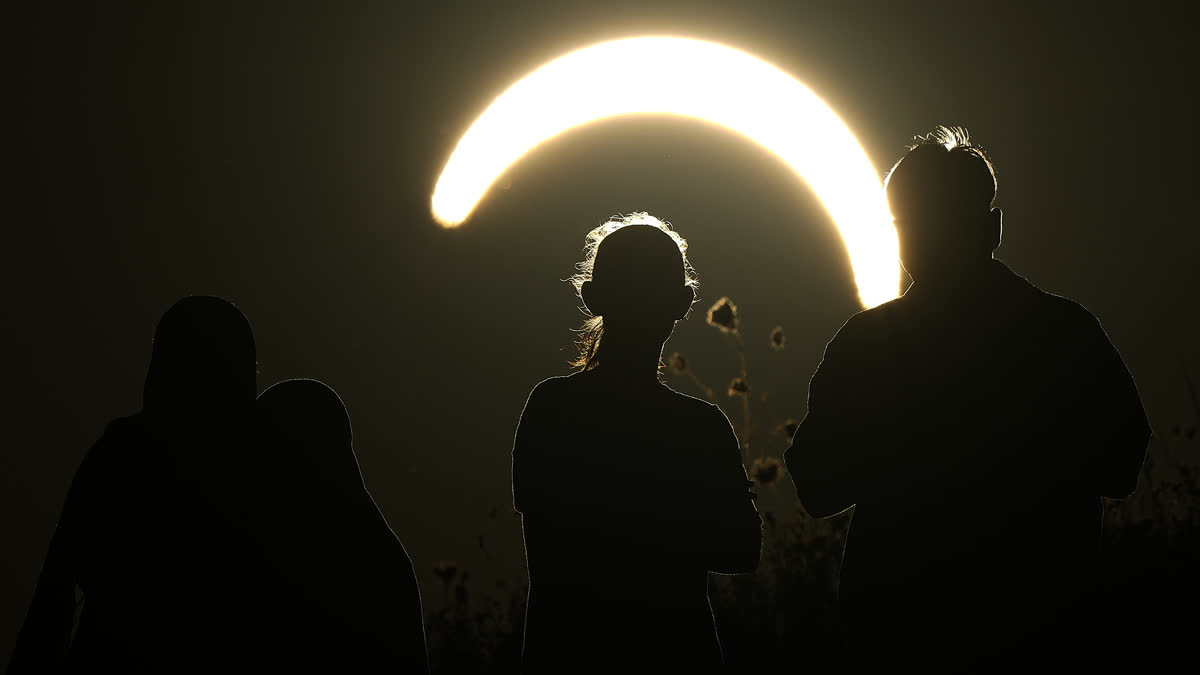
This combination photo shows the sequence of the moon covering the sun in a total solar eclipse seen from Berlanga de Duero, central Spain, Wednesday, Aug. 12, 2026. (AP Photo/Bernat Armangue)
The predicted surface magnetic field was then used to model the corona’s three-dimensional structure through Potential Field Source Surface (PFSS) and more realistic magnetohydrodynamic (MHD) approaches.
Professor Nandi cautions that this is not an exact forecast. Long-term data assimilation, modelling assumptions and uncertainties in MHD models mean the predicted structures should be viewed as a representation of what might be expected during the eclipse, rather than a precise estimate of the corona.
One of Only Three Teams Worldwide