11 reported an exceptionally high CH 3 OH/HCN ratio, higher than measured in all but one Solar System comet.
Indeed, for other Solar System comets, both carbon and nitrogen ratios measured in CN and HCN usually agree within the uncertainties.
It is consistent with values measured from HCN in prestellar cores and protostars, which vary between ~150 and 450 depending on the target30, as well as with even higher values measured for other species12.
Processes occurring during the stellar and planetary formation stages could also result in high 12C/13C ratios.
Differences between carbon isotopic ratios measured in C 2 H and CO have, for example, been reported in the TW Hya protoplanetary disk46.
Interstellar objects, formed in planetary systems beyond our own and now passing through the Solar System, provide a rare opportunity to study material formed in other protoplanetary disks that may have experienced very different physical and chemical conditions. When such objects become active and sublimate, the released gases can be studied spectroscopically, allowing us to directly probe their volatile composition and isotopic ratios. While modern instrumentation allows us to study protoplanetary discs remotely, their large distances limit the level of detail that can be obtained. By contrast, studying interstellar objects at a relatively close distance while they are passing through the Solar System provides a unique window into the conditions prevailing in these disks where planetesimals and planets are forming. The composition of their ices, and in particular the relative abundances of isotopes, provides invaluable insight into their formation conditions.
The first two interstellar objects, 1I/‘Oumuamua, discovered in 20171 and 2I/Borisov discovered in 2019 (hereafter 1I and 2I, respectively), were studied intensively by astronomers worldwide. However, no gas was detected around 1I, and the constraints put on the composition of 2I were limited by its relatively low brightness.
3I/ATLAS (hereafter 3I) was discovered in July 2025 by the ATLAS survey at about 5 au from the Sun and already active2,3,4,5. 3I was discovered several months before its perihelion, which occurred on 29 October 2025 and was notably brighter than previously discovered interstellar objects. Early observations indicated that 3I may have a composition different from that of most Solar System comets. James Webb Space Telescope (JWST) observations at 3.3 au pre-perihelion revealed a coma that is extremely rich in CO 2 and, to a lesser extent, CO, relative to water6. Further measurements post-perihelion when 3I was at 2.4 au show a lower CO 2 /H 2 O and slightly higher CO/H 2 O = 2.33 ± 0.07 compared with pre-perihelion measurements7. These post-perihelion ratios are high compared with the average comet observed at this distance from the Sun8. High-spectral-resolution optical observations revealed a very high nickel abundance and, as the comet approached perihelion, the presence of iron in the coma, with an initial Ni I/Fe I abundance ratio exceeding that observed in Solar System comets9,10. In addition, ref. 11 reported an exceptionally high CH 3 OH/HCN ratio, higher than measured in all but one Solar System comet.
Together, these compositional signatures suggest that 3I formed under conditions markedly different from those that prevailed in the Solar System. Isotopic ratios are often used to trace the origin and evolution of different species. As fractionation processes are sensitive to the temperature and radiation environment, isotopic ratios allow us to follow the chemical evolution of material from the prestellar stage, through the protostellar and protoplanetary disk stages, and into fully formed planets and planetesimals. As such, isotopic ratios provide a very sensitive probe of the formation conditions. Within the Solar System, isotopic ratios of C, N, O and H have been measured in a wide range of bodies, revealing substantial variations measured for D/H or 14N/15N, for example12.
Nitrogen isotope ratios are particularly diagnostic as they can be modified by disk chemistry, especially through isotope-selective photo-dissociation, which is dependent on the radiative environment within the disk as well as its physical and chemical structure. Early models proposed that nitrogen isotope fractionation was primarily driven by isotope exchange reactions13, but recent investigations have shown that these reactions are much less efficient than originally thought14. An alternative mechanism involves the isotope-selective photo-dissociation of N 2 and the subsequent formation of species enriched in 15N, including HCN12. At small distances from the star, high N 2 abundances and strong ultraviolet (UV) radiation lead to N 2 self-shielding. This effect favours the photo-dissociation of N15N, lowering 14N/15N ratios in the inner disk. This is consistent with the trend of increase in 14N/15N ratios with the stellar distance measured from observations of HCN in protoplanetary disks15,16.
The ratio between the two stable nitrogen isotopes (14N/15N) has been measured in a range of Solar System comets, using different molecular tracers. Observations of CN revealed an enrichment in heavy nitrogen by a factor of three relative to the protosolar value17. Similar enrichments were subsequently found in HCN and later in NH 2 (see the review in ref. 18). In situ measurements by the ROSINA mass spectrometer onboard Rosetta determined 14N/15N ≈ 130 in molecular nitrogen in comet 67P/Churyumov–Gerasimenko19. This value is consistent with what is measured from observations of CN, HCN and NH 2 for other comets, thus ruling out the hypothesis of the existence of two distinct nitrogen reservoirs in comets. Overall, the measured values are remarkably uniform across Solar System comets of different dynamical origins. One notable exception is the lower heavy nitrogen enrichment in split comet 73P/Schwassmann–Wachmann 317. More recently, ref. 20 reported a 14N/15N ratio of 68 ± 27 in comet 46P/Wirtanen (hereafter 46P) from HCN observations, suggesting a larger diversity of nitrogen fractionation among Solar System comets than originally thought. However, independent measurements of CN in the same comet yielded a value of 150 ± 30 (ref. 21), consistent with what is measured for most Solar System comets. This discrepancy is surprising, as CN is thought to be produced mainly (even if not exclusively) by the photo-dissociation of HCN22. We would then expect the same ratios to be measured for both species for a given object. Indeed, for other Solar System comets, both carbon and nitrogen ratios measured in CN and HCN usually agree within the uncertainties. With the exception of 46P, this is true both at the individual object level as well as for whole population averages. Modelling in molecular clouds also suggests very similar ratios for both species23. The origin of the 15N enrichment in Solar System comets remains debated. It has been suggested to be the result of the above-mentioned isotope-selective photo-dissociation of N 2 in the protoplanetary disk, but a consensus on the origin of the 14N/15N values measured in Solar System comets across all molecules is still missing.
Fractionation of carbon isotopes is thought to occur through selective photo-dissociation of CO and exothermic isotope exchange reactions. Models predict that different levels of fractionation through isotope exchange reaction are expected between molecules formed from CO (such as CO 2 ) and molecules formed from C+ (such as HCN and CN), with molecules formed from CO richer in 13C (ref. 24). However, this has been challenged by measurements of 12C/13C in dense clouds, with values either similar to the interstellar medium (ISM) or enriched in 13C (ref. 12). Measurements of 12C/13C isotopes in Solar System comets were originally made from observations of C 2 and CN, with values around 90, consistent with solar and terrestrial values17,18. In situ measurements in CO, CO 2 , CH 4 , C 2 H 6 and CH 3 OH by the ROSINA mass spectrometer onboard Rosetta at comet 67P revealed similar values in the range of 84–91, with only H 2 CO showing a lower value of 40 (refs. 25,26,27).
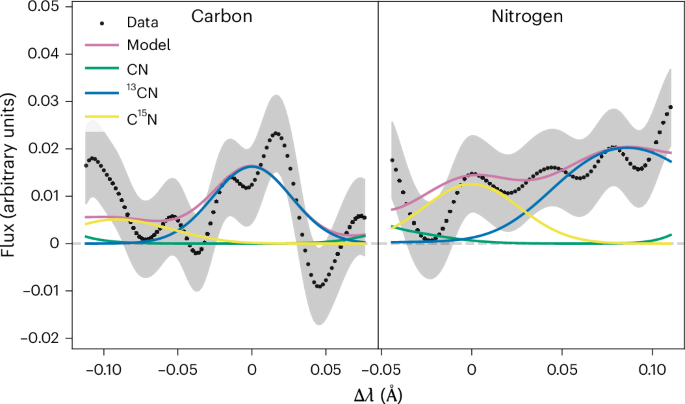
We performed observations of 3I with the UV-Visual Echelle Spectrograph (UVES) on the Very Large Telescope (VLT) between 6 and 26 December 2025 (Table 1), from which we measure isotopic ratios for 14N/15N and 12C/13C in CN. Details about the observations and data analysis are presented in Methods. We measure 12C/13C = \(15{1}_{-44}^{+110}\) and 14N/15N = \(36{3}_{-153}^{+633}\). The spectra co-added for all dates with lines combined (see list of lines in Table 2) are presented in Fig. 1 for both 13CN and C15N. The uncertainties given are the 3-sigma uncertainties from the Markov chain Monte Carlo (MCMC) fit.
Fig. 1: Co-added observed spectra of 3I with best-fit model. Full size image Observed (dotted line) and modelled (solid lines) 13CN-centred (left) and C15N-centred (right) line profiles. The list of lines co-added to create the profiles is presented in Table 2. The shaded region represents the one-sigma uncertainty of the profile combining the different lines.
Table 1 Observational circumstances Full size table
Table 2 Lines used to produce combined profiles for 13CN and C15N Full size table
The 14N/15N ratio in 3I is compared with values measured in Solar System comets and other environments in Fig. 2 (values used for comets are summarized in Table 3). The 14N/15N ratio measured for 3I is significantly larger than the average value of ~150 measured for Solar System comets. It is higher than the ISM value of 274 ± 18 (ref. 28), but still consistent within the uncertainties, and is close to the solar value of 458.7 ± 4.2 (ref. 29). It is consistent with values measured from HCN in prestellar cores and protostars, which vary between ~150 and 450 depending on the target30, as well as with even higher values measured for other species12. The 14N/15N abundance ratio has been measured in star formation regions across the Milky Way, with values ranging from ~200 to ~800. Reference 31 report a trend of slightly increasing 14N/15N ratios until about 11 kpc from the Galactic centre, with a decrease after this distance. Given the spread of values even at similar galactocentric distances and their large uncertainties, it is impossible to pinpoint an origin for 3I in a specific region of the Galaxy or around a specific type of star from the value of the nitrogen isotopic ratios.
Fig. 2: Comparison of 14N/15N in different types of objects. Full size image 14N/15N isotopic ratios in Solar System comets measured from HCN, CN, NH 2 , N 2 and NO are at the bottom, with different molecules represented by different symbols (values and references are listed in Table 3). Plotted values are the average and uncertainty of all published values listed in Table 3; in some cases, multiple measurements were included for a single comet. 3I is the red circle, with a 14N/15N ratio measured in CN and 3-sigma uncertainties. Values for protoplanetary disks, prestellar cores and protostars follow the same convention. Boxes represent the interval of values from the literature. Values from protoplanetary disks (PPD) come from refs. 15,16. Prestellar 14N/15N values come from ref. 30 for HCN and from ref. 12 for the other molecules. The horizontal dashed black lines separate the different types of astronomical objects in which isotopes are measured. au, astronomical unit.
Table 3 Nitrogen isotope ratios in comets Full size table
The 14N/15N ratio has been measured in several protoplanetary disks. Disk-integrated measurements of HCN initially revealed a higher abundance of heavy nitrogen compared with prestellar cores12, with values consistent with Solar System comets and about a factor of two lower than those measured for 3I. Reference 32 provides tentative evidence for increasing 14N/15N ratios with distance from the host star in protoplanetary disks. These measurements were obtained making the hypothesis of a fixed 12C/13C ratio, which is currently under scrutiny and might not be valid. If the 12C/13C ratio varies with the distance in the disk, it would impact the trend of increasing 14N/15N ratios with distance from the host star, making these results harder to interpret. However, later measurements of the T Tauri star TW Hya made without assuming a constant 12C/13C ratio in the protoplanetary disk confirmed the 14N/15N ratios increase with stellar distance in the disk15. They report a disk-averaged 14N/15N ratio of 223 ± 21, with values of 121 ± 11 at 20 au increasing to 339 ± 28 at 45 au. More recently, ref. 16 reported a ratio increasing from about 100 at 5 au for PDS 70, peaking at more than 300 around 40 au and then decreasing at larger distances from the star (similarly to ref. 15, they did not assume a constant 12C/13C ratio in the protoplanetary disk). These trends have been attributed to shielding in the inner part of protoplanetary disks, making the isotope-selective photo-dissociation of N 2 less efficient and preventing enrichment in 15N. The 14N/15N we measure could indicate that 3I was formed in a part of the disk where the isotope-selective photo-dissociation of N 2 is not very efficient. This could indicate formation at a relatively large distance from the star, or more generally in an environment where shielding prevents isotope-selective photo-dissociation of N 2 .
The 12C/13C isotope ratio in 3I is significantly higher than the values measured in CN for Solar System comets (Table 4), which average around 90 and range from 65 to ~100 (ref. 18). This is illustrated in Fig. 3. The value we measure is higher than the current local ISM value of 69 ± 6 (ref. 33). 12C/13C was constrained in 3I by ref. 6, who set a lower limit of 12C/13C > 63 in 3I from the detection of CO 2 and 13CO 2 using NIRSPEC on the JWST. Reference 34 reported a 12C/13C in CO 2 of ~100. More recently, ref. 7 reported a 12C/13C ratio in CO 2 and CO in the range 129–196 from JWST observations. This is consistent with our measurement of the same ratio in CN.
Fig. 3: Comparison of 12C/13C in different types of objects. Full size image 12C/13C isotopic ratios in Solar System comets were measured from various molecules, with different molecules represented by different symbols. Plotted values are the weighted average and uncertainty of all published values listed in Table 4; in some cases, multiple measurements were included for a single comet. The 67P point represents the weighted average of nine measurements of eight molecules obtained in situ during the Rosetta mission. 3I is the red circle with 3-sigma uncertainties. Values for protoplanetary disks (PPD)15,16,83,84, prestellar cores12, Galactic41 and ISM33 follow the same colour convention and are identified in the legend. Boxes represent the interval of values from the literature. The horizontal dashed black lines separate the different types of astronomical objects in which isotopes are measured.
Table 4 Carbon isotope ratios in comets Full size table
Interstellar objects inherit properties from their parent stars35. Modelling by ref. 36 and work by ref. 37 suggest that 3I originated around an old low-metallicity star. Chemical evolution models presented by ref. 38 indicate that high 12C/13C ratios are expected around low-metallicity stars. As the Galaxy becomes more chemically complex, more 13C is produced relative to 12C, for example through the CNO cycle in asymptotic giant branch stars39. This is supported by observations of a radial gradient in the 12C/13C ratio with distance from the Galactic centre (with lower values (20–25) towards the centre of the Galaxy and larger (up to ~130) ratios at large galactocentric distances40,41) matching the well-known metallicity radial gradient in the Milky Way42; regions with lower metallicity stars display higher 12C/13C ratios. Therefore, the relatively low abundance of 13C we measure is consistent with an origin of 3I around a low-metallicity star.
Processes occurring during the stellar and planetary formation stages could also result in high 12C/13C ratios. The 12C/13C ratio in 3I is higher than that reported for protoplanetary disks; ref. 15 measures 86 ± 4 from HCN in the TW Hya protoplanetary disk and ref. 16 reports values <100 for PDS70 at stellar distances smaller than 100 au. Contrary to the nitrogen ratio, there is no strong indication of variation of the carbon isotopic ratio within disks, except potentially for PDS70 at large distances from the star16. Models predict that the dominant mechanism for carbon isotope fractionation in disks is the exothermic exchange reaction:
$$\mathrm{CO}{+}^{13}{{\rm{C}}}^{+}{\rightleftharpoons }^{13}\mathrm{CO}+{{\rm{C}}}^{+}+35\,{\rm{K}}.$$
In that scenario, molecules formed from C+ (such as CN) are 13C-poor, while molecules formed from CO are 13C-rich. As demonstrated in ref. 12, scenarios where the absorption is low, leading to sufficient far-UV radiation, can result in high 12C/13C in HCN. This would be consistent with 3I forming in the outer disk, where photons can scatter and reach deeper layers. Recent work by ref. 43 also investigated the effect of the carbon-to-oxygen elemental ratio in protoplanetary disks. Their model indicates that an abundance ratio of C/O ~1−1.5 (higher than the C/O in solar twins ~0.5 or the Sun ~0.55, refs. 44,45) can result in H12CN/H13CN ratios larger than 100. This could be consistent with the large abundance of CO and CO 2 relative to water reported by refs. 6,7.
Scenarios involving exothermic exchange reactions in the protoplanetary disk as mentioned in the previous paragraph are expected to lead to two different reservoirs. On the one hand, molecules formed from C+ (such as CN) would have a high 12C/13C ratio; on the other hand, molecules forming from CO would have a lower ratio. As 13C is exchanged between the two reservoirs depending on the conditions, if the starting 12C/13C ratio is similar to the Solar System, a much higher 12C/13C for CN should be coupled to a lower ratio in CO and CO 2 . Differences between carbon isotopic ratios measured in C 2 H and CO have, for example, been reported in the TW Hya protoplanetary disk46. However, this is not consistent with measurement of the 12C/13C ratio in CO and CO 2 in 3I by JWST, which are similarly high to those measured in CN. Both measurements have relatively large uncertainties but are significantly higher than Solar System-like ratios. The high 12C/13C in CN, CO and CO 2 for 3I thus favours an origin from a 13C-poor reservoir. The combination of JWST and VLT measurements indicates that the high 12C/13C in 3I/ATLAS is more compatible with formation around an older low-metallicity star rather than processes in the protoplanetary disk.
Work by ref. 47 indicates that the long residence of 3I in interstellar space (on the order of gigayears) probably resulted in Galactic cosmic ray processing of the surface layers of 3I, which could have affected the composition of the gas observed, particularly pre-perihelion. Our observations were all performed post-perihelion, at a time when the comet had been very active for several months. Integrating the water production rate over the perihelion passage, and assuming a gas-to-dust ratio of unity, we estimate that the comet lost a surface layer of at least ~5 m, if the mass loss was distributed uniformly across the nucleus (Xing et al., in preparation). This estimate adopts a nucleus radius of 1.3 ± 0.2 km (ref. 48). Given the material loss experienced by 3I about perihelion, the gas in the coma probed by this work could originate from deeper layers that were possibly unaffected by processing, although this is difficult to confirm with the currently available measurements.
The measurement of a high 14N/15N and 12C/13C isotopic ratio in the interstellar comet 3I are compatible with an origin in the outer disk around a low-metallicity star. As the first interstellar object for which isotopic ratios can be measured, 3I raises the intriguing question of how much interstellar objects can reveal about planetesimal formation across a range of timescales and stellar environments in our Galaxy.