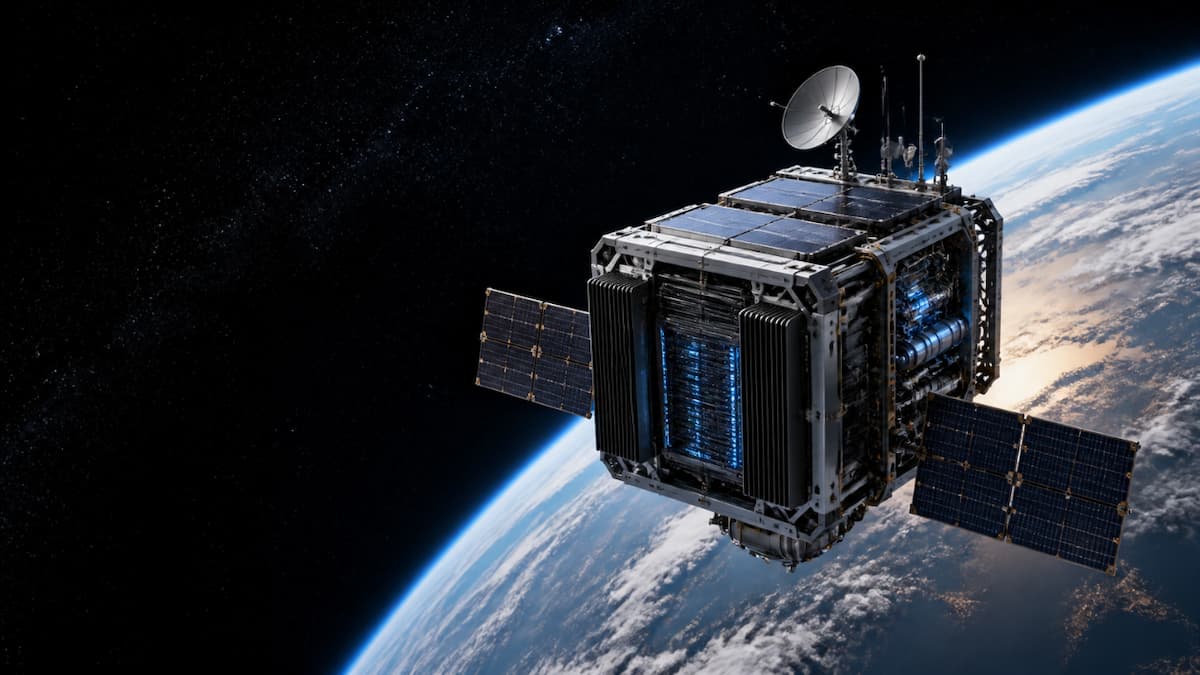
4 Nov 2026Google Project Suncatcher sends first AI response from orbitGoogle says its Project Suncatcher prototype satellite has generated what it describes as the first AI response from a data centre-class Tensor Processing Unit (TPU) in orbit.
In Google’s Project Suncatcher update, the company said the milestone followed several weeks of commissioning after the satellite launched on 1 October.
Such a test would move Project Suncatcher beyond a single isolated processor towards distributed machine-learning workloads across satellites.
Running a data centre-class AI accelerator in orbit demonstrates one of the basic technical steps needed for space-based AI infrastructure at prototype scale.
For now, Project Suncatcher remains an early engineering experiment rather than evidence that large-scale space data centres are close to deployment.
4 Nov 2026
Google Project Suncatcher sends first AI response from orbit
Google says its Project Suncatcher prototype satellite has generated what it describes as the first AI response from a data centre-class Tensor Processing Unit (TPU) in orbit. In Google’s Project Suncatcher update, the company said the milestone followed several weeks of commissioning after the satellite launched on 1 October. The test marks an early step in Google’s research into whether space could eventually host scalable space-based data infrastructure for AI workloads.
During a ground-station pass over Svalbard, Norway, engineers sent a prompt to the onboard Gemma 4 open model asking it to generate a haiku about being in space. The satellite generated the response and transmitted it back to Earth. Google then tested additional creative prompts and telemetry requests, showing the onboard system could run the model and return payload information.
Independent reporting on the prototype says the spacecraft carries four Google TPUs, although only one can operate at a time, and generates up to 1 kW of electricity. The test highlights practical constraints still facing orbital computing, including power availability, communications, and the effects of radiation on hardware and memory used for AI workloads.
Google’s next phase will examine how the TPUs perform under thermal stress and radiation exposure in orbit. The company says reliable operation would pave the way for its next milestone: two interconnected satellites planned for 2027. Such a test would move Project Suncatcher beyond a single isolated processor towards distributed machine-learning workloads across satellites.
The project remains an experimental research programme rather than a commercial cloud service. Its long-term premise is that orbital systems could support large-scale AI computing, but major engineering and economic questions remain around cooling, radiation tolerance, power, launch costs and high-speed inter-satellite communications.
Why does it matter?
Running a data centre-class AI accelerator in orbit demonstrates one of the basic technical steps needed for space-based AI infrastructure at prototype scale. The more significant question is whether the hardware can operate reliably for long periods and whether multiple satellites can share workloads efficiently.
If those hurdles can be overcome, orbital computing could eventually provide another route for expanding AI infrastructure. For now, Project Suncatcher remains an early engineering experiment rather than evidence that large-scale space data centres are close to deployment.