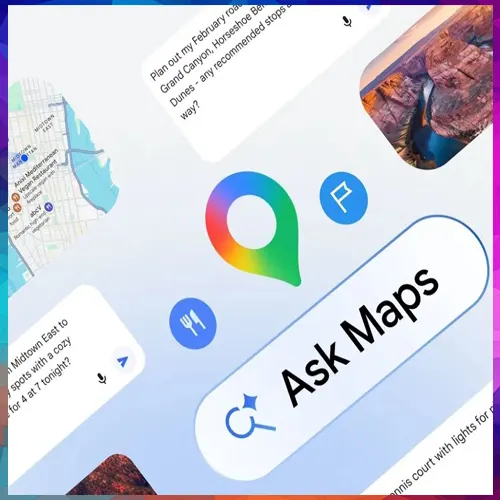
Google is expanding the capabilities of its Ask Maps feature, turning Google Maps into a more action-oriented assistant that can help users move from discovering places to completing tasks.
For instance, a user could ask Maps to find a nearby restaurant offering specific food and beverage options.
Ask Maps can help users discover hotels and nearby events and then direct them to participating services to complete reservations or purchase tickets.
This could help Maps understand elements such as travel plans, hotel bookings and scheduled activities when responding to queries.
Maps adds more real-time local informationAlongside the AI upgrades, Google is adding more real-time information to Maps.
Google is enhancing Maps with AI-powered actions, personalised recommendations and real-time local information, enabling users to discover restaurants, hotels and events while simplifying bookings and everyday travel planning.
Google is expanding the capabilities of its Ask Maps feature, turning Google Maps into a more action-oriented assistant that can help users move from discovering places to completing tasks. The latest update introduces agentic AI capabilities that can respond to natural-language requests and guide users through activities such as food ordering, hotel bookings and event ticket purchases.
The upgraded experience allows users to describe what they want in conversational language rather than searching through multiple listings. For instance, a user could ask Maps to find a nearby restaurant offering specific food and beverage options. Ask Maps can then identify relevant establishments and present suitable choices.
Once a restaurant is selected, users can tap the “Order online” option to continue through supported services such as Square, Toast or Uber Eats. They can review or modify their selections before completing the purchase. The feature is designed to reduce the number of steps required to move from a location search to an actual transaction.
Google is also extending the capability beyond food. Ask Maps can help users discover hotels and nearby events and then direct them to participating services to complete reservations or purchase tickets.
Personalised recommendations through Gmail and Calendar
Google is also introducing Personal Intelligence to Maps, allowing Ask Maps to provide recommendations based on information available in a user’s Gmail and Google Calendar. This could help Maps understand elements such as travel plans, hotel bookings and scheduled activities when responding to queries.
For example, a traveller could ask for recommendations on restaurants or activities close to their hotel. By considering relevant information from their existing Google services, Maps can provide suggestions tailored to the user’s plans rather than relying solely on generic location-based results.
Privacy remains a key part of the feature. Personal Intelligence is disabled by default, and users must explicitly opt in before Ask Maps can access relevant information from Gmail and Calendar. The feature can also retain context from earlier conversations, enabling more continuous interactions.
The rollout of these capabilities is currently focused on the US, while Personal Intelligence is expanding across several markets, including Australia, Brazil, Canada, Indonesia, Japan and Mexico, as well as more than 150 countries and territories where the feature is available in English.
Maps adds more real-time local information
Alongside the AI upgrades, Google is adding more real-time information to Maps. Users can receive updates about traffic conditions, road closures, construction activity and accidents, helping them make better decisions while travelling.
Maps can also provide an indication of how busy certain restaurants, cafés and shops are, giving users additional context before deciding where to visit.
The broader update reflects Google’s push to make Maps more than a navigation and discovery service. By combining conversational AI, personal data and real-time local information, the company is positioning Ask Maps as an assistant that can help users discover options and take the next step toward completing everyday tasks.